Abstract
Garlic (Allium sativum L.) is an important Philippine crop, valued both as culinary ingredient and as alternative medicine. Its bioactivity is mainly attributed to organosulfur compounds such as alliin and allicin, with other metabolites such as phenolic compounds also playing a role. Despite this, limited biochemical data exist on Philippine garlic varieties. This study aimed to characterize 12 garlic accessions collected from Ilocos Norte by determining their alliin content and total phenolic content (TPC). Alliin was quantified through high-performance thin-layer chromatography (HPTLC) densitometry, while TPC was measured using the Folin-Ciocalteu assay. Results revealed differences in both alliin content and TPC, with “Ilocos Pink” consistently exhibiting the highest values (32.84 mg/g FW of alliin; 0.4985 mg GAE/g FW of TPC), suggesting strong potential for bioactivity. In contrast, “Miracle” (19.78 mg/g FW of alliin; 0.1806 mg GAE/g of TPC) and Tan Bolters (20.07 mg/g FW of alliin; 0.1658 mg GAE/g of TPC) had the lowest values for both alliin content and TPC. These findings highlight the varietal differences among accessions, providing a baseline for further studies on their bioactivity, breeding, and post-harvest utilization. This research underscores the importance of characterizing local garlic varieties to strengthen their competitive value and to promote their utilization in specialized applications.
-
Key words: Alliin, Allium, Garlic, Organosulfur, Phenolic Content, Polyphenols
Introduction
Garlic is an important crop in the Philippines. It has played a crucial role to the common Filipino, not only due to its culinary value but also its use as traditional medicinal plant. Garlic has also been widely considered around the world as both flavoring and medicine since the ancient times. It has been recognized to have the ability to prevent and heal a wide range of diseases (
Londhe et al. 2011). This is all owing to its biochemical composition.
Organosulfur compounds which contribute ~2.3% of the total bulb weight of garlic have been widely accepted to cause its pungency and aroma (
Oosthuizen et al. 2018). The most studied of these organosulfur compounds is allicin. Allicin has been found in various studies to have antimicrobial, antiparasitic, antioxidant, anticancer, antihypertensive, antidiabetic, and immunomodulatory activites (
Salehi et al. 2019). On the other hand, there is scarcity in studies on the main precursor for organosulfur compounds in garlic, alliin. An in vivo study by
Tanyeli et al. (2019) showed that alliin administration combats oxidative lung injury. An in vitro study by
Salman et al. (1999) also demonstrated the immunomodulatory effect of alliin. Alliin derivatives other than allicin have also been shown to exhibit health/medical potentials. For instance,
Liu et al. (2015) showed in an in vitro study that S-allylmercapto-L-cysteine inhibits the growth of cancer cells by induction of apoptosis and inhibition of telomerase activity. Ajoene has also been shown in studies to exhibit anti-inflammatory, anti-leukemia, antimicrobial, and anti-tumor potentials (
Hassan 2004;
Hitchcock et al. 2021;
Li et al. 2002;
Naganawa et al. 1996).
Souza et al. (2011) demonstrated in an in vivo study the potential of N-acetylcysteine for controlling obesity, diabetes, and dyslipidemia. N-acetylcysteine also exhibited antioxidant activity (
Souza et al. 2011).
Phan et al. (2019) also attribute the antioxidant and antimicrobial activity in garlic extracts to organosulfur compounds.
It is a common experience among Filipinos that local garlic, mostly produced in Ilocos Norte has stronger taste, pungency, and aroma than the commonly imported cultivars from Taiwan or China. This is a reason to speculate that local garlic has more of the abovementioned beneficial compounds. Despite this, very limited data on the biochemical properties of Philippine garlic is available. Previously, a study by
Rubio et al. (2024) demonstrated that Ilocos garlic varieties Mexican, Miracle, Tan Bolters, and Ilocos Pink has more alliin than store-bought samples presumably imported from Taiwan, explaining the perceived stronger taste, pungency, and aroma.
Molino et al. (2021) have also attempted to explain the unique flavor of Philippine garlic and demonstrated that the composition of γ-Glu dipeptides in Philippine cultivars is distinct to the imported cultivar.
Artes et al. (2022) also studied the changes during storage on the physico-chemical characteristics of bulbs of local garlic cultivars collected from different Philippine provinces. It must be noted, however, that Molino (Molino et al.) et al.’s and Artes et al.’s papers lacked proper nomenclature of the varieties of the sampled cultivars. The present study builds on the abovementioned studies by comparing more accessions and properly documenting variety names, as they are known to local farmers and/or recorded in the Philippines‘ crop registry managed by the National Seed Industry Council (NSIC). (Some acccessions‘ variety names have not yet been registered to the NSIC.) Further, this will expand on the potential of Philippine Garlic for nutraceutical and pharmaceutical uses.
The present study aimed to determine the alliin and total phenolic content (TPC) of Philippine garlic accessions collected in Ilocos Norte via High-Performance Thin-Layer Chromatography (HPTLC) densitometry and Folin-Ciocalteu assay, respectively. Twelve (12) accessions collected from Ilocos Norte, Philippines, of cultivars originating from various provinces in the Philippines were studied, namely, Batanes White, Cabuyao, Ilocos Pink (NSIC 2017 Gr 03), Ilocos White (NSIC 2017 Gr 01), Mexican (NSIC 2017 Gr 04), Mindoro, Miracle (NSIC 2017 Gr 07; also MMSU Gem), Nueva Ecija Pink, Romblon, Sarang, Tan Bolters (NSIC 2017 Gr 06; also Ilocos Tan Bolters), and VFTA M6. The results of the study could pave the way for the development and breeding of superior Philippine garlic, i.e. with maintained strength of pungency, aroma, and taste, but with larger bulbs.
Materials and Methods
Garlic Bulb Samples
Bulb samples of 12 garlic accessions were obtained from the genebank of the Garlic Research Center, Mariano Marcos State University. All samples were grown in the same field (GCS: 18.05°N, 120.55°E; clay loam soil type) under uniform cultural management practices and harvested simultaneously.
Garlic plants were spaced at 20×15 cm (row×plant). Prior to planting, the field was irrigated to facilitate planting and prevent damage to the cloves used as planting material. From 15 days after planting (DAP) onward, irrigation was applied weekly or as needed during the morning to maintain damp soil. A total of 120-60-60 kg ha-1 N-P2O5-K2O was applied in two splits: 60-60-60 kg ha-1 basally, and the remaining nitrogen at 35 DAP. Carrageenan plant growth regulator was applied as a foliar spray at 15, 30, and 45 DAP.
There was very minimal rainfall throughout the cropping season (< 20 mm). The mean daily minimum and maximum air temperatures were 21.8℃ and 32.1℃, respectively.
The garlic was harvested at 92 DAP, and was sun-dried for two weeks before storing under ambient conditions. All analyses were performed within two months after harvest.
Alliin Extraction
One-gram (1 g) of fresh garlic clove was homogenized for 5 minutes in 20 mL of 80% ethanol (ACS grade ethanol with distilled water) using a homogenizing probe. The resulting solution was then probe-sonicated (5 seconds run, 2 seconds pulse on a TUE-500 ultrasonic homogenizer [China]) for 10 minutes. The solution was then centrifuged for 3 minutes. The supernatant was collected. Another 20 mL of distilled water was then used to resuspend the pellet to extract any residual amount left of the target compound, alliin. The suspension was then centrifuged for another 3 minutes. The supernatant was pooled together with the first extract.
Alliin Quantification
The following are the apparatus used for the HPTLC densitometric analysis: CAMAG TLC Plate Heater III (Switzerland), CAMAG Linomat5 Spotter (Switzerland), and CAMAG TLC Visualizer 2 (Switzerland).
Firstly, the thin-layer chromatography (TLC) plate (Supelco® HPTLC aluminum sheets, Silica gel 60 F254; Layer thickness: 150-200 μm) was heated at 105℃ for 30 minutes using the plate heater. Samples and standards were then spotted automatically upon loading on a Hamilton syringe. For each sample, three lanes were loaded with 10 µL each to form three technical replicates. Alliin 1000 ppm standard solution was loaded in consecutive lanes to form the calibration curve (2 µL, 4 µL, 6 µL, 8 µL, and 10 µL). After spotting, the plate was heated at 63-65℃ for 5 minutes to evaporate the solvent from the sample spots.
The TLC plate was then developed under mobile phase of 6:2:2 solution of n-Butanol (ACS grade), acetic acid (ACS grade), and distilled water. After development, the plate was then heated at 71℃ for 3 minutes to evaporate the mobile phase. The plate was then derivatized by spraying ninhydrin: n-butanol: acetic acid solution (0.3:100:3; w/v/v; all ACS grade). The TLC plate was then dried at 80-100℃ for 5 minutes.
Once the TLC plate was ready, quantification of alliin was done through the visualizer module and the CAMAG visionCATS software.
Total Phenolic Content Determination
The TPC was determined through Folin-Ciocalteu Assay. Five (5) grams of fresh garlic cloves was homogenized in 15 mL of 80% ethanol. Afterwards, the samples were centrifuged for 3 minutes at 3000 rpm. The supernatant was used for analysis. The assay was done on six technical replicates for each sample.
A volume of 170 µL of the samples and gallic acid standards was dispensed on a deep-well plate. Afterwards, 850 µL Folin-Ciocalteu reagent was added to all the wells and the resulting solution was incubated for 6 minutes. Next, 680 µL of 7.5% sodium carbonate was added to the solution and was incubated for 1 hour. The resulting solutions were subjected to spectrophotometric analysis at 765 nm wavelength, and TPC was calculated in terms of gallic acid equivalents (GAE).
Results
Alliin Content
Alliin content in the garlic samples was measured using HPTLC densitometry. The measured values are summarized in
Table 1. Across the 12 accessions, the alliin content ranged from 19.78 mg/g FW to 32.84 mg/g FW.
Among the accessions analyzed, Ilocos Pink exhibited the highest alliin content (32.84 mg/g FW), followed by Nueva Ecija Pink, Mindoro, and Ilocos White, which showed similarly elevated levels. In contrast, Miracle showed the lowest alliin content (19.78 mg/g FW), closely followed by Tan Bolters (20.07 mg/g FW). The remaining accessions displayed intermediate alliin concentrations.
Total Phenolic Content (TPC)
TPC was quantified through the Folin-Ciocalteu Assay. The measured values are summarized in
Table 1. TPC values across the garlic accessions ranged from 0.1658 mg GAE/g FW to 0.4985 mg GAE/g FW. Ilocos Pink had the highest TPC (0.4985 mg GAE/g FW), followed by Nueva Ecija Pink and Mindoro, which also showed comparatively elevated phenolic levels. Conversely, Tan Bolters recorded the lowest TPC (0.1658 mg GAE/g FW), with Miracle, Sarang, and Ilocos White likewise exhibiting relatively low phenolic contents.
An exploratory comparison of alliin and TPC values across accessions via regression analysis suggested a weak positive trend between sulfur-containing compounds and phenolic content (R2 = 0.57). However, this relationship was not subjected to inferential statistical testing and should therefore be interpreted descriptively, indicating that variation in alliin and phenolic content may occur independently among garlic accessions.
Discussion
Ilocos Pink and Ilocos White exhibiting higher alliin content than Batanes White partly aligns with
Molino et al. (2021), who reported that alliin was “upregulated” in an “authenticated local cultivar” from Ilocos Norte (tagged as ILAU) compared with an authenticated local cultivar from the Department of Agriculture Regional Office 2—Batanes Experimental Station in Basco, Batanes (tagged as BAU) as well as other unauthenticated samples collected nationwide. It is important to note, however, that Molino et al. did not specify the particular varieties represented by the ILAU and BAU accessions. Moreover, in contrast to their samples, which were sourced from multiple locations, the garlic accessions in this study were planted in the same field under uniform cultural management practices and harvested simultaneously.
Artes et al. (2022) reported that garlic collected from Ilocos Norte was more pungent during the early stages of storage compared with those from Batanes and Occidental Mindoro. They studied physico-chemical changes during ambient storage, with pungency quantified through pyruvate content, a measure positively correlated with total thiosulfinate levels. Similar to Molino et al., the samples in Artes et al.’s study were also collected from different locations and were not thoroughly documented.
Alliin, an odorless compound, is the major organosulfur component in garlic (intact) by weight (
Salehi et al. 2019). As earlier mentioned, alliin serves as the main precursor for organosulfur compounds contained in garlic such as thiosulfinates. Intact garlic bulbs are not pungent but when cut, crushed, or grated for food preparation, a sulfuric odor is produced. This is associated with a defense mechanism of the garlic plant. When garlic cells are damaged, alliinase from the vacuoles of vascular bundle sheath cells (located around the veins or phloem) catalyzes the conversion of alliin from the cytoplasm or cytoplasmic vesicle of the damaged cells. The resulting compound is allylsulfenic acid, which is then converted to allicin, which is further converted to other volatile odor compounds such as diallyl disulfide, and diallyl trisulfide (
Yamaguchi et al. 2020). Depending on the food processing done on garlic, a variety of alliin derivatives are produced, further developing odor, aroma, flavor, and even bioactivity (
Bi et al. 2023;
Kubec et al. 1997;
Liu et al. 2022;
Shang et al. 2019). Thus, the higher alliin content observed in Ilocos Pink, Nueva Ecija Pink, Mindoro, and Ilocos White suggests that these accessions may offer a richer flavor profile in culinary applications and potentially stronger bioactivity.
As earlier mentioned,
Rubio et al. (2024) also demonstrated that Ilocos garlic varieties have more alliin than store-bought samples presumably imported from Taiwan.
Rubio et al. (2024) reported the store-bought samples contained 13.96 mg/g FW alliin. Traditionally, it is believed that local Philippine garlic varieties are tastier, more pungent, and more aromatic than imports from Taiwan and China. The results of the current study also support this when compared with
Rubio et al.’s (2024) data. In comparison,
Zhang et al. (2015) reported that unprocessed garlic from Chinese local market had 11.28 ± 0.22 mg/g FW of alliin content.
Liu et al. (2022) also reported ~10 mg/g FW in unprocessed Chinese garlic. As for data for alliin content in garlic from another region,
Iberl et al. (1990) reported that the alliin content of garlic from German local markets were in the range of ~9 mg/g FW. It must be noted, however, that alliin extraction and quantification methodologies vary among abovementioned studies. Thus, to further supplement
Rubio et al.’s (2024) results, future research would be beneficial in distinguishing Philippine garlic varieties against more foreign varieties in terms of alliin content.
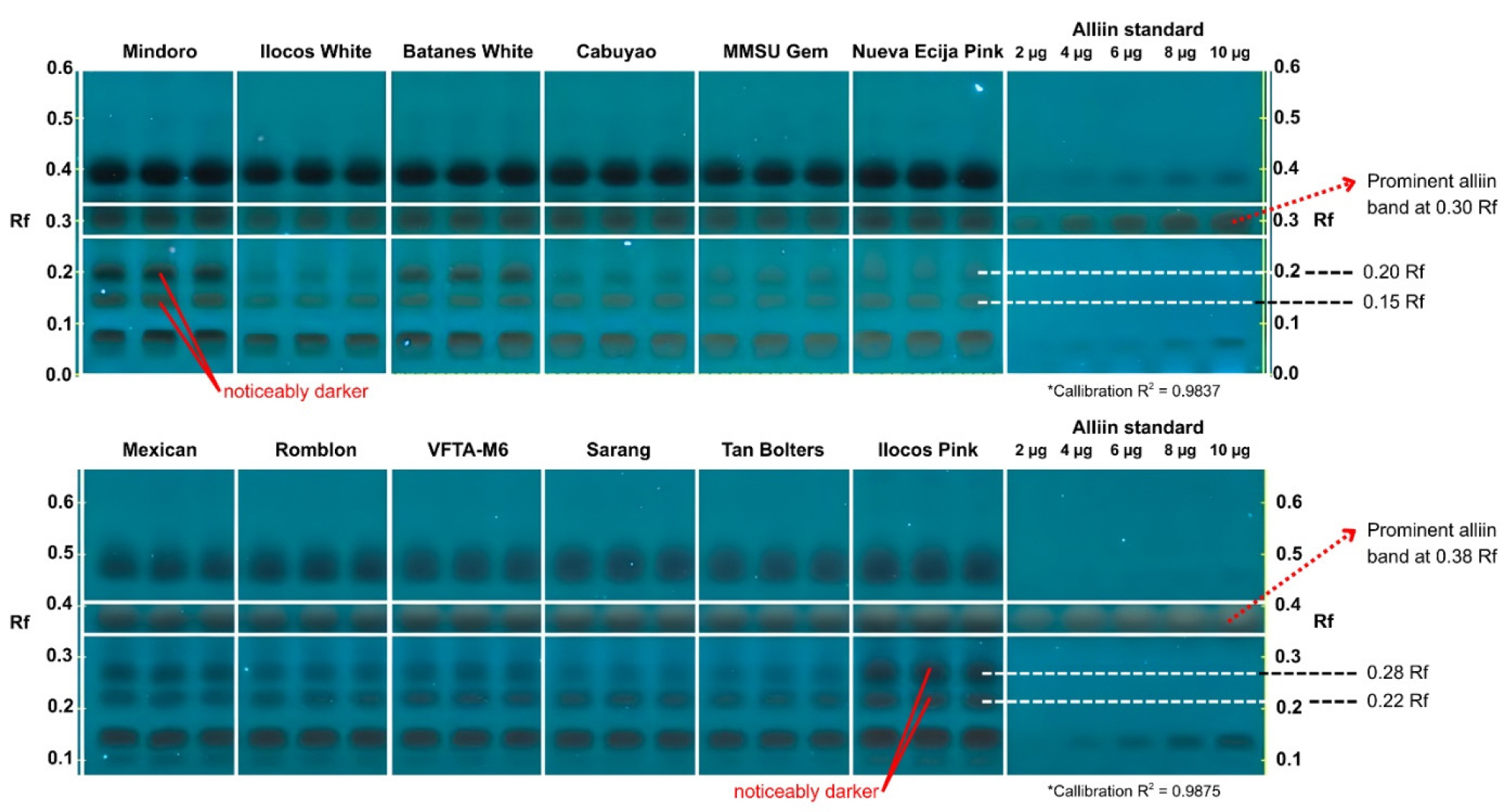
In addition to the alliin quantified in the fresh garlic samples, the developed TLC plate (
Fig. 1) reveals a variety of other compounds, presumably cysteine sulfoxides (
Lanzotti 2006). Ninhydrin reacts with the amino functional group present in cysteine sulfoxides, resulting in the formation of the colored bands on the TLC plate. Although ethanolic extraction is supposed to deactivate alliinase and prevent conversion of alliin, other organosulfur compounds being extracted are expected as fresh garlic also contains such. Moreover, the alliin extraction method employed did not include a purification step.
It can be observed in
Fig. 1 that some bands are noticeably more intense in color among certain accessions. For instance, in the first TLC plate (top), the bands at 0.15 Rf and 0.20 Rf are noticeably darker in the Mindoro accession. In the second TLC plate (bottom), the bands at 0.22 Rf and 0.28 Rf are also noticeably darker in the Ilocos Pink accession. This suggests a higher concentration of the compounds represented by such bands. These differences in the biochemical profile of the garlic varieties can be further elicited to understand the differences of these garlic varieties in terms of pungency and even bioactivity. It is worth noting, however, that the derivatized TLC plate shown in
Fig. 1 does not visualize all organosulfur compounds in garlic, as some do not react with ninhydrin to form derivatives visualizable at 366 nm.
As for the TPC, no other publicly available literature describes the comparison of Philippine cultivars or varieties in terms of phenolic content. Reported data from literature for TPC in garlic from other countries are comparable to the data of the present study.
Rababah et al. (2025) reported garlic from Jordan to contain 0.2910 mg GAE/g FW.
Čeryová et al. (2023) characterized seven Slovak garlic cultivars and reported TPC ranging 0.36711 to 0.47211 mg GAE/g FW.
Popa et al. (2024) characterized 16 Romanian garlic varieties and reported 0.65607-1.31732 mg GAE/g FW.
Hirata et al. (2016) also characterized 103 clones of garlic collected in various regions of the world and reported a range of 0.5229-1.3752 mg GAE/g FW. While some of these studies have reported values that may be significantly higher than reported in the present study, it must be noted, that the extraction procedure prior to TPC analysis vary across the studies. Thus, future research would also be beneficial in distinguishing Philippine garlic varieties against foreign varieties in terms of TPC.
Phenolics in garlic have been highlighted together with organosulfur compounds to contribute to the to the diverse health benefits of garlic. From literature, the main phenolic compounds in garlic are β-resorcylic acid, pyrogallol, gallic acid, rutin, protocatechuic acid, and quercetin. (
Liu et al. 2018;
Nagella et al. 2014). Among studies and reviews, phenolic compounds in garlic are reported to have antioxidant, cardiovascular protective, antimicrobial, and anti-cancer activity (
Bozin et al. 2008;
Cocom et al. 2025;
El-Saadony et al. 2024;
Kallel et al. 2014;
Shang et al. 2019;
Szychowski et al. 2018).
Bozin et al. (2008) suggested that the amount of phenolics in three different methanolic extracts of garlic (from air-dried immature garlic plants, from air-dried mature garlic plants, and from fresh mature garlic plants) correlated with their antioxidant activities.
Szychowski et al. (2018) also attributed the antioxidant activity of aqueous garlic extracts to phenolics as well as plant-derived proteins. Their in vitro study also demonstrated the anti-cancer potential of aqueous garlic extract, owing to its phenolic content (
Szychowski et al. 2018).
Kallel et al. (2014) characterized “garlic husk waste” as potential source of phenolic compounds. Garlic husk extracts were reported to exhibit antimicrobial and antioxidant properties.
Implications
It is widely documented in literature, both for garlic and many other plant species, that cultural management, soil parameters, and climatic conditions affect both the agronomic characteristics and metabolome profile (
Atif et al. 2020;
de Almeida et al. 2025;
Hanif et al. 2022). For instance,
Atif et al. (2020) reported that garlic plant and bulb morphology, as well as the composition of endogenous phytohormones (such as gibberellic acid, jasmonic acid, indole-3-acetic acid, and p-coumaric acid) significantly varied with different photoperiods and temperatures. They also reported significant differences in allicin content in the pseudostem across different photoperiods and temperatures (
Atif et al. 2020). Considering this, comparison of the biochemical composition of garlic samples grown in the same field under uniform cultural management practices and harvested simultaneously proves important for investigating varietal differences. Uniform conditions eliminate varying physiological responses of accessions to varied cultural management, soil parameters, and climatic conditions, thereby improving scientific clarity of the comparison (
Hanif et al. 2022).
This study provides the first systematic biochemical characterizations of Philippine garlic accessions grown under such uniform conditions. By linking varietal differences in alliin and phenolic content to potential culinary and functional advantages, it establishes a baseline for germplasm conservation, varietal improvement, and the promotion of Philippine garlic as a premium crop in both local and international markets.
The gathered data on alliin and total phenolic content indicate genetic and varietal differences among the sampled garlic accessions. The results confirm that biochemical composition—and thus food value, food functionality, and possible medicinal value—differs across garlic accessions, underscoring the importance of varietal selection in breeding and utilization. Accessions such as Ilocos Pink, Nueva Ecija Pink, Mindoro, and Ilocos White exhibited higher alliin content, suggesting stronger taste, pungency, and aroma, which translates to greater culinary value. Moreover, accessions with both high alliin and phenolic levels, particularly Ilocos Pink, Nueva Ecija Pink, and Mindoro, may offer enhanced antioxidant activity and greater health-promoting potential compared with lower-content varieties.
These findings support the positioning of select Philippine garlic varieties as premium products in domestic and export markets. Beyond fresh consumption, their biochemical profile also makes them suitable for value-added applications such as nutraceuticals, and even alternative medicine. Such initiatives could capture niche markets, strengthen consumer preference for local garlic, and ultimately benefit farmers through improved livelihood opportunities.
Finally, the observed variation highlights the importance of conserving local germplasm and identifying high-value cultivars for future crop improvement and/or breeding programs, and industry development.
Recommendations
The current study was limited to the quantification of alliin content and TPC among 12 garlic accessions collected from Ilocos Norte, of cultivars originating from various provinces in the Philippines. While results from this study contribute to explaining the perceived stronger taste, pungency, and aroma of Philippine garlic than imported cultivars, a dedicated study comparing local cultivars to foreign ones would more adequately substantiate this. Future work should also focus on the quantification of other bioactive compounds in Philippine garlic to provide a more comprehensive biochemical profile. Furthermore, value-adding and quantification of bioactive compounds in value-added products will elevate the functional food and even potential medicinal value of Philippine garlic.
Acknowledgements
This study connected with a four-year project on garlic and other agri-food condiments genetic resources at Mariano Marcos State University funded by the Philippine government through the Department of Science and Technology-Philippine Council for Agriculture, Aquatic and Natural Resources Research and Development (DOST-PCAARRD) under the Niche Centers in the Regions for Research and Development (NICER) national program. Alliin and total phenolic content quantification was assisted by Herbanext Laboratories, Inc.
Fig. 1Image of the developed TLC plates visualized under 366 nm light (2 of 2 plates). Color variation on the various compounds’ presentation in the TLC plates is due to the variation in the amount of ninhydrin solution sprayed on the plates for derivatization.
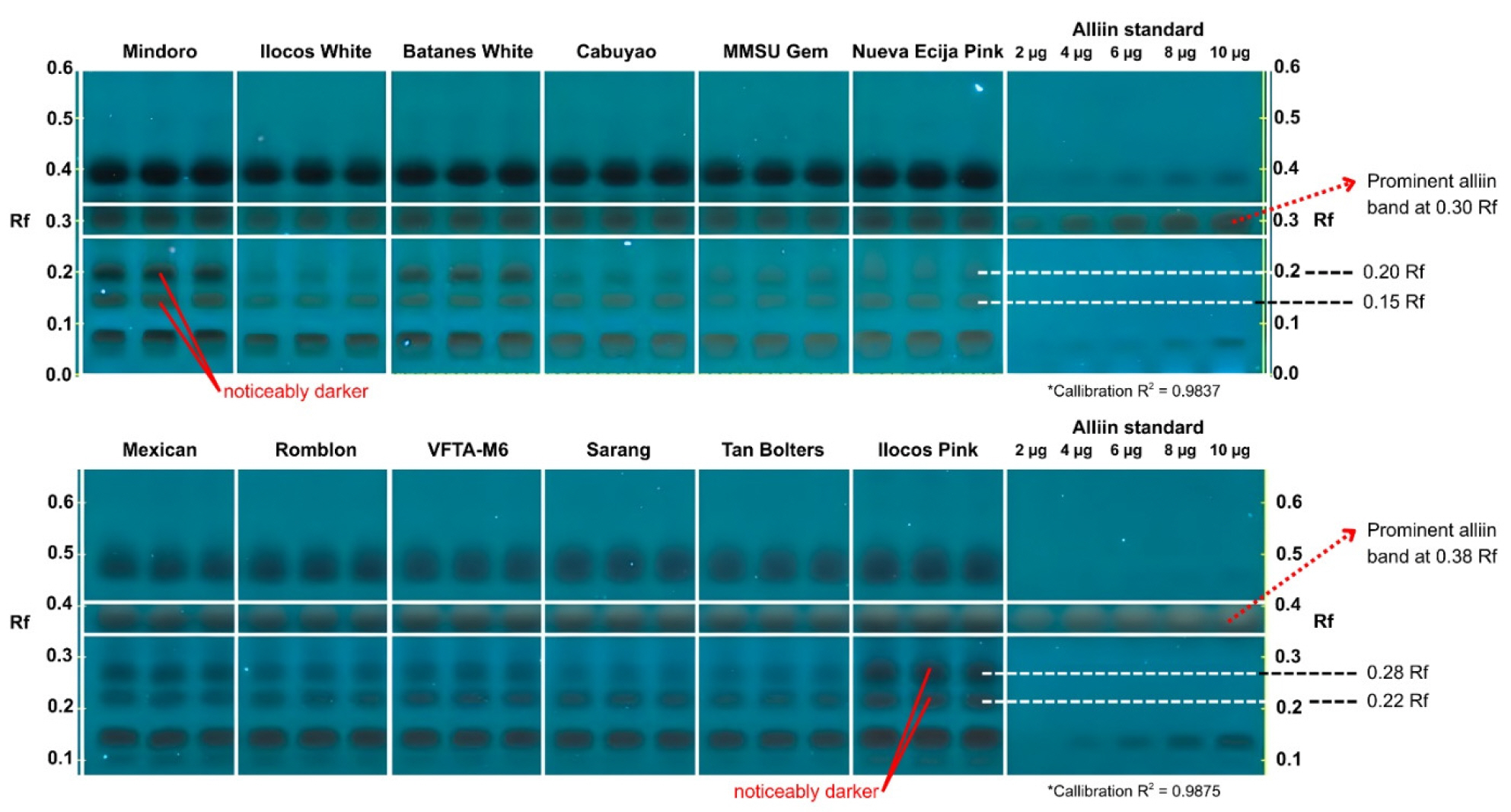
Table 1Alliin content and TPC of samples from the 12 garlic accessions. Data are presented as mean ± standard deviation.
Table 1
|
Garlic Accession |
Alliin (mg/g FW) |
Phenolic Content (mg GAE/g FW) |
|
Batanes White |
28.91 ± 1.28 |
0.2511 ± 0.0115 |
|
Cabuyao |
30.68 ± 0.27 |
0.2780 ± 0.0177 |
|
Ilocos Pink |
32.84 ± 0.53 |
0.4985 ± 0.0245 |
|
Ilocos White |
31.00 ± 1.41 |
0.2203 ± 0.0196 |
|
Mexican |
28.11 ± 0.93 |
0.2851 ± 0.0257 |
|
Mindoro |
31.23 ± 0.40 |
0.4113 ± 0.0311 |
|
Miracle |
19.78 ± 0.39 |
0.1806 ± 0.0123 |
|
Nueva Ecija Pink |
31.76 ± 0.38 |
0.4178 ± 0.0272 |
|
Romblon |
26.87 ± 0.33 |
0.3113 ± 0.0299 |
|
Sarang |
25.62 ± 0.93 |
0.2120 ± 0.0196 |
|
Tan Bolters |
20.07 ± 0.29 |
0.1658 ± 0.0081 |
|
VFTA M6 |
27.97 ± 0.89 |
0.2684 ± 0.0227 |
References
- Artes LA, Maunahan MV, Resorez JM, Nuevo PA. 2022. Physico-chemical changes in garlic (Allium sativum L.) after prolonged storage at ambient conditions in the Philippines. J. Int. Soc. Southeast Asian Agric. Sci. 28(2): 81-90.
- Atif MJ, Amin B, Ghani MI, Ali M, Zhang S, Cheng Z. 2020. Effect of photoperiod and temperature on garlic (Allium sativum L.) bulbing and selected endogenous chemical factors. Environ. Exp. Bot. 180: 104250.
- Bi J, Yang Z, Li Y, Li B, Gao Y, Ping C, et al. 2023. Effects of different cooking methods on volatile flavor compounds in garlic. Int. J. Gastron. Food Sci. 31: 100642.
- Bozin B, Mimica-Dukic N, Samojlik I, Goran A, Igic R. 2008. Phenolics as antioxidants in garlic (Allium sativum L., Alliaceae). Food Chem. 111(4): 925-929.
- Čeryová N, Lidiková J, Pintér E, Šnirc M, Franková H, Ňorbová M, et al. 2023. Total polyphenol content, total flavonoid content, and antioxidant activity of garlic (Allium sativum L.) Cultivars. J. Microbiol. Biotechnol. Food Sci. 13(1): e9668.
- Cocom LM, Wang H-C, Tseng K-C, Chu Y-L. 2025. The antimicrobial and antioxidant properties of raw, aged, and fermented garlic: Influence of processing methods. Food Sci. Nutr. 13(8): e70743.
- de Almeida NR, Ikehara BRM, Calácio CC, Oliveira TF, Pinto FG. 2025. Metabolomic analysis to study the effect of foliar copper supplementation on sulfur-containing compounds of garlic bulb by LC-MS. Metabolomics. 21(2): 36.
- El-Saadony MT, Saad AM, Korma SA, Salem HM, Abd El-Mageed TA, Alkafaas SS, et al. 2024. Garlic bioactive substances and their therapeutic applications for improving human health: A comprehensive review. Fimmu. 15: 1277074.
- Hanif M, Khan R, Kiran J, Haq IU, Ali S, Niaz Y, et al. 2022. Interactive effect of organic and mineral phosphorus on volatile compounds, morphology, and physiology of garlic (Allium sativum L.). J. King Saud Univ. Sci. 34(8): 102351.
- Hassan HT. 2004. Ajoene (natural garlic compound): A new anti-leukaemia agent for AML therapy. Leuk. Res. 28(7): 667-671.
- Hirata S, Abdelrahman M, Yamauchi N, Shigyo M. 2016. Characteristics of chemical components in genetic resources of garlic Allium sativum collected from all over the world. Genet. Resour. Crop. Evol. 63(1): 35-45.
- Hitchcock JK, Mkwanazi N, Barnett C, Graham LM, Katz AA, Hunter R, et al. 2021. The garlic compound Z-Ajoene, S-Thiolates COX2 and STAT3 and dampens the inflammatory response in RAW264.7 macrophages. Mol. Nutr. Food Res. 65(3): 2000854.
- Iberl B, Winkler G, Müller B, Knobloch K. 1990. Quantitative determination of allicin and alliin from garlic by HPLC*. Planta Med. 56(03): 320-326.
- Kallel F, Driss D, Chaari F, Belghith L, Bouaziz F, Ghorbel R, et al. 2014. Garlic (Allium sativum L.) husk waste as a potential source of phenolic compounds: Influence of extracting solvents on its antimicrobial and antioxidant properties. Ind. Crops Prod. 62: 34-41.
- Kubec R, Velíšek J, Doležal M, Kubelka V. 1997. Sulfur-containing volatiles arising by thermal degradation of alliin and deoxyalliin. J. Agric. Food Chem. 45(9): 3580-3585.
- Lanzotti V. 2006. The analysis of onion and garlic. J. Chromatogr. A. 1112(1): 3-22.
- Li M, Ciu J-R, Ye Y, Min J-M, Zhang L-H, Wang K, et al. 2002. Antitumor activity of Z -ajoene, a natural compound purified from garlic: Antimitotic and microtubule-interaction properties. Carcinogenesis. 23(4): 573-579.
- Liu C, Lu L, Yang C, Niu C, Wang J, Zheng F, et al. 2022. Effects of thermal treatment on alliin and its related sulfides during black garlic processing. LWT. 159: 113158.
- Liu J, Ji F, Chen F, Guo W, Yang M, Huang S, et al. 2018. Determination of garlic phenolic compounds using supercritical fluid extraction coupled to supercritical fluid chromatography/tandem mass spectrometry. J. Pharm. Biomed. Anal. 159: 513-523.
- Liu Y, Yan J, Han X, Hu W. 2015. Garlic-derived compound S-allylmercaptocysteine (SAMC) is active against anaplastic thyroid cancer cell line 8305C (HPACC). Technol. Health Care. 23(1_suppl): S89-S93.
- Londhe VP, Gavasane AT, Nipate SS, Bandawane DD, Chaudhari PD. 2011. Role of garlic (Allium sativum) in various diseases: An overview. Journal of Pharmaceutical Research and Opinion. 1(4): 129-134.
- Molino RJEJ, Rellin KFB, Nellas RB, Junio HA. 2021. Small in size, big on taste: Metabolomics analysis of flavor compounds from Philippine garlic. PLoS One. 16(5): e0247289.
- Naganawa R, Iwata N, Ishikawa K, Fukuda H, Fujino T, Suzuki A. 1996. Inhibition of microbial growth by ajoene, a sulfur-containing compound derived from garlic. Appl. Environ. Microbiol. 62(11): 4238-4242.
- Nagella P, Thiruvengadam M, Ahmad A, Yoon JY, Chung IM. 2014. Composition of polyphenols and antioxidant activity of garlic bulbs collected from different locations of Korea. Asian J. Chem. 26(3): 897-902.
- Oosthuizen CB, Reid A-M, Lall N. 2018. Garlic (Allium sativum) and its associated molecules, as medicine. In Medicinal plants for holistic health and well-being (pp. 277-295). Academic Press.
- Phan AD, Netzel G, Chhim P, Netzel ME, Sultanbawa Y. 2019. Phytochemical characteristics and antimicrobial activity of australian grown garlic (Allium sativum L.) cultivars. Foods. 8(9): 358.
- Popa P-M, Băbeanu C, Cosmulescu S-N. 2024. Evaluation of chemical compounds in local garlic genotypes from southwestern romania. Appl. Sci. 14(16): 6899.
- Rababah T, Al-U'datt M, Angor M, Alsaad A, Akkam Y, Gammoh S, et al. 2025. Fresh crushed garlic exhibits superior allicin and pyruvic acid stability, while fresh sliced garlic leads in phenolic and antioxidant content. Appl. Food Res. 5(1): 100850.
- Rubio JJ, Cava MJ, Asuncion J, Halabaso E, Maoirat-Abad MR. 2024. Healthy garlic options: Alliin and total phenolic content of ilocos garlic (Allium sativum L.). Mariano Marcos State University, City of Batac, Ilocos Norte Philippines.
- Salehi B, Zucca P, Orhan IE, Azzini E, Adetunji CO, Mohammed SA, et al. 2019. Allicin and health: A comprehensive review. Trends Food Sci. Technol. 86: 502-516.
- Salman H, Bergman M, Bessler H, Punsky I, Djaldetti M. 1999. Effect of a garlic derivative (alliin) on peripheral blood cell immune responses. Int. J. Immunopharmacol. 21(9): 589-597.
- Shang A, Cao S-Y, Xu X-Y, Gan R-Y, Tang G-Y, Corke H, et al. 2019. Bioactive compounds and biological functions of garlic (Allium sativum L.). Foods. 8(7): 246.
- Souza GA, Ebaid GX, Seiva FRF, Rocha KHR, Galhardi CM, Mani F, et al. 2011. N-acetylcysteine an allium plant compound improves high-sucrose diet-induced obesity and related effects. Evid. Based Complement. Alternat. Med. 2011(1): 643269.
- Szychowski KA, Rybczynska-Tkaczyk K, Gawel-Beben K, Swieca M, Karas M, Jakuczyk A, et al. 2018. Characterization of active compounds of different garlic (Allium sativum L.) cultivars. Pol. J. Food Nutr. Sci. 68(1): 73-81.
- Tanyeli A, Güzel D. 2019. Alliin mitigates cecal ligation puncture (CLP)-induced lung injury through antioxidant and antiinflammatory effects. Turk. J. Sci. 4(2): 46-59.
- Yamaguchi Y, Kumagai H. 2020. Characteristics, biosynthesis, decomposition, metabolism and functions of the garlic odour precursor, S-allyl-l-cysteine sulfoxide (Review). Exp. Ther. Med. 19(2): 1528-1535.
- Zhang Z, Lei M, Liu R, Gao Y, Xu M, Zhang M. 2015. Evaluation of alliin, saccharide contents and antioxidant activities of black garlic during thermal processing. J. Food Biochem. 39(1): 39-47.