Abstract
Watermelon [Citrullus lanatus (Thunb.) Matsum and Nakai] is one of the economically most important fruit crops of the Cucurbitaceae family. Among different watermelon traits, disease resistance and fruit quality are the important traits for growers and consumers. The single nucleotide polymorphism (SNP) markers similar to those traits can potentially and cost-effectively distinguish the genetic variations among these traits. Consequently, we developed 33 SNP makers linked to different watermelon traits associated with fruit quality and disease resistance, and validated in the genetic resources of watermelon and F1 breeding lines using ‘Fluidigm SNP Genotyping’ assay. Most of the SNP markers distinguished the alleles into three different types such as reference allele, alternative allele and heterozygous from watermelon genotypes for various traits. The SNP markers ‘ZymFL-T81P’ (ZYMV- resistance), ‘FON1-U161’ and ‘FON1-S075’ (Fusarium wilt-resistance), ‘Pmr21-Cla831’ (PM-resistance), and ‘ClGBS-J168’ and ‘GBS-GC230’ (GSB-resistance) can successfully differentiate resistant (R), susceptible (S) and heterozygous watermelon genotypes. Similarly, the SNP marker associated with sugar content, citrulline content, arginine content, rind hardness, flesh firmness, fruit shape, rind strip pattern of watermelon fruit and seed coat colour can successfully distinguished the watermelon genetic resources and F1 breeding lines as reference allele (A) type, alternative allele (B) type and heterozygous (H). These SNP markers could be utilized for marker assisted selection as well as screening of a large number of watermelon germplasm for fruit quality and disease resistance. However, further validation like artificial inoculation of pathogens for the traits related to disease resistance is required in watermelon crops.
-
Key words: Molecular marker, SNP, Fluidigm assay, Fruit quality, Disease resistance watermelon traits, High-throughput genotyping
INTRODUCTION
Watermelon [
Citrullus lanatus (Thunb.) Matsum and Nakai] is an economically important fruit crop of the Cucurbitaceae family. Citrullus species originated in South Africa and are widely grown in tropical and subtropical regions of the world (
Guo et al. 2013). The genus Citrullus is botanically divided in two cultivated watermelons, including
C. lanatus var. lanatus (elite cultivars) and
C. lanatus var. citroides (citron) while
C. lanatus var. lanatus is the ancient ancestor (
Robinson and Decker-Walters 1997;
Guo et al. 2013). Watermelon has been cultivated in Africa and Egypt from at least 4000 years ago (
Paris 2015). The annual world production of watermelon is around 101.62 million tons (
http://faostat.fao.org/, accessed in October 2022). China is the major producer of watermelon (60.08 million tons) followed by Turkey (3.49 million tons), India (2.79 million tons) and Iran (2.74 million tons) of the world production (
http://faostat.fao.org/, accessed on October 2022). Watermelon is a highly nutritious and the best source of natural antioxidants, and plays an important role in human health as its fruit contain sugars and lycopene, and amino acids like arginine, glutathione and citrulline (
Perkins-Veazie et al. 2006). It is mostly consumed as fresh fruit throughout the world and maxi-mum consumption occurs during summer. It is also con-sumed after cooking in Africa (
Goda 2007).
The consumers’ preference of watermelon consumption depends heavily on fruit quality parameters (
Fall et al. 2019). These parameters include flesh color, soluble solid content (Brix), bitterness, citrulline content, arginine con-tent, seed size, rind thickness, flesh firmness, fruit shape, rind strip pattern and so on. For example, flesh sweetness is one of the most important determining factors to the consumers (
Fall et al. 2019; Bowen
et al. 2022). Flesh color is also an attractive trait to the consumers which includes red, pink, orange, canary yellow, salmon yellow, pale yellow, cream, and white (
Fall et al. 2019). The shape of watermelon fruit can vary from oval, round to blocky (
Wehner et al. 2001;
Nimmakayala et al. 2014).
Consequently, molecular detection of fruit quality and stress resistance traits are crucial to accelerate the water-melon breeding program. There is a gap behind the iden-tification of candidate genes and quantitative trait loci (QTLs) and their utilization in crop programs. In the past, some molecular markers like simple sequence repeats (SSRs), insertions/deletions (InDels) etc. have been used for quick and reliable genotyping of various traits of cultivated crops at molecular level for marker assisted selection (MAS) (
Ghislain et al. 2004;
Bisen et al. 2015;
Das et al. 2015;
Jain et al. 2019;
Jin et al. 2019b;
Kim et al. 2020). SSR markers are effectively used for genetic diver-sity analysis (
Hipparagi et al. 2017;
Haque et al. 2021;
Kumar et al. 2022) and cultivar differentiation in cucurbi-taceous crops, like watermelon (
Kwon et al. 2010), pump-kin (
Sim et al. 2015) and melon (
Kwon and Hong 2014). Although, SSR markers have a useful application in molecular breeding, but have limitations for large-scale genotyping (
Guichoux et al. 2011). However, the advance-ment of the next-generation sequencing (NGS) platform and bioinformatics tool, single-nucleotide polymorphism (SNP) markers accelerate the crop improvement programs using high-throughput SNP genotyping of cultivated crops (McCouch
et al. 2011;
Morrell et al. 2012;
Thomson 2014;
Serba et al. 2019;
Kishor et al. 2021). Since, SNPs are low-cost, highly abundant in the genome, co-dominantly inherited and have large-scale genotyping potentiality. Hence, they are considered as powerful genetic markers for crop genotyping in breeding programs (
Chung et al. 2014;
Park et al. 2022a). Recently, SNP based genotyping platform called “Fluidigm SNP array” has been effectively deployed for detection of genetic variations in different traits in various crop species (
Kim et al. 2017;
Nguyen et al. 2020;
Park et al. 2021;
Park et al. 2022a: Park
et al. 2022b).
Therefore, in this study, we aimed to develop SNP markers for detection of genetic variation in different traits associated with fruit quality and disease resistance, and their validation using 33 Fluidigm SNP array which might be valuable for developing a high-throughput SNP geno-typing in watermelon.
MATERIALS AND METHODS
Plant materials
A total of 192 watermelon genetic sources and 192 watermelon F1 hybrid breeding lines were used for validation of SNP markers associated with various traits (
Supplementary Table S1). All the seeds were provided by Chun Seed Company Ltd. (Seongju, Korea). The water-melon F1 hybrid breeding lines were generated using random mating.
The genomic DNA was isolated from the young leaves of each watermelon genotype using the ‘DNeasy Plant Mini Kit’ (Qiagen, Wilmington, USA) following the manu-facturer’s guidelines. The concentration and purity of DNA samples were determined using a Nanodrop (N-1000) spectrophotometer (Thermo Scientific, Wilmington, USA) and maintained a concentration of 20 ng/mL with nuclease- free water.
Fluidigm genotyping assay
A total of 33 Fluidigm SNP assay sets were designed (
Table 1 and
Supplementary Table S1) considering the following target sequence criteria: i) The target sequences must be at least 60 bp long (including flanking sequence of the target SNP site) and no more than 250 bp long; ii) Only one SNP was found in the target sequence; iii) The target sequence showed a G/C content of less than 65%. A Specific Target Amplification primer (STA), a Locus Specific Primer (LSP), and two Allele Specific Primers (ASPs) were used (
Jung et al. 2017). The SNP flanking sequences were retrieved from ‘Cucurbit Genomics Database (CuGenDB)’ (
http://cucurbitgenomics.org). To increase the probability of success of the Fluidigm SNP assay, STA was performed prior to performing the Fluidigm SNP assay (
Jung et al. 2017;
Kim et al. 2017). Following STA, Fluidigm SNP assays using the 192.24 IFC were used. The Fluidigm SNP assays were carried out in a series using three machines: i) the IFC controller RX (Fluidigm, South San Francisco, USA); ii) the IFC cycler (Fluidigm, South San Francisco, USA); iii) the EP1 system (Fluidigm, South San Francisco, USA). FAM (red dots, X axis) and HEX (green dots, Y axis) fluorescence were analyzed in each SNP type assay, and each fluorescence was linked to each SNP (
Supplementary Table S1). Three genotypes (reference, alternative allele, and heterozygous) were identified using Fluidigm SNP genotyping analysis version 4.1.3 (Fluidigm, South San Francisco, USA).
RESULTS
We developed a total of 33 SNPs lined to various traits related to the fruit quality and disease resistance in watermelon (
Supplementary Table S2). The SNPs infor-mation including chromosomal location, phenotypes of reference and alternative alleles were retrieved from the previously reported research articles presented in
Table 1 and
Supplementary Table S3. Thereafter, we analyzed those 33 primer sets by the ‘Fluidigm SNP type’ assays using 192 watermelon genetic sources and 192 watermelon F1 hybrid breeding lines. The results showed that all of which showed successful DNA amplification (
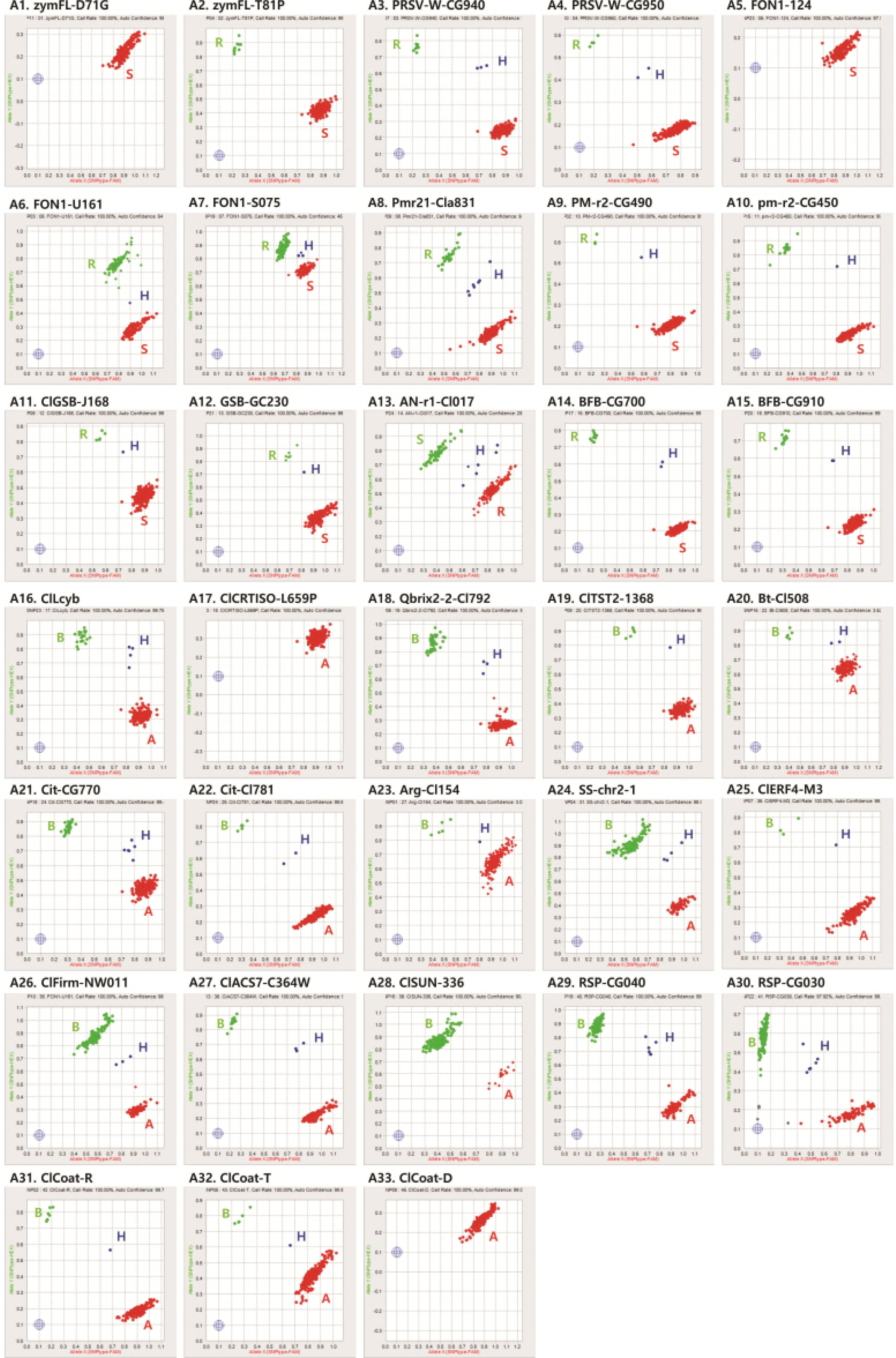
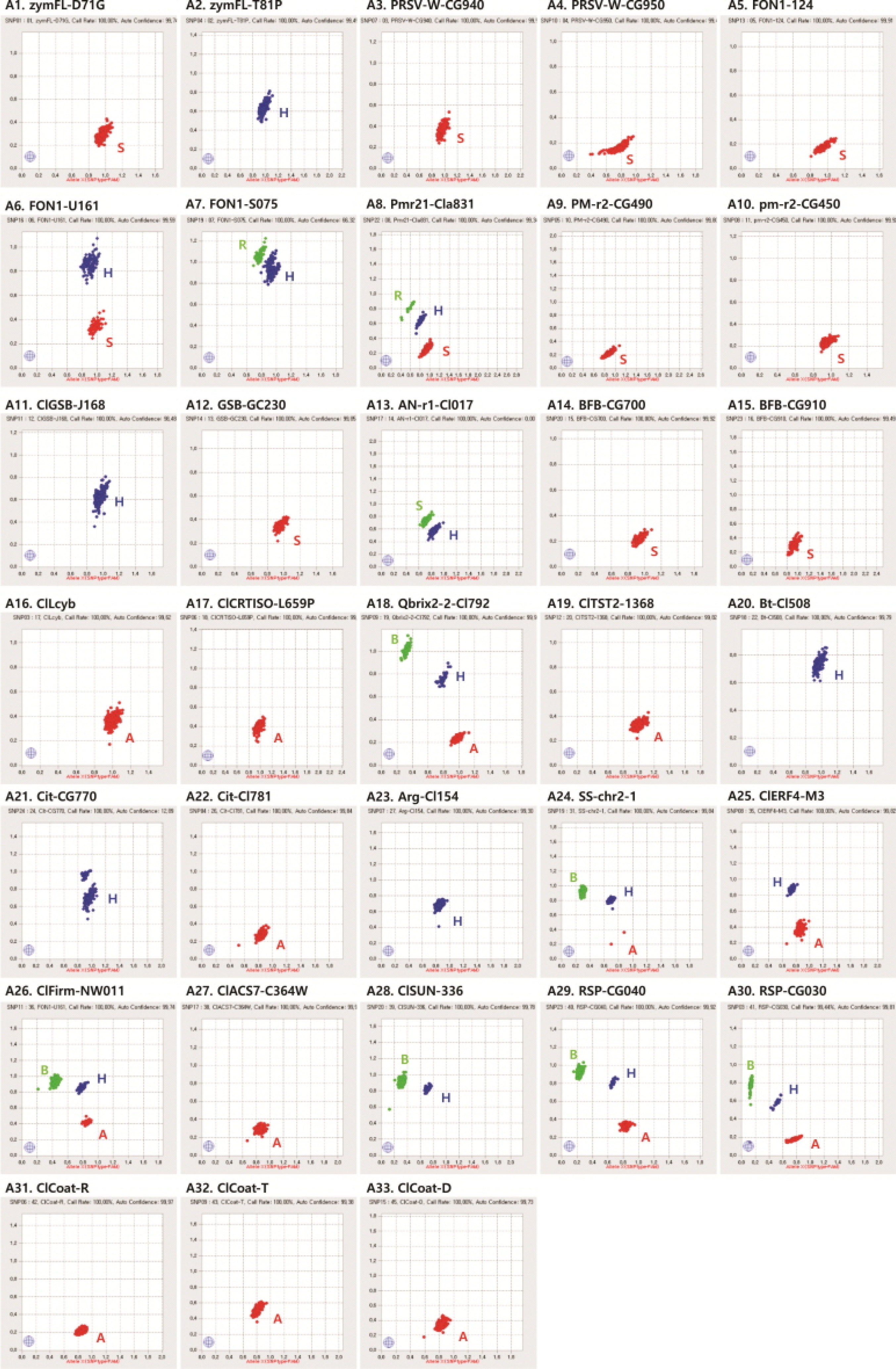
Fig. 1 and 2 and
Supplementary Table S4-S7). The red, blue and green colored dots denoted XX (fluorescence of only the FAM dye), XY (both FAM and HEX dyes) and YY (only HEX dye), respectively. The marker type for fruit related traits was categorized into homozygote reference SNP (A), homozygote alternative SNP (B) and heterozygotes (H) (
Fig. 1 and 2,
Supplementary Table S5 and S7). On the other hand, marker type related to disease resistance was grouped into resistant SNP (R), susceptible SNP (S) and heterozygotes (H) (
Supplementary Table S4 and S6). The SNP marker ‘ZymFL-D71G’ linked to zucchini yellow mosaic virus (ZYMV) identified all the watermelon gene-tic resources and F1 hybrid breeding lines as susceptible (S) while ‘ZymFL-T81P’ detected 9 resistant (R) genotypes from watermelon genetic resources and all heterozygotes (H) from F1 hybrid breeding lines (
Fig. 1 and 2, Supple-mentary Table S4 and S6). For papaya ring spot virus-W (PRSV-W), both SNP markers ‘PRSV-W-CG940’ and ‘PRSV-W-CG950’ distinguished five genotypes as resis-tant (R), only one as heterozygous (H, W185), rest of all as susceptible (S) from watermelon genetic resources whereas all susceptible (S) for F1 hybrid breeding lines (
Fig. 1 and 2,
Supplementary Table S4 and S6). Moreover, five resistant (R; W167, W173, W87, W191 and W192) and two heterozygous (H; W164 and W174) genotypes were detected by the ‘PRSV-W-CG940’ marker while one as heterozygous (H; W168) genotype by ‘PRSV-W-CG950’. In case of Fusarium wilt, two SNP markers ‘FON1-U161’ and ‘FON1-S075’ together distinguished 84 resistant (R) genotypes while ‘FON1-124’ detected all susceptible (S) from watermelon genetic resources (
Fig. 1 and 2, Supple-mentary Table S4 and S6). For watermelon F1 hybrid breeding lines, the SNP marker ‘FON1-124’ detected all susceptible (S), ‘FON1-U161’ detected partially heterozy-gous (H) and partially susceptible (S), and ‘FON1-S075’ identified 62 resistant (R) and 130 heterozygous (H) genotypes against Fusarium wilt. The SNP marker ‘Pmr21- Cla831’ linked to powdery mildew resistance against the pathogen race 1W distinguished 34 genotypes as resistant (R), 7 genotypes as heterozygous (H) and remaining 151 genotypes as susceptible (S) from watermelon genetic resources (
Fig. 1, and
Supplementary Table S4). On the other hand, 13, 37 and 142 lines were identified as resistant (R), heterozygous (H) and susceptible (S), respectively from F1 hybrid breeding lines (
Fig. 2, and
Supplementary Table S6). Moreover, we tested another two SNP markers (‘PM-r2-CG490’ and ‘PM-r2-CG450’) for resistance against powdery mildew race 2. The marker ‘PM-r2-CG490’ identified 3 genotypes (W167, W187 and W192), one genotype (W164) and remaining 188 genotypes as resistant (R), heterozygous (H) and susceptible (S), respectively, whereas marker ‘PM-r2-CG450’ identified 14 genotypes, one genotype (W164) and rest of the genotypes as resistant (R), heterozygous (H) and susceptible (S), respectively from watermelon genetic resources (
Fig. 1 and Supplemen-tary Table S4). Furthermore, all 192 F1 hybrid breeding lines were detected as susceptible (S) by both SNP markers (
Fig. 2 and
Supplementary Table S6). We also tested two SNP markers (‘ClGBS-J168’ and ‘GBS-GC230’) associated with gummy stem blight (GSB) (
Table 1). Of those markers, the SNP marker ‘ClGBS-J168’ identified 5 genotypes (W165, W166, W170, W176 and W177), one genotype (W185) and 186 genotypes as resistant (R), heterozygous (H) and susceptible (S), respectively while ‘GBS-GC230’ identified 6 genotypes, one genotype (W185) and 185 genotypes as resistant (R), heterozygous (H) and susceptible (S), respectively from watermelon genetic resources (
Fig. 1 and
Supplementary Table S4). For F1 hybrid breeding lines, all 192 lines were distinguished as heterozygous (H) and susceptible (S) by the SNP markers ‘ClGBS-J168’ and ‘GBS-GC230’, respectively (
Fig. 2 and
Supplementary Table S6). Only one SNP marker, namely ‘AN-r1-Cl017’ for anthracnose disease resistance was checked and the results showed that a total of 135 geno-types, 6 and 51 genotypes were resistant (R), heterozygous (H) and susceptible (S), respectively for watermelon genetic resources, 114 and 78 genotypes were heterozy-gous (H) and susceptible (S), respectively for F1 hybrid breeding lines (
Fig. 1 and 2,
Supplementary Table S4-S6). However, no anthracnose disease resistant genotype was detected by ‘AN-r1-Cl017’ from F1 hybrid breeding lines. Two SNP markers, ‘BFB-CG700’ and ‘BFB-CG910’ were also tested for bacterial fruit blotch resistance in water-melon. Both markers detected 12 genotypes and two genotypes (W174 and W183) as resistant (R) and hete-rozygous (H), respectively from watermelon genetic re-sources and F1 hybrid breeding lines (
Fig. 1 and 2,
Supplementary Table S4-S6). The SNP marker ‘BFB- CG700’ distinguished all 192 genotypes as heterozygous (H) and ‘BFB-CG700’ identified all F1 hybrid breeding lines as susceptible (S) (
Fig. 1and 2,
Supplementary Table S4-S6).
Two SNP markers (‘ClLcyb’ and ‘ClCRTISO-L659P’) were tested for flesh color (
Supplementary Table S2). Out of 192 watermelon genetic resources, 166, 22 and 4 genotypes were detected as reference allele (A) corres-ponding to red or other color, alternative allele (B) associ-ated with canary yellow flesh and heterozygous (H), respectively by the SNP marker ‘ClLcyb’, whereas all genotypes were detected as reference allele (A) by ‘ClCRTISO-L659P’ (
Fig. 1 and
Supplementary Table S5). All F1 hybrid breeding lines were detected as reference allele (A; red or other color) by both SNP markers (
Fig. 2 and
Supplementary Table S7). For sugar content, a total of two SNP markers, ‘Qbrix2-2-Cl792’ and ‘ClTST2-1368’ were tested (
Table 1). Out of these markers, Qbrix2-2- Cl792 identified 146, 43 and 3 genotypes as reference allele (A) correspond to high sugar content, alternative allele (B) related to low sugar content and heterozygous (H), respectively from watermelon genetic resources whereas 90, 58 and 44 lines as reference allele (A) related to high sugar content, alternative allele (B) linked to low sugar content and heterozygous (H), respectively from F1 hybrid breeding lines (
Fig. 1 and 2,
Supplementary Table S5 and S7). A total of 186 genotypes, 5 and 1 genotypes were detected as reference allele (A) related to high sugar content, alternative allele (B) linked to low sugar content and heterozygous (H), respectively from watermelon genetic resources, while all 192 F1 hybrid breeding lines were identified as reference allele (A) related to high sugar content using ‘ClTST2-1368’ (
Fig. 1 and 2, Supplemen-tary Table S5 and S7). The SNP marker ‘Bt-Cl508’ related to bitterness of watermelon detected 185 genotypes, 5 and 2 as reference allele (A; non-bitter), alternative allele (B; bitter) and heterozygous (H), respectively from watermelon genetic resources whereas all heterozygous (H) for F1 hybrid breeding lines (
Fig. 1 and 2,
Supplementary Table S5 and S7). Two SNP markers, namely ‘Cit-CG770’ and ‘Cit-Cl781’, were used for screening the watermelon gene-tic resources and F1 hybrid breeding lines citrulline content (
Table 1). The result showed that ‘Cit-CG770’ identified 157 genotypes, 29 and 6 genotypes as reference allele (A; low citrulline content), alternative allele (B; high citrulline content) and heterozygous (H), respectively from water-melon genetic resources while all 192 F1 hybrids breeding lines were identified as heterozygous (H) (
Fig. 1 and 2,
Supplementary Table S5 and S7). Similarly, ‘Cit-Cl781’ detected 185 genotypes, 5 and 2 genotypes as reference allele (A; high citrulline content), alternative allele (B; low citrulline content) and heterozygous (H), respectively from watermelon genetic resources whereas all 192 F1 hybrid breeding lines were detected as reference allele (A; high citrulline content) (
Fig. 1 and 2,
Supplementary Table S5 and S7). The SNP marker ‘Arg-Cl154’ (for arginine content) detected 186, 5 and 1 as reference allele (A; high arginine content), alternative allele (B; low arginine con-tent) and heterozygous (H), respectively from watermelon genetic resources but all 192 F1 hybrid breeding lines were found heterozygous (H) (
Fig. 1 and 2,
Supplementary Table S5 and S7). For seed size, out of 192 watermelon genetic resources, 69, 119 and 4 genotypes were detected as reference allele (A; normal seed), alternative allele (B; small seed) and heterozygous (H), respectively while 2, 135 and 55 genotypes were detected as reference allele (A; normal seed), alternative allele (B; small seed) and heterozygous (H), respectively from F1 hybrid breeding lines by the SNP marker ‘SS-chr2-1’ (
Fig. 1 and 2,
Supplementary Table S5 and S7). A total of 188, 3 and 1 genotypes were detected as reference allele (A; high rind hardness), alternative allele (B; low rind hardness) and heterozygous (H), respectively from watermelon genetic resources but 144 and 48 genotypes were detected as reference allele (A; high rind hardness), and heterozygous (H), respectively from F1 hybrid breeding lines by the SNP marker ‘ClERF4-M3’ (
Fig. 1 and 2,
Supplementary Table S5 and S7). For flesh firmness, 71, 118 and 3 genotypes were detected as reference allele (A; soft flesh), alternative allele (B; hard flesh) and heterozygous (H), respectively from watermelon genetic resources, and 36, 117 and 49 genotypes were detected as reference allele (A; soft flesh), alternative allele (B; hard flesh) and heterozygous (H), respectively from F1 hybrid breeding lines by the SNP marker ‘ClFirm-NW011’ (
Fig. 1 and 2,
Supplementary Table S5 and S7). The SNP marker ‘ClACS7-C364W’ associated with sex determination identified 176, 13 and 3 genotypes as reference allele (A; monoecious), alternative allele (B; andromonoecious) and heterozygous (H), respectively from watermelon genetic resources but all 192 F1 hybrid breeding lines were identified as reference allele (A; monoecious) (
Fig. 1 and 2,
Supplementary Table S5 and S7). For fruit shape, 17 and 175 genotypes were detected as reference allele (A; oval), alternative allele (B; spherical) and heterozygous (H), respectively from water-melon genetic resources whereas 145 and 47 F1 hybrid breeding lines were detected as alternative allele (B; spherical) and heterozygous (H), respectively by the SNP marker ‘ClSUN-336’ (
Fig. 1 and 2,
Supplementary Table S5 and S7). Two SNP markers (‘RSP-CG040’ and ‘RSP- CG030’) were analyzed for rind strip patterns in water-melon fruit (
Table 1). The result showed that there were 86, 100 and 6 genotypes were detected as reference allele (A; solid rind), alternative allele (B; striped rind) and hetero-zygous (H), respectively from watermelon genetic resour-ces, and 94, 81 and 17 genotypes were detected as reference allele (A; solid rind), alternative allele (B; striped rind) and heterozygous (H), respectively from F1 hybrid breeding lines using both SNP markers (‘RSP-CG040’ and ‘RSP- CG030’) (
Fig. 1 and 2,
Supplementary Table S5 and S7). For seed coat colour, from 192 watermelon genetic re-sources, 185 and 7 genotypes were detected as reference allele (A; black), alternative allele (B; non-black) and heterozygous (H), respectively by the SNP marker ‘ClCoat-R’, 187 and 5 genotypes were detected as refer-ence allele (A; non-red) and alternative allele (B; red) and heterozygous (H), respectively by the SNP marker ‘ClCoat-T’, and all 192 genotypes were detected as reference allele corresponding to dotted black seed coat using SNP marker ‘ClCoat-D’ (
Fig. 1 and
Supplementary Table S5). In case of F1 hybrid breeding lines, all 192 lines were identified as reference allele (A) by all three SNP markers (black: ‘ClCoat-R’; non-red: ‘ClCoat-R’; dotted black: ‘ClCoat-D’) (
Fig. 2 and
Supplementary Table S7).
DISCUSSION
The fruit quality parameters and stress resistance/ tolerance (biotic and abiotic) are the key challenges in crop improvement programs. Several diseases like the zucchini yellow mosaic virus (ZYMV), papaya ring spot virus-W (PRSV-W), Fusarium wilt, powdery mildew (PM), gummy stem blight (GSB), anthracnose, and bacterial fruit blotch (BFB) drastically reduce the yield and quality of water-melon fruit. Consequently, watermelon cultivars with better quality and resistance to various diseases are in great demand. We developed 33 SNP marker sets for a quick and high-throughput genotyping system to distinguish the traits related to fruit quality and disease resistance using ‘Fluidigm SNP Genotyping’ assay. The ‘Fluidigm SNP Genotyping’ technology has already been proven as a cheap and potential genotyping platform for detecting genetic variants of large number of traits at a time in various crop species (
Kim et al. 2017;
Nguyen et al. 2020;
Park et al. 2021;
Park et al. 2022a).
We analyzed a total of 384 genotypes which included 192 watermelon genetic sources and 192 watermelon F1 hybrid breeding lines using 33 SNP markers by ‘Fluidigm SNP Genotyping’ assay to discriminate different watermelon traits related to fruit quality and disease resistance. The ‘Fluidigm SNP Genotyping’ results revealed that all the analyzed SNP markers were successful in DNA amplifi-cation from all 384 watermelon genotypes (
Fig. 1 and
2). A similar result was reported in Oriental melon (
Kishor et al. 2021), pepper (
Kim et al. 2017) and squash (
Park et al. 2022a). Most of the analyzed SNP markers distinguished the alleles into three different types such as reference allele, alternative allele and heterozygous from watermelon genotypes for various traits. Ling
et al. 2009 reported two non-synonymous SNP in eukaryotic elongation factor eIF4E, of which one SNP (A241C; amino acid substitution T81P) showed resistance against ZYMV in watermelon ‘PI 595203’ and another SNP (A171G, amino acid substitution D71G) showed ZYMV resistance in four
Citrullus lanatus var. citroides, including ‘PI 244018’, ‘PI 482261’, ‘PI 492299’ and ‘PI 482322’. We analyzed both SNPs, however, the first SNP ‘ZymFL-T81P’ differentiated the genotypes into 9 resistant (R) and 183 susceptible (S) genotypes against ZYMV from 192 watermelon genetic resources whereas all heterozygous (H) genotypes for 192 F1 hybrid breeding lines (
Fig. 1 and
2,
Supplementary Table S4 and S6). Therefore, ‘ZymFL-T81P’ can be used to select ZYMV resistance as it differentiates between resistant and suscep-tible genotypes. Two SNP markers ‘FON1-U161’ and ‘FON1-S075’ together distinguished 84 resistant genotypes from 192 watermelon genetic resources (
Fig. 1 and
2,
Supplementary Table S4 and S6) and both of these markers can identify resistant (R), susceptible as well as heterozy-gous genotypes (H) against Fusarium oxysporum f. sp. niveum race 1 (FON-1).
Fall et al. (2018) also reported SNP marker ‘UGA1_502161’ (corresponding to ‘FON1-U161’ used in the present study) as a valuable marker for the selection of FON-1 resistance in ‘Calhoun Gray’.
Kim et al. (2015) reported the identification of a major QTL (pmr2.1) and SNP (C/T at 1302 position) on exon 2 of a NBS-LRR (R gene) ‘Cla01931’ linked to powdery mildew (PM) resistance against PM race 1W which was located on watermelon chromosome 2. Moreover,
Wu et al. (2019) reported SNPs linked to PM resistance against PM race 2W on chromosome 2 and 8. We analyzed one SNP (‘Pmr21- Cla831’) reported by
Kim et al. (2015) and two SNP (‘PM-r2-CG490’ and ‘PM-r2-CG450’) reported by
Wu et al. (2019). However, ‘Pmr21-Cla831’ distinguished the watermelon genetic resources and F1 hybrid breeding lines as resistant (R), susceptible (S) and heterozygous (H) (
Fig. 1 and
2,
Supplementary Table S4 and S6). Therefore, this SNP marker could be useful in identifying PM resistant genotypes.
Ren et al. (2020) reported a QTL linked to GSB resistance between the SNP markers ‘KASP_JS9383’ (C/T at 11424655 bp position) and ‘KASP_JS9168’ (C/T at 11995992 bp position) on chromosome 8 of watermelon (
C. lanatus). Out of these markers, we analyzed ‘KASP_ JS9168’ which corresponds to the SNP marker ‘ClGBS- J168’ of this study. Moreover,
Gimode et al. (2021) reported a candidate gene (ClCG07G013230) encoding for a disease resistance protein linked to GSB resistance in watermelon. There were four SNPs located in the gene; of those, a non-synonymous SNP (C/T at 498 bp position) changes the amino acid from (A/W). Furthermore, they revealed that this SNP showed polymorphism between ‘Crimson Sweet’ (GSB susceptible) and ‘PI 482276’ (GSB resistant). In the present study, we analyzed both previously reported SNPs (‘ClGBS-J168’ and ‘GBS-GC230’) associated with GSB resistance and validated with watermelon genetic resources and F1 breeding lines and both SNP markers can dis-tinguish resistant (R), susceptible (S) and heterozygous (H) (
Fig. 1 and
2,
Supplementary Table S4 and S6). These SNP markers can be a valuable resource for marker assisted selection (MAS) in watermelon breeding programs. How-ever, further validation through artificial inoculation of pathogens/races for every disease is required.
Related to fruit quality related traits, SNP marker ‘Qbrix2-2-Cl792’ (sugar content;
Ren et al. 2014), Cit- CG770’ (citrulline content;
Joshi and Fernie 2017), ‘Arg- Cl154’ (arginine content;
Wu et al. 2019), ‘ClERF4-M3’ (rind hardness;
Liao et al. 2020), ‘ClFirm-NW011’ (flesh firmness;
Juarez et al. 2013), ‘ClSUN-336’ (fruit shape;
Dou et al. 2018), ‘RSP-CG040’ and ‘RSP-CG030’ (rind strip pattern of watermelon fruit;
Wu et al. 2019), and ‘ClCoat-R’ and ‘ClCoat-T’ (seed coat colour;
Paudel et al. 2019) successfully distinguished the watermelon genetic resources and F1 breeding lines as reference allele (A), alternative allele (B) and heterozygous (H) (
Fig. 1 and
2,
Supplementary Table S4 and S6). Our results revealed that ‘Fluidigm SNP Genotyping’ could be an effective approach for the detection of polymorphism in various traits for a large number of genotypes at a time and the successful SNP markers could be utilized in MAS in watermelon breeding programs.
Supplemental Material
ACKNOWLEDGEMENTS
The authors are thankful to Korea Institute of Planning and Evaluation for Technology in Food, Agriculture and Forestry (IPET), Ministry of Agriculture, Food and Rural Affairs (MAFRA) for financial support.
Notes
-
CONFLICT OF INTEREST
The authors declare that they have no competing interests.
-
FUNDING
This work was supported by Korea Institute of Planning and Evaluation for Technology in Food, Agriculture and Forestry (IPET) through Digital Breeding Transformation Technology Development Program, funded by Ministry of Agriculture, Food and Rural Affairs (MAFRA) (Project number 322071-03).
Fig. 1Scatter plots of 33 SNP type assays in 192 watermelon genetic sources. Red, blue and green dots indicated XX (fluorescence of the only FAM dye), XY (both FAM and HEX dyes) and YY (only HEX dye) types, respectively. R: resistant, S: susceptible, A: reference allele, B: alternative allele, H: heterozygous.
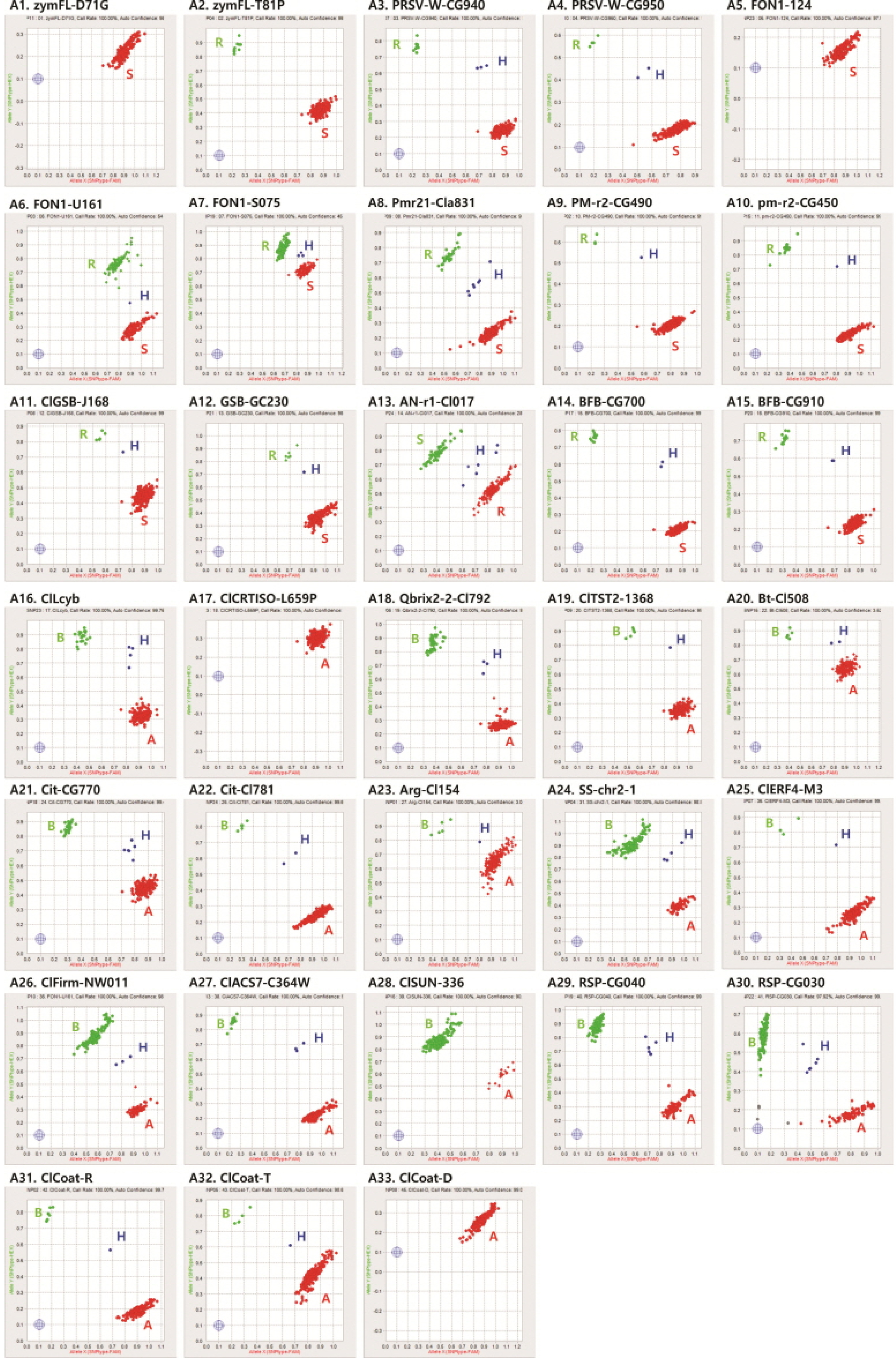
Fig. 2Scatter plots of 33 SNP type assays in 192 watermelon F1 hybrids breeding lines. Red, blue and green dots indicated XX (fluorescence of the only FAM dye), XY (both FAM and HEX dyes) and YY (only HEX dye) types, respectively. R: resistant, S: susceptible, A: reference allele, B: alternative allele, H: heterozygous.
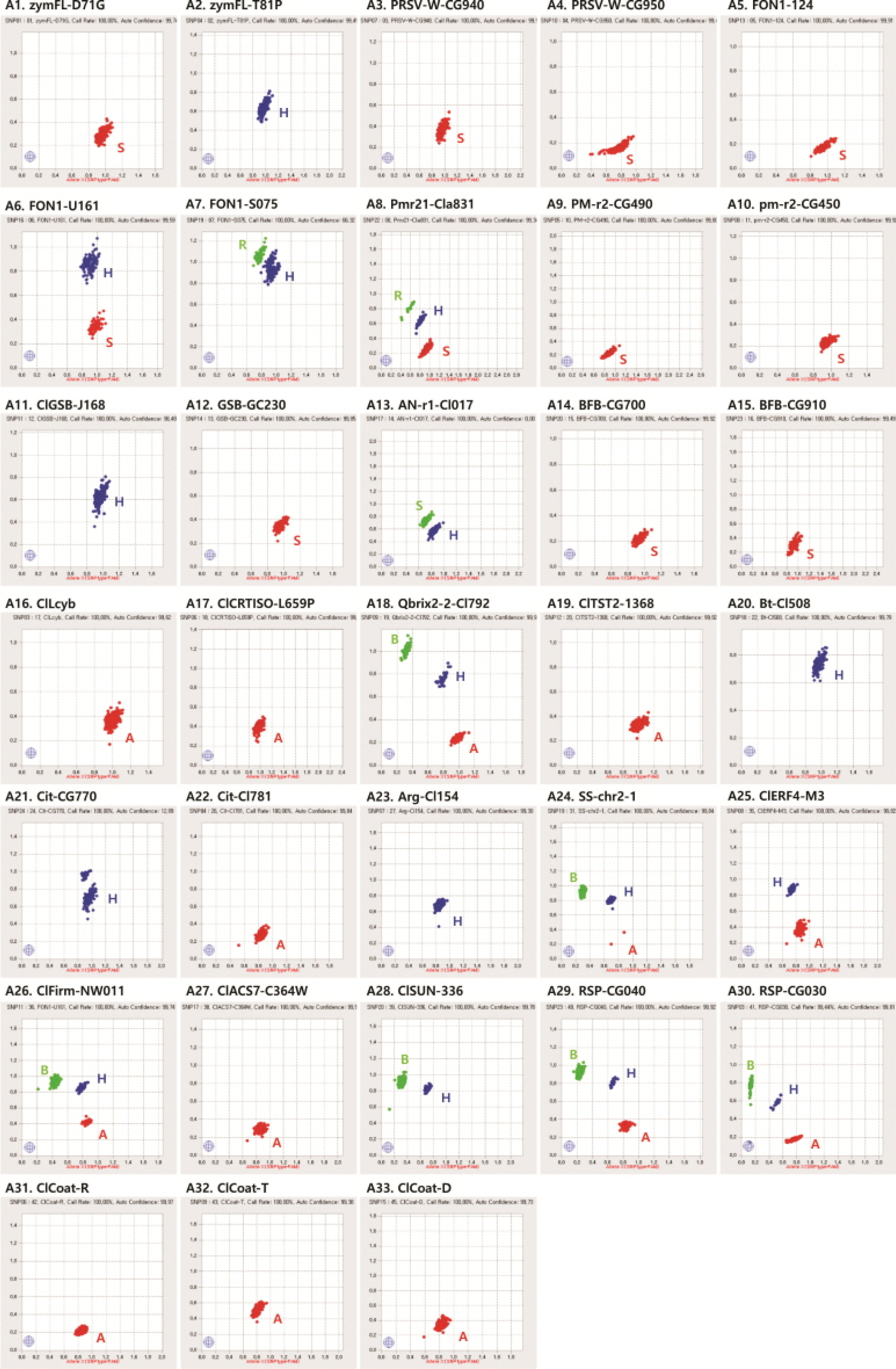
Table 1List of Fluidigm EP1 SNP type assays used in this study.
Table 1
|
Assay No. |
Assay name |
Traits |
Chromo-some |
SNP (Ref/Alt) |
SNP (color of dye)*
|
SNP (Phenotype) |
Reference |
|
Ref |
Alt |
|
A1 |
ZymFL-D71G |
Zucchini yellow mosaic virus |
3 |
...TCG[A/C]TAA... |
A(F):C(H) |
Susceptible |
Resistant |
Ling et al. 2009 |
|
A2 |
ZymFL-T81P |
|
3 |
...GCC[A/C]CCT… |
A(F):C(H) |
Susceptible |
Resistant |
Ling et al. 2009 |
|
A3 |
PRSV-W-CG940 |
Papaya ring spot virus -W |
2 |
...ATC[C/T]ATC… |
C(F):T(H) |
Susceptible |
Resistant |
Wu et al. 2019 |
|
A4 |
PRSV-W-CG950 |
8 |
...TGT[T/C]GAT... |
T(F):C(H) |
Susceptible |
Resistant |
Wu et al. 2019 |
|
A5 |
FON1-124 |
Fusarium wilt |
1 |
...GCT[T/G]TGA... |
T(F):G(H) |
Susceptible |
Resistant |
Ren et al. 2015 |
|
A6 |
FON1-U161 |
1 |
…TAC[T/C]ACA... |
T(F):C(H) |
Susceptible |
Resistant |
Fall et al. 2018 |
|
A7 |
FON1-S075 |
1 |
...AAA[A/G]CAC... |
A(F):G(H) |
Susceptible |
Resistant |
Fall et al. 2018 |
|
A8 |
Pmr21-Cla831 |
Powdery mildew (race 1W) |
2 |
...GTC[G/A]ATG... |
G(F):A(H) |
Susceptible |
Resistant |
Kim et al. 2015 |
|
A9 |
PM-r2-CG490 |
Powdery mildew (race 2) |
2 |
...AGC[T/C]CCC... |
T(F):C(H) |
Susceptible |
Resistant |
Wu et al. 2019 |
|
A10 |
PM-r2-CG450 |
8 |
...GAT[T/G]CCA... |
T(F):G(H) |
Susceptible |
Resistant |
Wu et al. 2019 |
|
A11 |
ClGBS-J168 |
Gummy stem blight |
8 |
...ATC[G/A]GTC... |
G(F):A(H) |
Susceptible |
Resistant |
Ren et al. 2020 |
|
A12 |
GBS-GC230 |
7 |
...GCG[G/A]TTG... |
G(F):A(H) |
Susceptible |
Resistant |
Gimode et al. 2021 |
|
A13 |
AN-r1-Cl017 |
Anthracnose |
8 |
...TGA[A/G]GCT... |
A(F):G(H) |
Resistant |
Susceptible |
Jang et al. 2019 |
|
A14 |
BFB-CG700 |
Bacterial fruit blotch |
10 |
...GGG[T/A]TTG... |
T(F):A(H) |
Susceptible |
Resistant |
Wu et al. 2019 |
|
A15 |
BFB-CG910 |
10 |
...ACA[T/C]ATA… |
T(F):C(H) |
Susceptible |
Resistant |
Wu et al. 2019 |
|
A16 |
ClLcyb |
Canary yellow flesh color |
4 |
...GGC[G/T]TCT... |
G(F):T(H) |
Red or other |
Canary yellow flesh |
Jin 2017 |
|
A17 |
ClCRTISO-L659P |
Orange-P flesh color |
11 |
...TAC[T/C]CGG... |
T(F):C(H) |
Red or other |
Orange-P flesh |
Jin et al. 2019a |
|
A18 |
Qbrix2-2-Cl792 |
Brix, Fructose, Sucrose |
2 |
...TTG[G/C]AGA... |
G(F):C(H) |
High sugar |
Low sugar |
Ren et al. 2014 |
|
A19 |
ClTST2-1368 |
2 |
...TGA[C/A]TAA... |
C(F):A(H) |
High sugar |
Low sugar |
Ren et al. 2018 |
|
A20 |
Bt-Cl508 |
Bitterness |
1 |
…GTT[A/G]GAT... |
A(F):G(H) |
Non-bitter |
Bitter |
Zhou et al. 2016 |
|
A21 |
Cit-CG770 |
Citrulline content |
2 |
...ATA[A/G]CTT… |
A(F):G(H) |
Low |
High |
Joshi and Fernie 2017 |
|
A22 |
Cit-Cl781 |
5 |
...TAA[A/T]CTT... |
A(F):T(H) |
High |
Low |
Joshi and Fernie 2017 |
|
A23 |
Arg-Cl154 |
Arginine content |
8 |
...CTC[C/T]TCC... |
T(F):C(H) |
High |
Low |
Wu et al. 2019 |
|
A24 |
SS-chr2-1 |
Seed size |
2 |
...CTC[T/C]GTT... |
T(F):C(H) |
Normal seed size |
Small seed size |
Lee et al. 2015 |
|
A25 |
ClERF4-M3 |
Cracking (Rind hardness) |
10 |
...ATC[C/T]TTT... |
C(F):T(H) |
High rind hardness |
Low rind hardness |
Liao et al. 2020 |
|
A26 |
ClFirm-NW011 |
Flesh firmness |
1 |
...ATA[G/A]TAC... |
G(F):A(H) |
Soft |
Hard |
Juarez et al. 2013 |
|
A27 |
ClACS7-C364W |
Monoecious or Andromonoecious |
3 |
...TTG[C/G]TGG... |
C(F):G(H) |
Monoecious |
Andromonoecious |
Boualem et al. 2016 |
|
A28 |
ClSUN-336 |
Fruit shape |
3 |
...AGA[A/G]CTC... |
A(F):G(H) |
Oval |
Spherical |
Dou et al. 2018 |
|
A29 |
RSP-CG040 |
Rind Strip Pattern |
6 |
...TGC[A/T]GCA… |
A(F):T(H) |
Solid |
Striped |
Wu et al. 2019 |
|
A30 |
RSP-CG030 |
6 |
...TTC[A/T]GAT... |
A(F):T(H) |
Solid |
Striped |
Wu et al. 2019 |
|
A31 |
ClCoat-R |
Seed coat color |
3 |
...ATT[C/A]CTT... |
C(F):A(H) |
Black |
Not black |
Paudel et al. 2019 |
|
A32 |
ClCoat-T |
|
5 |
...CCA[A/G]GGC... |
A(F):G(H) |
Not red |
Red |
Paudel et al. 2019 |
|
A33 |
ClCoat-D |
|
2 |
...TTT[A/T]CCA… |
A(F):T(H) |
Dotted black |
Flate black |
Paudel et al. 2019 |
References
- Bisen A, Khare D, Nair P, Tripathi N. 2015. SSR analysis of 38 genotypes of soybean (Glycine Max (L.) Merr. ) gene-tic diversity in India. Physiol. Mol. Biol. Plants.. 21(1): 109-115.
- Boualem A, Lemhemdi A, Sari MA, Pignoly S, Troadec C, Abou Choucha F, et al. 2016. The andromonoecious sex determination gene predates the separation of Cucumis and Citrullus genera. PloS one. 11(5): e0155444
- Bowen A, Grygorczyk A. 2022. Consumer eating habits and perceptions of fresh produce quality. In Postharvest Handl-ing (pp. 487-515). Academic Press..
- Boyhan G, Norton JD, Jacobson BJ, Abrahams BR. 1992. Evaluation of watermelon and related germplasm for resistance to zucchini yellow mosaic virus. Hort Sci.. 27: 1173
- Chung H, Jeong YM, Mun JH, Lee SS, Chung WH, Yu HJ. 2014. Construction of a genetic map based on high- throughput SNP genotyping and genetic mapping of a TuMV resistance locus in Brassica rapa. Mol. Genet. Genom.. 289(2): 149-160.
- Das S, Upadhyaya HD, Srivastava R, Bajaj D, Gowda CLL, Sharma S, et al. 2015. Genome-wide insertion–deletion (InDel) marker discovery and genotyping for genomics- assisted breeding applications in chickpea. DNA Res.. 22(5): 377-386.
- Dou J, Zhao S, Lu X, He N, Zhang L, Ali A, et al. 2018. Genetic mapping reveals a candidate gene (ClFS1) for fruit shape in watermelon (Citrullus lanatus L.). Theor. Appl. Genet.. 131(4): 947-958.
- Fall LA, Clevenger J, McGregor C. 2018. Assay development and marker validation for marker assisted selection of Fusarium oxysporum f. sp. niveum race 1 in watermelon. Mol. Breed.. 38(11): 1-10.
- Fall LA, Perkins-Veazie P, Ma G, McGregor C. 2019. QTLs associated with flesh quality traits in an elite × elite watermelon population. Euphytica. 215(2): 1-14.
- Ghislain M, Spooner DM, Nunez J, et al. Rodríguez FVillamón FVásquez C2004. Selection of highly informative and user-friendly microsatellites (SSRs) for genotyping of cultivated potato. Theor. Appl. Genet.. 108(5): 881-890.
- Gimode W, Bao K, Fei Z, McGregor C. 2021. QTL associated with gummy stem blight resistance in watermelon. Theor. Appl. Genet.. 134(2): 573-584.
- Goda M. 2007. Diversity of local genetic resources of watermelon Citrullus lanatus (Thunb. ) Matsum and Nakai. in Sudan. Sc Thesis. Swedish Biodiversity Centre, Uppsala, Sweden..
- Guichoux E, Lagache L, Wagner S, Chaumeil P, Lepais O, et al. Léger P2011. Current trends in microsatellite genotyping. Mol. Ecol. Resour.. 11(4): 591-611.
- Guo S, Zhang J, Sun H, Salse J, Lucas WJ, Zhang H, et al. 2013. The draft genome of watermelon (Citrullus lanatus) and resequencing of 20 diverse accessions. Nature Genet.. 45(1): 51-58.
- Haque MS, Saha NR, Islam MT, Islam MM, Kwon SJ, Roy SK, et al. 2021. Screening for drought tolerance in wheat genotypes by morphological and SSR markers. J. Crop Sci. Biotechnol.. 24(1): 27-39.
- Hassan MZ, Rahim MA, Jung HJ, Park JI, Kim HT, Nou IS. 2019. Genome-wide characterization of NBS-encoding genes in watermelon and their potential association with gummy stem blight resistance. Int. J. Mol. Sci.. 20(4): 902
- Hipparagi Y, Singh R, Choudhury DR, Gupta V. 2017. Genetic diversity and population structure analysis of Kala bhat (Glycine max (L.) Merrill) genotypes using SSR markers. Hereditas. 154(1): 1-11.
- Jain A, Roorkiwal M, Kale S, Garg V, Yadala R, Varshney RK. 2019. InDel markers: An extended marker resource for molecular breeding in chickpea. PLoS One. 14(3): e0213999
- Jin B, Lee J, Kweon S, Cho Y, Choi Y, Lee SJ, Park Y. 2019a. Analysis of flesh color-related carotenoids and development of a CRTISO gene-based DNA marker for prolycopene accumulation in watermelon. Hortic. Environ. Biotechnol.. 60(3): 399-410.
- Jin L, Zhao L, Wang Y, Zhou R, Song L, Xu L, et al. 2019b. Genetic diversity of 324 cultivated tomato germplasm resources using agronomic traits and InDel markers. Euphytica. 215(4): 1-16.
- Jin B, Park G, Choi Y, Nho J, Son B, Park Y. 2017. Evaluation of DNA Markers for Fruit-related Traits and Genetic Relationships Based on Simple Sequence Repeat in Watermelon Accessions. Hortic. Sci. Technol.. 35(1): 108-120.
- Joshi V, Fernie AR. 2017. Citrulline metabolism in plants. Amino Acids. 49(9): 1543-1559.
- Juarez B, King JJ, Bachlava E, Mills JM, Wentzell AM. 2013. Methods and Compositions for Watermelon Firmness. Patent Application Publication. Patent No: WO201303 3611A1. Pub.No.: US 2013/0055466A1. St. Louis, MS: Seminis Vegetable Seeds, Inc..
- Jung HJ, Veerappan K, Natarajan S, Jeong N, Hwang I, et al. Nagano2017. A system for distinguishing octoploid strawberry cultivars using high-throughput SNP genotyp-ing. Trop. Plant Biol.. 10(2): 68-76.
- Kim H, Yoon JB, Lee J. 2017. Development of Fluidigm SNP type genotyping assays for marker-assisted breeding of chili pepper (Capsicum annuum L.). Hortic. Sci. Technol.. 35(4): 465-479.
- Kim KH, Hwang JH, Han DY, Park M, Kim S, Choi D, et al. 2015. Major quantitative trait loci and putative candidate genes for powdery mildew resistance and fruit-related traits revealed by an intraspecific genetic map for wate-rmelon (Citrullus lanatus var. lanatus). PLoS One. 10(12): e0145665
- Kim M, Park Y, Lee J, Sim SC. 2020. Development of molecular markers for Ty-2 and Ty-3 selection in tomato breeding. Sci. Hortic.. 265: 109230
- Kishor DS, Noh Y, Song WH, Lee GP, Park Y, Jung JK, et al. 2021. SNP marker assay and candidate gene identifica-tion for sex expression via genotyping-by-sequencing- based genome-wide associations (GWAS) analyses in Oriental melon (Cucumis melo L. var. makuwa). Sci. Hortic.. 276: 109711
- Lee GP, Jang YJ. Sun-Ju Rhee.2015. Korea patent; KR1017 33303B1.
- Kumar SP, Susmita C, Sripathy KV, Agarwal DK, Pal G, Singh AN, et al. 2022. Molecular characterization and genetic diversity studies of Indian soybean (Glycine max (L.) Merr. ) cultivars using SSR markers. Mol. Biol. Rep.. 49(3): 2129-2140.
- Kwon YS, Oh YH, Yi SI, Kim HY, An JM, Yang SG, et al. 2010. Informative SSR markers for commercial variety discrimination in watermelon (Citrullus lanatus). Genes Genom.. 32(2): 115-122.
- Kwon YS, Hong JH. 2014. Use of microsatellite markers to identify commercial melon cultivars and for hybrid seed purity testing. Hortic. Sci. Technol.. 32(4): 525-534.
- Liao, N., Hu, Z. Hu, Z:
- Harris KR, Meyer JD, Levi A, Guner N, Wehner TC, et al. ren KS2009. Non-synonymous single nucleotide polymor-phisms in the watermelon eIF4E gene are closely associ-ated with resistance to Zucchini yellow mosaic virus. Theor. Appl. Genet.. 120(1): 191-200.
- Martyn RD, McLaughlin RJ. 1983. Effects of inoculum concentration on the apparent resistance of watermelon to Fusarium oxysporum f. sp. niveum. Plant Dis.. 67(5): 493-495.
- Morrell PL, Buckler ES, Ross-Ibarra J. 2012. Crop genomics: advances and applications. Nature Rev. Genet.. 13: 85-96.
- Nguyen NN, Kim M, Jung JK, Shim EJ, Chung SM, Park Y. 2020.Genome-wide SNP discovery and core marker sets for assessment of genetic variations in cultivated pump-kin (Cucurbita spp. Genome-wide SNP discovery and core marker sets for assessment of genetic variations in cultivated pump-kin (Cucurbita spp.
- Nimmakayala P, Abburi VL, Bhandary A, Abburi L, Vajja VG, Reddy R, et al. 2014. Use of VeraCode 384-plex assays for watermelon diversity analysis and integrated genetic map of watermelon with single nucleotide poly-morphisms and simple sequence repeats. Mol. Breed.. 34(2): 537-548.
- Palti J, Cohen Y. 1980. Downy mildew of cucurbits (Pseudoperonospora cubensis): the fungus and its hosts, distribution, epidemiology and control. Phytoparasitica. 8(2): 109-147.
- Paris HS. 2015. Origin and emergence of the sweet dessert watermelon, Citrullus lanatus. Ann. Bot.. 116(2): 133-148.
- Park JY, Jang YJ, Jung JK, Shim EJ, Sim SC, Chung SM. 2022a. Development of SNP Markers for the Identifi-cation of Commercial Korean Watermelon Cultivars Using Fluidigm Genotyping Analysis. Hortic. Sci. Technol.. 40(1): 75-84.
- Park G, Choi Y, Jung JK, Shim EJ, Kang MY, Sim SC, Chung SM, et al. 2021. Genetic diversity assessment and cultivar identification of cucumber (Cucumis sativus L.) using the fluidigm single nucleotide polymorphism assay. Plants. 10(2): 395
- Paudel L, Clevenger J, McGregor C. 2019. Chromosomal locations and interactions of four loci associated with seed coat color in watermelon. Front. Plant Sci.. 10: 788
- Perkins-Veazie P, Collins JK, Davis AR, Roberts W. 2006. Carotenoid content of 50 watermelon cultivars. J. Agric. Food Chem.. 54(7): 2593-2597.
- Ren R, Xu J, Zhang M, Liu G, Yao X, Zhu L, et al. 2020. Identification and molecular mapping of a gummy stem blight resistance gene in wild watermelon (Citrullus amarus) germplasm PI 189225. Plant Dis.. 104(1): 16-24.
- Ren Y, Guo S, Zhang J, He H, Sun H, Tian S, et al. 2018. A tonoplast sugar transporter underlies a sugar accumula-tion QTL in watermelon. Plant Physiol.. 176(1): 836-850.
- Ren Y, Jiao D, Gong G, Zhang H, Guo S, Zhang J, et al. 2015. Genetic analysis and chromosome mapping of resistance to Fusarium oxysporum f. sp. niveum (FON) race 1 and race 2 in watermelon (Citrullus lanatus L.). Mol. Breed. 35(9). 1-9.:
- Ren Y, McGregor C, Zhang Y, Gong G, Zhang H, Guo S, et al. 2014. An integrated genetic map based on four map-ping populations and quantitative trait loci associated with economically important traits in watermelon (Cit-rullus lanatus). BMC Plant Biol.. 14(1): 1-11.
- Robinson RW, Decker-Walters DS. 1997. Cucurbits. Cab International. Wallingford, Oxon, New York..
- Serba DD, Muleta KT, Amand P, Bernardo A, Bai G, Perumal R, et al. 2019. Genetic diversity, population structure, and linkage disequilibrium of pearl millet. Plㅋㅋㅋㅋㅋㅋㅋant Genome. 12(3): 180091
- Sim SC, Hong JH, Kwon YS. 2015. DNA profiling of com-mercial pumpkin cultivars using simple sequence repeat polymorphisms. Hortic. Environ. Biotechnol.. 56(6): 811-820.
- Somodi GC, Jones JB. 1991. Occurrence of bacterial water-melon fruit blotch in Florida. Plant Dis.. 75: 1053-1056.
- Stewart JE, Turner AN, Brewer MT. 2015. Evolutionary his-tory and variation in host range of three Stagonosporopsis species causing gummy stem blight of cucurbits. Fungal Biol.. 119(5): 370-382.
- Strange EB, Guner N, Wehner TC. Pesic‐VanEsbroeck Z2002. Screening the Watermelon Germplasm Collection for Resistance to Papaya Ringspot Virus Type‐W. Crop Sci.. 42(4): 1324-1330.
- Suvanprakorn K, Norton JD. 1980. Inheritance of resistance to race 2 anthracnose in watermelon. J. Am. Soc. Hort. Sci.. 105(6): 862-865.
- Thomson MJ. 2014. High-throughput SNP genotyping to accelerate crop improvement. Plant Breed.Biotechnol.. 2(3): 195-212.
- Wehner TC, Shetty NV, Elstron GW. 2001. Breeding and seed production. In: Maynard DN (ed) Watermelons: characteristics, production, and marketing. ASHS Press. Alexandria, VA 27-73.
- Wu S, Wang X, Reddy U, Sun H, Bao K, Gao L, et al. 2019. Genome of 'Charleston Gray', the principal American watermelon cultivar, and genetic characterization of 1,365 accessions in the US National Plant Germplasm System watermelon collection. Plant Biotechnol. J.. 7(12): 2246-2258.
- Zhou Y, Ma Y, Zeng J, Duan L, Xue X, Wang H, et al. 2016. Convergence and divergence of bitterness biosynthesis and regulation in Cucurbitaceae. Nature Plants. 2(12): 1-8.