Abstract
Hybridization studies and reciprocal crosses were carried out on Basella alba var alba and Basella alba var rubra morphotypes in the family Basellaceae collected from various locations in the southwestern part of Nigeria. This was done to ascertain the possibility of gene exchange between the morphotypes and to examine the performance of the F1 hybrids produced in other to help in their genetic improvement. A total of 300 crosses were carried out between the Basella alba and Basella rubra morphotypes studied. From the Basella alba × Basella rubra 150 crosses, 19 individuals were raised out of which two did not grow beyond two leave stage. The hybrids had purple pigmentation. From the reciprocal 150 Basella rubra × Basella alba crosses, 21 hybrids were raised of which 3 failed to germinate beyond two leave stage and all the remaining had red pigmentation. The F1 hybrids obtained from the crosses showed no significant difference with the parents in the vegetative and reproductive characters studied. The hybrids obtained were not significantly different irrespective of the choice of maternal parent as the red pigmentation was dominant. It was concluded that the hybrids showed no clear superiority compared with the parents except that it matured earlier under our environmental conditions.
-
Key words: Basellaceae, Dominant, Genetic improvement, Hybridization, Morphotypes, Reciprocal crosses
INTRODUCTION
Basella alba and
Basella rubra are the most common forms in the family Basellaceae (
Ozela et al. 2007).
Basella alba is native to Africa and Asia and it is widely cultivated in tropical and sub-tropical arrears where it is used as vegetables.
Basella alba is particularly abundant in Malaysia, Philippines, Tropical Africa, the Caribbean and Tropical South America (
Palada and Crossman 1999), and Southeast of Brazil (
Echo plant information sheet 2006). Researchers often treat
Basella rubra as a synonym of
Basella alba (
Cook 2010;
Deshmukh and Gaikward 2014).
Basella is commonly referred to as Indian spinach, Malabar Spinach, Ceylon Spinach, country Spinach, and wine Spinach (
Roy et al. 2010). It is commonly referred to as ‘amunututu’ in the southwestern part of the country where the research was undertaken. It is a very popular vegetable in many coastal communities of Southern Nigeria and it is one of the major ingredients in the Northern and Northeastern foods com-pliment (
Izonfuo et al. 2006;
Pareek et al. 2010). It is cultivated at homes as pot herbs and contain high nutritive value and the juice is used as a dye for official seals, as a rouge on the facial skin and food coloring (
Daniel 2006;
Herbal Medicine Research Centre 2002). The purple pig-mented morphotype - Basella
alba var
rubra is the most beautiful and attractive form having wide fleshy ovate shinning leaves, twinning much branched stems and small sessile pinkish flowers on distant spikes (
Adhikari 2012). The plant is vast in its properties and applications (
Saroj et al. 2012). The stems and leaves have wild applications in phytomedicine like acne and freckle treatment, burns, dysentery, anemia, cancer etc. (
Roshan et al. 2012).
The
Basella genome with all its attendant benefits is underutilized and underexploited and very little attention has been paid to its genetic improvement (
Medagam et al. 2014;
Bolaji et al. 2022). This might be due to its designation as orphan crop in the research world. From the different research survey on
Basella, there has been reports on the morphological characteristics and anatomical properties but the knowledge and the possibility of the genetic exchange among its forms is still very vague. Natural hybridization between the mor-photypes has not been reported. Little is known about the fitness of the resulting hybrids. The knowledge of hybrid fitness is important for any meaningful plant conservation. There is therefore the need to pioneer the hybridization of the
Basella morpho-types.
Hybridization is a powerful tool in the hand of plant breeders for any crop improvement programs. Breeders use hybridization to produce vigorous hybrids and new phe-notypes (
Benjamin et al. 2017). Some other information that can be inferred from plants hybridization are adaptive introgression, hybrid speciation, heterosis etc. Also plant hybridization has been a great tool in evolution and as-sessment of gene flow from parent to offspring in plants (
Ellstrand et al. 1999;
Bolaji et al. 2023). Many new species have originated by means of hybridization followed by chromosome dou-bling. This have allowed better adaptive values of the newly formed species. It has been estimated that in the phylo-genetic relationship of flowering plants, about 40-75% of all flowering plants species have originated because of hybridization (
Ehrich and Wilson 1991). Furthermore, New characteristics can arise because of hybridization through the effect of hybrid gene com-binations which stimulate the occurrence of new mutations (
Stebbins 1971), hence its use in plant taxonomy.
From literatures, the green-stemmed
Basella alba pos-sesses characteristics like bigger leaves and more leaves which might make it preferable to the red-stemmed
Basella rubra. However, the red-stemmed is preferred by some consumers due to its delicious taste (
Roy et al. 2010;
Gayathree et al. 2020). From some markets preferences and reports, the colour of the leaves determine the choice of consumers for consumption and this affects the level of sweetness with the purple pigmented leaves reportedly having the sweetest leaves. It is thus obvious that the two morphotypes have their strengths and weaknesses, hence the need to produce hybrids combining these properties.
As consumer standards begin to skyrocket, the process of crossing, selection and other traditional crop improvement methods cannot be overemphasized. Some of these methods have been used in the development of peach and other plants (cock
et al. 2010;
lezzoni 2008).
This research was undertaken to verify the possibility of the production of viable hybrids, determine the reproductive barriers that could prevent gene exchange and to evaluate the performance of F1 hybrids produced from the Basella morphotypes in comparison with their parents in other to help in their genetic improvements.
MATERIALS AND METHODS
Parental inbred lines used in this study
Herbarium studies were carried out at the Department of Botany, OAU, Ile-Ife Herbarium and the Flora of West Tropical Africa by Hutchinson and Dalziel (1963) was consulted to provide information on the species distribution and identification. Twelve parental inbred lines used in this study, including the areas of collection and co-ordinates are as listed (
Table 1). Accession numbers were given to the diverse
Basella inbred lines at the IFE Herbarium. The seeds from different accessions were collected and planted inside plastic packs.
The seedlings were transplanted into polythene bags filled with top soil at the screen house of the Department of Botany, OAU. Ile-Ife. The crosses and the evaluation of generations were carried out at the screenhouse of Botany department, OAU, Ile-Ife, Nigeria in a half diallel mating arrangements in 2019. A total of 300 crosses were carried out between the Basella morphotypes involving 150 reci-procal crosses each. Pollens were then transferred from the male parent to the stigma of the ovulate parent, and then bagged and tagged for easy identification and monitoring. Seeds formed from the hybridization (F1) were raised alongside their parents and characterized. The experiment was laid out in a randomized complete block design with five replicates for evaluation of parents (P1 and P2) and the F1 population. crop management practices like weed control, regular watering were carried out.
Data collection and analysis
Both the vegetative and reproductive attributes of the Basella alba var. alba, Basella alba var. rubra and the F1 hybrids studied were characterised. The vegetative attri-butes investigated include: plant habit, mean plant height at flower bud initiation, mean number of primary branches, mean internode distance, stem pubescence, stem colour, mean stem diameter, leaf colour, leaf pubescence, leaf shape, leaf margin, leaf venation pattern, leaf arrangement, leaf attachment, mean leaf length, mean leaf width and mean petiole length.
The reproductive attributes investigated include: inflore-scence type, colour, type and number of perianths, number of anthers, colour and type of pollens, colour and type of filaments, type of stigma, type of style, type of ovary, mean flower per spike, type of fruits, shape of fruits, colour of fruits (ripe and unripe), mean fruit length, mean fruit diameter, mean fruit per spike, type of seeds, seed colour (ripe and unripe), mean seed length, mean seed diameter and mean seeds per spike. The combining ability analysis was performed by subjecting the quantitative reproductive data obtained to the General Linear Model (GLM) analysis of variance (ANOVA) and the means were separated by Duncan Multiple Range Test (DMRT) at P < 0.05 using System Analysis Software (SAS) version 9.0.
RESULTS
Crosses involving Basella alba var rubra as ovulate parents (Basella rubra × Basella alba)
In the crosses where
Basella rubra served as the ovulate parent (
Table 2), forty-six (46) out of the 150 crosses took (ovule became swollen), while 104 did not take. Out of those that took, 26 set fruits, while the remaining 20 were aborted before they could set seeds. It took longer time (average of 10-30 days) for the seedlings of the hybrids to emerge unlike in the parents (average of 5-20 days). Twenty-six (26) F
1 seeds were harvested out of which five failed to germinate, therefore 21 F
1 population were raised, three (3) out which were weak and failed to grow beyond the two-leaved stage. All the remaining eighteen (18) F
1 hybrids population had purple stem and leaves like in
Basella rubra. The
Basella rubra ×
Basella alba hybrid studied was perennial, herbaceous and twinning;mean plant height 60.74 ± 2.39 cm; stem glabrous, red, mean stem diameter 3.28 ± 0.11 cm; number of primary branches 4.23 ± 0.36; mean internode distance 4.49 ± 0.31 cm; leafred, simple, glabrous, succulent, cordate, margin entire, apex acute and round, venation pinnate, leaf arrangement opposite at seedling stage, alternate at mature stage, leaf attachment petiolate; leaves exstipulate, mean leaf length 6.12 ± 0.42 cm, mean leaf width 4.76 ± 0.24 cm, mean petiole length 1.47 ± 0.07 cm; inflorescence racemose, perianth 5, joined at base, cream with pink apex, bracts attached to base of perianth, flowers bisexual, pedicel sessile and glabrous, symmetry radial; Anther 5, pollen light yellow, powdery; filament white with adnate attach-ment; stigma simple, glabrous; style of unequal length, white, simple, glabrous; ovary superior, placentation basal; mean flower per spike 15.89 ± 1.63; fruit berry, glabrous, spherical, apedicelate on green spike; four lobed, one-seeded, unripe colour green, ripen colour deep purple; mean fruit length 1.01 ± 0.07 cm; mean fruit diameter 2.09 ± 0.10 cm; mean number of fruits per spike 10.67 ± 1.01; seeds nutlets, brown, spherical in shape; mean seed length 0.59 ± 0.03 cm, mean seed diameter 1.19 ± 0.09 cm; mean number of seed per spike 12.01 ± 0.85. The mean number of days to 50% flowering was 71.22 ± 4.17.
Forty-one (27.3%) out of the 150 crosses carried out took while others (72.7%) failed. Nineteen (19) i.e., 46.34% of those that took set fruits (
Table 3) giving rise to 19 F
1 seeds. Two (10.5%) out of these 19 F
1 hybrid seeds did not germinate, therefore only 17 F
1 population were raised. The 17 F
1 population took the features of
Basella rubra. The flowers had light purple pigmentation at the apex. The
Basella alba ×
Basella rubra hybrid studied was perennial, herbaceous and twinning;mean plant height 58.70 ± 2.32 cm; stem glabrous, red, mean stem diameter 3.10 ± 0.15 cm; number of primary branches 3.71 ± 0.42; mean internode distance 4.18 ± 0.38 cm; simple, glabrous, suc-culent, cordate, margin entire, apex acute and round, vena-tionpinnate, leaf arrangement opposite at seedling stage, alternate at mature stage, leafattachmentpetiolate; leaves ex stipulate, mean leaf length 6.13 ± 0.35 cm, mean leaf width 4.83 ± 0.23 cm, mean petiole length 1.70 ± 0.05 cm; inflorescence racemose, perianth 5, joined at base, cream with pink apex, bracts attached to base of perianth, flowers bisexual, pedicel sessile and glabrous, symmetry radial; Anther 5, pollen light yellow, powdery; filament white with adnate attachment; stigma simple, glabrous; style of unequal length, white, simple, glabrous; ovary superior, placentation basal;mean flower per spike 17.42 ± 1.17; fruit berry, glabrous, spherical, apedicelate on green spike; four lobed, one-seeded, unripe colour green, ripen colour deep purple; mean fruit length 0.93 ± 0.06 cm; mean fruit diameter 2.11 ± 0.14 cm; mean number of fruits per spike 10.71 ± 1.32; seeds nutlets, brown, spherical in shape; mean seed length 0.57 ± 0.04 cm, mean seed diameter 1.27 ± 0.02 cm; mean number of seed per spike 11.09 ± 0.57. The mean number of days to 50% flowering was 64.57 ± 2.10. The habits of the
Basella alba and
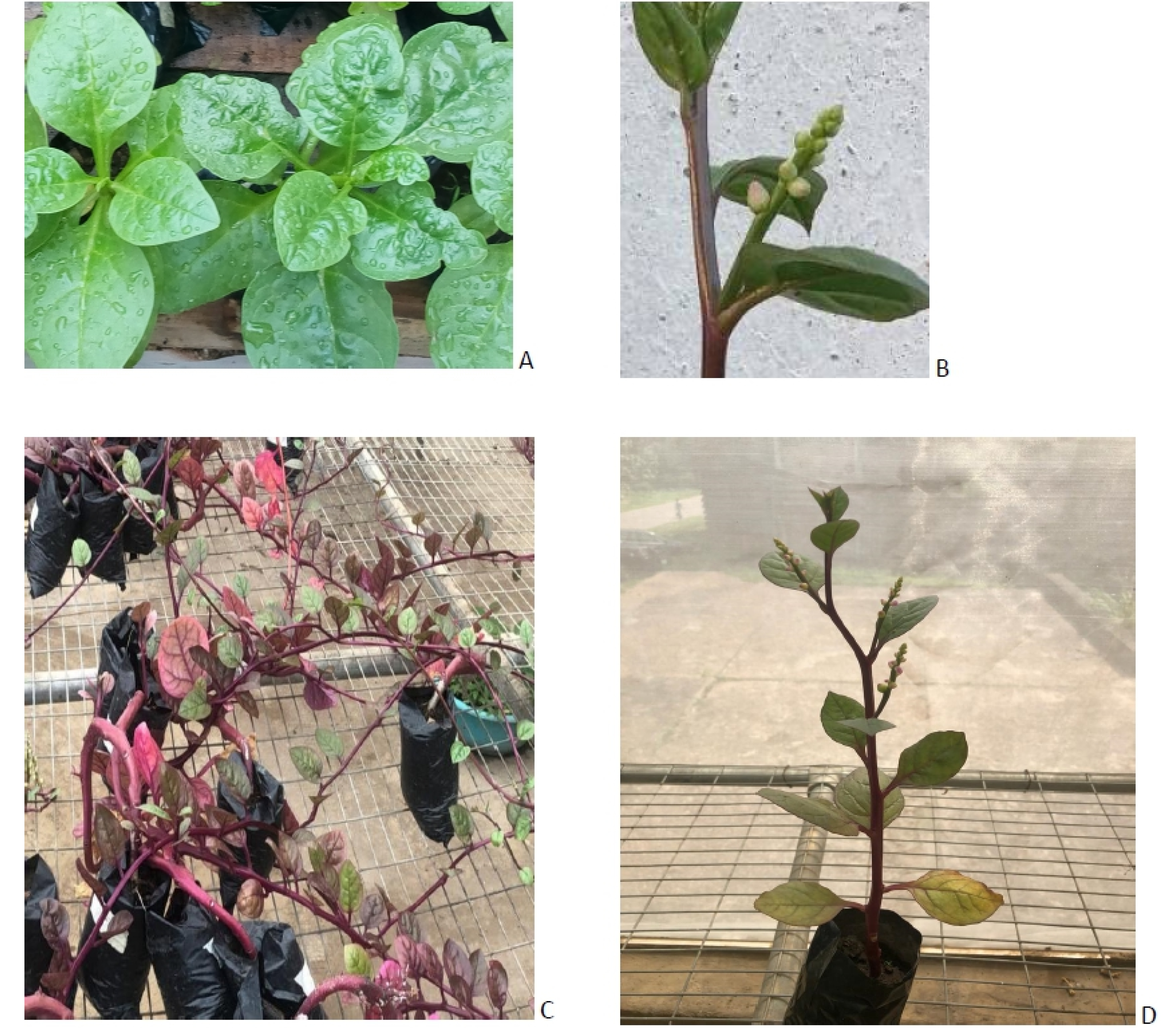
Basella rubra and the hybrids produced from the reciprocal crosses are presented in
Fig. 1. while the comparative mmorphologicalcharacterization of
Basella alba var.
alba and
Basella alba var.
rubra studied and there hybrids are shown in
Table 4.
DISCUSSION
The
Basella morphotypes studied hybridized successfully to produce high viable and fertile offsprings. This confirms their taxonomic status as morphotypes and not separate species. Different researchers have corroborated the fact that they are synonyms as reported by
Roy et al. (2010). Also the compatibility of crossing was bilateral as crossing was successful independent of which was used as the ovulate parent. The occurrence of some seeds that failed to germinate in the crosses carried out could be an indication of hybrid inviability. From the survey of literatures, there are different reasons that could lead to hybrid inviability.
Brar and Khush (1997) reported that hybrid inviabilty could be caused due to genic disharmony and accidents in the early stages of embryonic development. These accidents are not likely to be chromosomal as both morphotypes have been reported to have the same chromosome number.
Stebbins (1971) reported that even when the hybrids are closely related, hybrid inviability could still be possible.
Oziegbe et al. (2019) reported hybrid seed inviability between
Stachytapheta augustifolia and
Stachytapheta cayenesis even though they possessed the same chromo-some number.
Apart from the occurrence of hybrid inviability, hybrid weakness was also observed as some of the F
1 seeds could not grow beyond the two leaved stage. Hybrid weakness is a common occurrence in nature (
Bomblies 2009), and it is an effective tool for reproductive isolation (
Chen et al. 2013). According to
Gepts et al. (1985), the appearance of F
1 hybrids weakness may reflect geographical isolation and the existence of two separate gene pools within a species.
From the foregoing, there exists a certain level of repro-ductive isolation among the morphotypes even though they were not strong enough to prevent the formation of fertile offsprings. The challenges of creating hybrids decrease as the phylogenetic distance between combining species increases (
Kaneko et al. 2014). Other factors that could determine the success of any geneticcrosses are methods of pollen dissemination, physical distance between the species, direction of crosses and environmental factors (
Scheffler et al. 1994;
Choudhary et al. 2001). The failure of fertilized ovules to develop into seeds and hybrid weakness are common scenario in hybridization. However, early pollination and stump pollination are possible strate-gies that could be used to overcome pre and post fer-tilization barriers in plants (
Van et al. 1997).
It is necessary to access the fitness of the hybrids produced as they guide us to predict the destiny of the hybrids in natural habitats (
Snow et al. 2003). Curators over the years have considered the lack of characterization has a reason for underutilization of germplasm (
Medagan et al. 2014). If this goals will be realistic, it is quite neces-sary to select the correct parental associated with the repro-ductive and vegetative growth as was done in this study which will then reveal the true capacity for better potentials (Zhi
et al. 2003).The hybrids showed a significant infer-iority in the plant height at maturity, leaf length, leaf width, average number of flowers per spike,number of days to 50% flowering but showed a higher hybrid vigor in number of days to seedling emergence. Very less variation was found among hybrids for petiole length and internode distance.
Varalakshmi and Deveraj (2010) have observed that the high variability of
Basella in leaf length, leaf width and internode distance could form the basis of effective selection of superior uses in
Basella.
Wang et al. (2006) reported that leaf characters such as leaf area, petiole length and petiole thickness are genetically inherited and varied from variety to variety. Results from this study showed that the hybrid generated had nearly the same fitness with the parentsal though some intermediates and inferior quantitative cha-racters were found in the hybrids. These inferior characters and intermediates are not likely as a result of hybrid depression or inferiority but basically as a result of the early maturity of the hybrids since quantitative parameters were taken at flowering stage.
Medagan et al. (2014) corroborated the fact that leaf length, leaf width and leaf yield are more or else influenced by environmental factors, hence genetic improvement will be difficult in these lines due to masking effects of the environment in genotypic effects. There has been results where hybrids did not show any considerable superiority or inferiority with the parentals (
Zhi et al. 2003). Plant height at flower bud initiation and number of days to 50% flowering was significantly lower in the hybrids when compared to the parents. This implies that the hybrids spent much lesser time on the vegetative phase than theparents. It also implies that the hybrids attained sexual maturity at varying periodswhen compared with the parents. This could mean that the possibility of the hybrids intro-gressing with the parentals in nature is quite slim and any breeding purpose for backcrossing of the hybrids with the parents can only be achieved by varying the planting periods of the hybrids.
The difference in number of days to seedling emergence in hybrids relative to the parentals could indicate greater ability to circumvent unfavorable environmental conditions like heat, drought etc. From the qualitative characters of the hybrids studied, the hybrids were similar to the Basella alba var rubra morphotype with respect to the stem pubescence, stem colour, mean stem diameter, leaf colour, leaf pubescence, leaf shape, leaf margin, leaf venation pattern, leaf arrangement, leaf attachment, inflorescence type, colour, type and number of perianths, number of anthers, colour and type of pollens, colour and type of filaments, type of stigma, type of style, type of ovary, type of fruits, shape of fruits, colour of fruits (ripe and unripe), type of seeds and seed colour (ripe and unripe). Though the two parentals differed mainly in their pigmentation, the F1 hybrids showed the red pigmentation of the Basella alba var rubra morphotype implying that the red pigmentation was dominant over the green and could also be an evolu-tionary advancement over the green morphotype. This close morphological similarity between the hybrids and the parentals may also be the reason while no hybrid occur-rence has been reported in nature.
This study concluded that the morphotypes can success-fully hybridized to produce viable and fertile offsprings even though there were reproductive barriers between them. However, the F1 hybrids did not show clear superi-ority compared with the parents from our own experi-mental conditions. This means that the hybrids were not necessarilyadvantageous except for early maturity observed in the hybrids.
CONCLUSION
This study concluded that the morphotypes can suc-cessfully hybridized to produce viable and fertile offsprings even though there were reproductive barriers between them. However, the F1 hybrids did not show clear superi-ority compared with the parents from our own experimental conditions. This means that the hybrids were not neces-sarily advantageous except for early maturity observed in the hybrids.
ACKNOWLEDGEMENTS
The authors gratefully thank the technical staff members of the Department of Botany, Obafemi Awolowo Uni-versity for their technical assistant during the course of this study.
Fig. 1Habit of Basella alba, Basella rubra and the hybrids Studied. (A) Habit of Basellaalba studied, (B) habit of Basella alba × Basellarubra studied, (C) habit of Basella rubra studied, (D) Basella rubra × Basella alba hybrids studied.
Table 1Sources of the Basella alba var. alba (green-stemmed) and the Basella alba var. rubra (red-stemmed) parental inbred lines used in this study.
Table 1
|
Accession |
Morphotype |
Source |
Location |
Comment |
|
BAIWO (10)*
|
Basella alba var. alba
|
Osun state |
7.629444°N4.191111°E |
Cultivated in home gardens |
|
BAIFE (8) |
Basella alba var. alba
|
Osun state |
7.523056°N4.515833°E |
Cultivated in school gardens |
|
BAONDO (5) |
Basella alba var. alba
|
Ondo state |
7.236111°N5.239722°E |
Cultivated in home gardens |
|
BAEKITI (5) |
Basella alba var. alba
|
Ekiti state |
7.616389°N5.218333°E |
Cultivated in gardens |
|
BAOYO (5) |
Basella alba var. alba
|
Oyo state |
7.419167°N3.964722°E |
Cultivated in church gardens |
|
BALAG (5) |
Basella alba var. alba
|
Lagos state |
6.942778°N4.191111°E |
Cultivated beside home |
|
BRIWO (9) |
Basella alba var. rubra
|
Osun state |
7.629444°N4.191111°E |
Cultivated in home gardens |
|
BRIFE (8) |
Basella alba var. rubra
|
Osun state |
7.523056°N4.515833°E |
Cultivated in school gardens |
|
BRONDO (10) |
Basella alba var. rubra
|
Ondo state |
7.236111°N5.239722°E |
Cultivated in home gardens |
|
BREKITI (7) |
Basella alba var. rubra
|
Ekiti state |
7.616389°N5.218333°E |
Cultivated in home gardens |
|
BROYO (5) |
Basella alba var. rubra
|
Oyo state |
8.146111°N4.259167°E |
Cultivated in school gardens |
|
BRLAG (6) |
Basella alba var. rubra
|
Lagos state |
6.942728°N3.098056°E |
Cultivated in home gardens |
Table 2Combining ability of B. rubra and B. alba studied.
Table 2
|
Cross combination |
F1 individual |
Number of
fertilized ovule |
Number of
aborted |
Number of
fruit formed |
|
BRIWO07 × BAIWO09 |
5 |
3 |
3 |
- |
|
BRONDO01 × BAIFE8 |
4 |
2 |
1 |
1 |
|
BRIFE03 × BAIFE10 |
5 |
1 |
- |
1 |
|
BRIFE07 × BAIWO08 |
4 |
1 |
1 |
- |
|
BRIWO06 × BAIWO04 |
4 |
- |
- |
- |
|
BRONDO6 × BAIFE5 |
6 |
3 |
2 |
1 |
|
BREKITI03 × BAONDO02 |
6 |
1 |
1 |
- |
|
BROYO2 × BAOYO2 |
5 |
2 |
- |
2 |
|
BROYO5 × BAIWO01 |
4 |
1 |
- |
1 |
|
BREKITI02 × BAIFE04 |
5 |
1 |
1 |
- |
|
BRIFE02 × BAIWO07 |
4 |
2 |
1 |
1 |
|
BRIWO02 × BAONDO3 |
6 |
2 |
1 |
1 |
|
BRIFE02 × BAEKITI05 |
5 |
1 |
1 |
- |
|
BRIWO02 × BAOYO02 |
7 |
1 |
0 |
1 |
|
BROYO3 × BAONDO4 |
6 |
2 |
1 |
1 |
|
BR1WO08 × BAEKITI04 |
5 |
2 |
1 |
1 |
|
BRIFE09 × BAONDO6 |
7 |
2 |
1 |
1 |
|
BREKITI02 × BA1WO04 |
5 |
1 |
- |
1 |
|
BRIFE10 × BAIFE04 |
8 |
3 |
1 |
2 |
|
BRIFE02 × BAEKITI03 |
5 |
1 |
- |
1 |
|
BRIFE04 × BAIWO8 |
8 |
2 |
1 |
1 |
|
BROYO03 × BAOYO07 |
5 |
3 |
1 |
2 |
|
BRONDO08 × BAIWO08 |
5 |
2 |
1 |
1 |
|
BRIWO08 × BAOYO06 |
5 |
1 |
- |
1 |
|
BRIFE03 × BAIFE03 |
4 |
1 |
- |
1 |
|
BROYO03 × BAONDO05 |
5 |
2 |
1 |
1 |
|
BRONDO05 × BAEKITI04 |
6 |
1 |
0 |
1 |
|
BREKITI04 × BAIWO06 |
5 |
2 |
- |
2 |
|
Total |
150 |
46 |
20 |
26 |
Table 3Combining ability of Basella alba and Basella rubra studied.
Table 3
|
Cross combination |
Number of crosses |
Number of fertilized ovule |
Number aborted |
Number of fruit formed |
|
BAIWO04 × BRIWO07 |
4 |
2 |
1 |
1 |
|
BAIFE6 × BRONDO2 |
4 |
2 |
1 |
1 |
|
BAONDO04 × BREKITI02 |
6 |
1 |
- |
1 |
|
BAOYO1 × BROYO2 |
3 |
1 |
1 |
- |
|
BROYO2 × BAIWO5 |
4 |
1 |
- |
- |
|
BAIFE04 × BREKITI03 |
3 |
- |
- |
1 |
|
BAONDO4 × BROYO3 |
4 |
1 |
1 |
- |
|
BRIWO01 × BRIWO02 |
5 |
2 |
1 |
1 |
|
BAIFE01 × BRONDO05 |
4 |
1 |
- |
1 |
|
BAIFE5 × BRIFE7 |
3 |
1 |
1 |
- |
|
BAIWO03 × BRIFE2 |
4 |
2 |
1 |
1 |
|
BAEKITI04 × BR1WO08 |
6 |
3 |
1 |
2 |
|
BAONDO6 × BRIFE09 |
5 |
1 |
1 |
- |
|
BA1WO04 × BREKITI02 |
4 |
1 |
0 |
1 |
|
BAIFE03 × BRIFE10 |
4 |
2 |
1 |
1 |
|
BAIWO08 × BRIFE03 |
5 |
2 |
2 |
- |
|
BAONDO3 × BRIWO02 |
4 |
2 |
1 |
1 |
|
BAEKITI05 × BRIFE02 |
5 |
1 |
1 |
- |
|
BAIWO09 × BRIWO02 |
4 |
2 |
1 |
1 |
|
BAEKITI06 × BRIFE02 |
5 |
1 |
- |
1 |
|
BAIWO10 × BRIFE04 |
4 |
- |
- |
- |
|
BAOYO07 × BROYO03 |
5 |
2 |
1 |
- |
|
BAIWO08 × BRONDO08 |
5 |
2 |
1 |
1 |
|
BAOYO06 × BRIWO08 |
5 |
1 |
- |
1 |
|
BAIFE04 × BRIFE03 |
4 |
1 |
- |
1 |
|
BAONDO06 × BROYO03 |
5 |
- |
- |
- |
|
BAEKITI04 × BRONDO03 |
6 |
1 |
1 |
- |
|
BAOYO2 × BROYO2 |
4 |
1 |
- |
1 |
|
BAOYO5 × BRIWO01 |
5 |
- |
- |
- |
|
BAIFE04 × BREKITI02 |
5 |
- |
- |
- |
|
BAIWO07 × BRIFE02 |
4 |
1 |
1 |
- |
|
BAONDO3 × BRIWO02 |
3 |
1 |
1 |
- |
|
BAEKITI05 × BRIFE02 |
2 |
1 |
- |
1 |
|
BAOYO02 × BRIWO02 |
3 |
- |
- |
- |
|
BAIWO06 × BREKITI04 |
4 |
1 |
1 |
- |
|
Total |
150 |
41 |
22 |
19 |
Table 4Comparison between morphological characters of parents and Basella alba var. alba × Basella alba var. rubra hybrids studied.
Table 4
|
Characters |
Basella alba
|
Basella rubra ×
Basella alba hybrids |
Basella alba ×
Basella rubra hybrids |
Basella rubra
|
|
Plant habit |
Perennial, herbaceous, twinning |
Perennial, herbaceous, twinning |
Perennial, herbaceous, twinning |
Perennial, herbaceous, twinning |
|
Plant height at flower bud initiation (cm) |
87.70 ± 9.05b
|
60.74 ± 2.39c
|
58.70 ± 2.32c
|
119.49 ± 6.80a
|
|
No. of primary branches |
5.26 ± 0.30a
|
4.23 ± 0.36a
|
3.71 ± 0.42b
|
4.33 ± 0.24b
|
|
Internode distance |
5.05 ± 0.44a
|
4.49 ± 0.31ab
|
4.18 ± 0.38b
|
4.58 ± 0.45b
|
|
Stem texture and colour |
Glabrous, green |
Glabrous, red |
Glabrous, red |
Glabrous, red |
|
Stem diameter |
3.180 ± 0.12b
|
3.28 ± 0.11ab
|
3.10 ± 0.15b
|
3.64 ± 0.11a
|
|
Leaves |
Green, glabrous, succulent, cordate, margin entire, venationpinnate, leaf arrangementalternate, leafattachmentpetiolate |
Red, glabrous, succulent, cordate, margin entire, venationpinnate, leaf arrangementalternate, leafattachmentpetiolate |
Red, glabrous, succulent, cordate, margin entire, venationpinnate, leaf arrangementalternate, leafattachmentpetiolate |
Red, glabrous, cordate, margin entire, venationpinnate, leaf arrangementalternate, leaf attachment petiolate |
|
Leaf length (cm) |
7.75 ± 2.25a
|
6.12 ± 0.42b
|
6.13 ± 0.35b
|
6.02 ± 0.28b
|
|
Leaf width (cm) |
6.67 ± 0.25a
|
4.76 ± 0.24c
|
4.83 ± 0.23bc
|
5.23 ± 0.23b
|
|
Petiole length (cm) |
1.95 ± 0.05a
|
1.47 ± 0.07b
|
1.70 ± 0.07a
|
1.71 ± 0.07b
|
|
Inflorescence |
Racemose, perianth 5, joined at base, cream with pink apex, bracts attached to base of perianth, flowers bisexual, pedicel sessile and glabrous, symmetry radial; Anther 5, pollen light yellow, powdery; filament white with adnate attachment; stigma simple, glabrous; style of unequal length, white, simple, glabrous; ovary superior, placentation basal |
Racemose, perianth 5, joined at base, cream with deep purple apex, bracts attached to base of perianth, flowers bisexual, pedicel sessile and glabrous, symmetry radial; Anther 5, pollen deep yellow, powdery; filament white with adnate attachment; stigma simple, glabrous; style of unequal length, white, simple, glabrous; ovary superior, placentation basal |
Racemose, perianth 5, joined at base, cream with deep purple apex, bracts attached to base of perianth, flowers bisexual, pedicel sessile and glabrous, symmetry radial; Anther 5, pollen deep yellow, powdery; filament white with adnate attachment; stigma simple, glabrous; style of unequal length, white, simple, glabrous; ovary superior, placentation basal |
Racemose, perianth 5, joined at base, cream with deep purple apex, bracts attached to base of perianth, flowers bisexual, pedicel sessile and glabrous, symmetry radial; Anther 5, pollen deep yellow, powdery; filament white with adnate attachment; stigma simple, glabrous; style of unequal length, white, simple, glabrous; ovary superior, placentation basal |
References
- Adhikari R, Kumar NHN, Shruthi SD. 2012. A review on medicinal importance of Basella alba L. Int. j. pharm. sci. drug. res.. 4: 110-114.
- Benjamin , Goulet E, Federico , Roda , Robin Hopkins. 2017. Hybridization in plants: Old ideas, new techniques. Plant physiol.. 173: 65-78.
- Bolaji AO, Atanda SO, Adeniran IO. 2022. Reproductive biology of green stemmed and red stemmed Basella alba. Botanica. 28(1): 75-80. https://doi.org/10.35513/Botlit.2022.1.9.
- Bolaji AO, Atanda SO, Adeniran IO. 2023. Morphological characterization and cytological studies of the green stemmed and the red stemmed Basella alba. Notulae Scientia Biologicae.. 15(2): 11338. https://doi.org/10.55779/nsb15211338.
- Bomblies K, Wiegel I. 2007. Hybrid necrosis: auto immunity as a potential flow barrier in plant species. Nat. Rev. Genet.. 8: 382-393.
- Brar SD, Khush GS. 1997. Alien introgression in rice. Plant Mol. Biol.. 35: 35-40.
- Chen C, Hao C, Jun-xiang Shan, Mei-Zhen Zhu, Min Shi, Ji-Ping Gao, et al. 2013. Genetic and physiological Analysis of a novel type of interspecific hybrid weakness in rice. Int. J. Plant Sci.. 7: 112-114.
- Choudhary BR, Joshi P. 2001. Genetic diversity in advanced derivatives of Brassica Interspecific hybrids. Euphytica. 121(1): 1-7.
- Cook A. 2010. Linnaeus and Chinese plants: A test of the linguistic imperialism thesis. Notes Rec R Soc Lond. pp. 121-138..
- Daniel M. 2006. Medicinal plants: chemistry and properties. Science publishers. New Hampshire, USA.: pp. 198.
- Deshmukh SA, Gaikwad DK. 2014. A review of the taxonomy, ethnobotany, phytochemistry and pharmacology of Basella alba (Basellaceae). J. Appl. Pharm. Sci.. 4: 153-165.
- Echo plant information sheet.2006. (Echo, Inc). Malabar Spinach (Ceylon spinach. Poi sag) Basella alba, Basella rubra. pp. 23-24.
- Ehrich PR, Wilson E. 1991. Biodiversity studies: science and policy. Science Journal.. 253: 758-762.
- Ellstrand NC, Prentice HC, Hancock JF. 1999. Gene flow and introgression from domesticated plants into their wild relatives. Annu Rev Ecol Evol Syst.. 30: 539-563.
- Gayathree THI, Karunarathne SI, Ranaweera LT, Jayarathne HSM, Kannangara SK, Ranathunga APDT, et al. 2020. Green-spinach, red-spinachand tree-spinach ('three-fold spinach' in Sri Lanka): An Insight into Phylogenetics and Consumer Preference. Emir J Food Agric.. 32: 82-91.
- Gepts P, Bliss FA. 1985. F1 hybrid weakness in the common bean: differential geographic origin suggests two gene pools in cultivated bean germplasm. J. Hered.. 76: 447-450.
- Hancock JF, Scorza R, Lobos GA. Hancock JF, 2008. Peaches. editor. Temperate fruit crop breeding. Springer. USA:
- Herbal Medicine Research Centre.2022. Institute for medical research. 10: Compendium of Medicinal plants used in Malaysia. Kuala Lumpur: pp. 103-104.
- Izonfuo WAL, Fekarurhobo GK, Obomanu FG, Daworiye LT. 2006. Acid base indicator properties of dyes from local plants I: dyes from Basellaalba (Indian spinach) and Hibiscus sabdariffa. J. Appl. SCI. Environ. Manag.. 10: 5-8.
- Kaneko Y, Bang SSW. 2014. Interspecific and intergeneric hybridization and chromosomal engineering of Brassi-caceae crops. Breed. Sci.. 64(1): 14-22.
- Lezzoni AF. Lezzoni AF, 2008. Cheries. editor. Temperate fruit crop breeding. USA. Springer: pp. 151-75.
- Medagam TR. Hameedunisa BegumSivaraj Natarajan2014. Preliminary characterization and evaluation of landraces of Indian Spinanch (Basella spp.L.).for agro-economic and quality traits. Plant Breed. Biotech.. 2(1): 48-63.
- Ozela EF, Stringhetia PS, Clauca MC. 2007. Stability of Anthocyanin in Spinach vine (Basellarubra) Fruits Cienc. Investig. Agrar.. 34(2): 115-120.
- Oziegbe M, Solanke DG, Azeez SO. 2019. Interspecific hybridization studies of three Stachytarpheta species from Nigeria. Jordan J. Biol.. 12(4): 435-440.
- Palada MC, Crossman MA. 1999. Evaluation of tropical leaf vegetables in the Virgin Islands. Perspectives on new crops and new uses. ASHS press, Alexandria, VA..
- Pareek V, Singh M, Bhat ZA, Singh P, Kumar D, Sheela S. 2010. Studies on mucilage of Basellaalba Linn. J. Pharm. Res.. 3: 1892-1894.
- Roshen A, Kumar HNN, Shrutmi SD. 2012. A review on medicinal importance of Basellaalba. L. Int. j. pharm. sci. drug. res.. 4: 110-114.
- Roy SK, Gangopadhyay G, Mukherjee KK. 2010. Is stem twinning form of B. alba L. a naturally occurring variant. Curr. Sci.. 98: 1370-1375.
- Saroj V, Rao PS, Rao SK, Krunal S. 2012. Pharmacognostical study of Basellaalba stem. Int. J. Res. Pharm. Sci.. 3: 1093-1094.
- Scheffler J, Dale P. 1994. Opportunities for gene transfer from transgenic oil seed rape (Brassica napus) to related species. Transgenic Resort.. 3: 263-278.
- Snow AA, Pilson D, Rieserberg LH, Alexander HM. 2003. A transgene reduces herbivory and enhances fecundity in wild sunflowers. Ecol. Appl.. 3: 279-286.
- Stebbins GL. 1971. Processes of Organic Evolution. Prentice- Hill, Inc.. Englewood Cliffs, New Jersey: pp. 85-87.
- Van JM, Dejeu MJ. Sawhey V.K, Shivanna KR, 1997. Methods for overcoming inter-specific crossing barriers. editors. Pollen Biotechnology for crop production and Improvement. Cambridge university press. pp. 273-92.
- Varalakshmi B, Devaraj J. 2010. Genetic variability in Indian spinach (Basellaalba). J. Hortic. Sci.. 5: 21-24.
- Wang L, Zhu GM, Fang WC. 2006. The evaluation criteria of some of some botanical quantitative characters of peach genetic resources. Agricultural Sciences in China.. 5: 905-10.
- Zhi PS, Bao R, Bin W. Jiakwanchema2004. Fitness estimation through performance comparison of F1 hybrids with their parental species Oryza rufipojon and Oryza sativa. Ann. Bot.. 93: 311-316.