Abstract
Bakanae disease is an important fungal disease caused by Gibberella fujikuroi. The outbreak of rice bakanae disease causes the most important problems for rice producing countries and affects almost all known rice cultivars. Identifying balance disease resistance in Korean Rice Landrace with diverse genetic sources is important for efficient breeding. In this study, we tried to find out useful genetic resources for bakanae resistant cultivar. The result suggested highly strong 3 varieties (‘IT010631’, ‘IT009118’ and ‘IT009221’.) to be used in breeding program. Additionally, we applied reported marker related qFfR1 bakanae disease to accessions which showed strong resistance. It is expected that these resources can be used to develop useful cultivars for each trait. Especially, accessions showed strong resistance in this study have different genotype with reported resistant resources, they would be used to find other genes related to bakanae resistance.
-
Key words: Bakanae disease, Rice landrace, Oryza sativa
INTRODUCTION
Landrace can be defined as a dynamic population of a cultivated plant that has historical origin, distinct identity and lacks formal crop improvement, as well as often being genetically diverse, locally adapted and associated with traditional farming systems (
Camacho et al. 2005).
Kwon et al. (2000) reported that Korean rice landrace contain high genetic diversity compared to Korean japonica cultivar and this result shows the potential value of landrace.
Meanwhile, one of the problems discussed recently in Korea rice cultivation is bakanae disease. Although this disease had not been big problem over the last few decades, incidence of bakanae disease has been increased recently because of some reasons such as climate change and spread of organic farming which don’t use chemical fungicides (
Park et al. 2003;
Hur et al. 2016). This disease occurred 28.8% of rice paddy in 2006 and 31% in 2013 (
Han 2007;
Hur et al. 2016). Since infected seedlings normally die or bear empty grains later when it grows up, increased bakanae disease led to serious yield loss (
Ou 1985;
Yasin et al. 2003). The common way to prevent bakanae disease is seed disinfection using hot water or fungicide (
Hayasaka et al. 2001). But the hot water immersion method can’t work when rice seed is severely infected because its effect cannot be efficiently transmitted into the pericarp layers. And using fungicides can be restricted due to pathogens which have tolerance to fungicides (Ishii
et al. 1989;
Lee et al. 2010). Moreover, because the fungicides can harm environment, it can’t be used for organic farming. To help this situation, alternative solution is required. In this situation, developing resistance resource would be efficient, environment friendly way to prevent danger from bakanae disease. Accordingly, to secure genetic control to bakanae disease, several studies have been processed and several QTLs related to resistance to bakanae disease were identified (
Hur et al. 2015;
Fiyaz et al. 2016;
Volante et al. 2017;
Ji et al. 2018). However genetic resources that is clearly identified to have resistance to bakanae disease is not sufficient (Li 1993; Khokhar
et al. 2002;
Hur et al. 2016;
Volante et al. 2017).
MATERIALS AND METHODS
Plant materials
Total 359 rice landrace used for estimation of bakanae resistance with ‘Shingwang’ as resistant control and ‘Ilpum’ as susceptible control. ‘Shingwang’ and ‘Ilpum’ showed clear different resistance to bakanae before (
Hur et al. 2016). Isolate used for inoculation is CF283 reported that have tolerance to tebuconazole and benomyl (
Lee et al. 2010).
To identify resistance to bakanae disease rice have been inoculated by different ways such as cultured fungal spores (Khokhar
et al. 2002;
Iqbal et al. 2011;
Lee et al. 2011), artificially infected soil (
Rajagopalan 1961) and naturally infected soil (Saremi
et al. 2008). This study was performed based on method of
Kim et al. (2014) and
Hur et al. (2016). For inoculation, pathogen cultured by using PDB (Potato Dextrose Broth) was diluted with water and set the concentration of solution to 2 × 10
6 spore/mL. Then, 30 seeds per each accession were contained in separated tissue embedding cassette to soak seeds for inoculation. These tissue embedding cassette had been soaked in the solution for 3 days with dark condition and the temperature was 26℃. After inoculation, seeds were sowed on seedling boxes. They had been grown in green house for 3 weeks to identify their response to pathogen and phenotype. Estimation of phenotype was based on method of
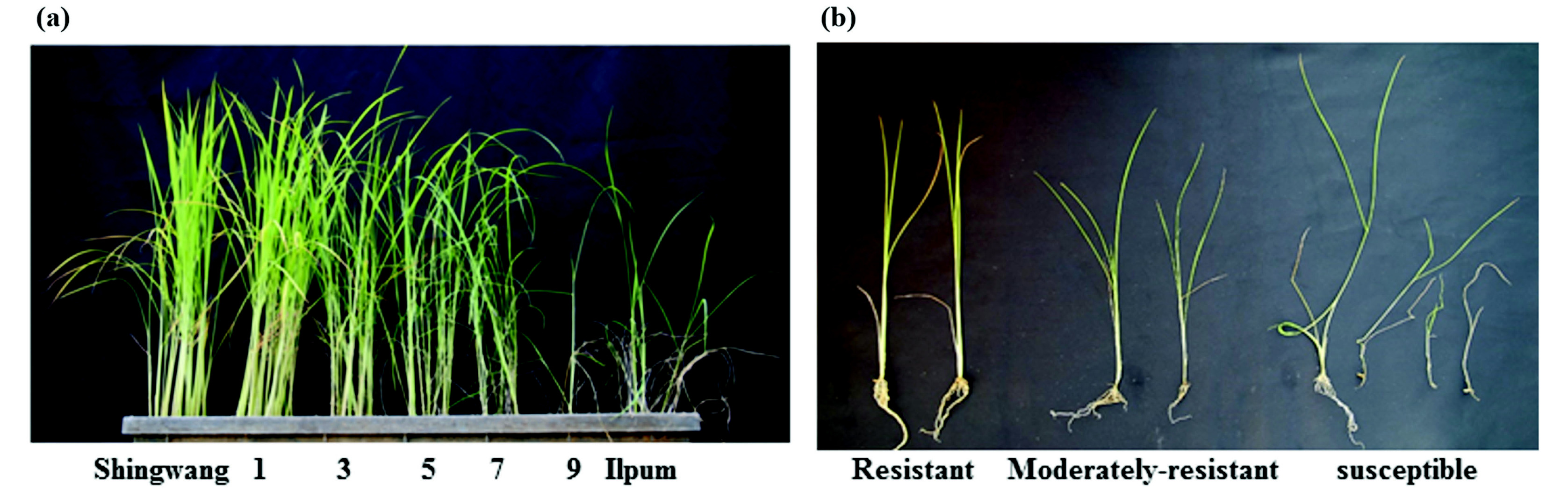
Hur et al. (2016). The response to pathogen was evaluated by calculating the plants showing resistance in each line after rating population`s vitality as 5 levels (1 - resistant to 9 - susceptible)
(
Fig. 1a). In each population, plants hard to find symptoms of bakanae disease were considered as showing resistance (score 1 and 3) whereas plants showed severe irreversible symptoms and died plants are classified as susceptible plant (score 9). Meanwhile, plants which had mildest symptoms were classified as moderately resistant plant (score 5 and 7) (
Fig. 1b). To make their phenotype as numeric data, the resistance of each accession was calculated as (sum of individuals * resistant score; resistance 1, moderate 0.5, susceptible 0)/germinated individuals. The estimated proportion of healthy plants were converted to percentage.
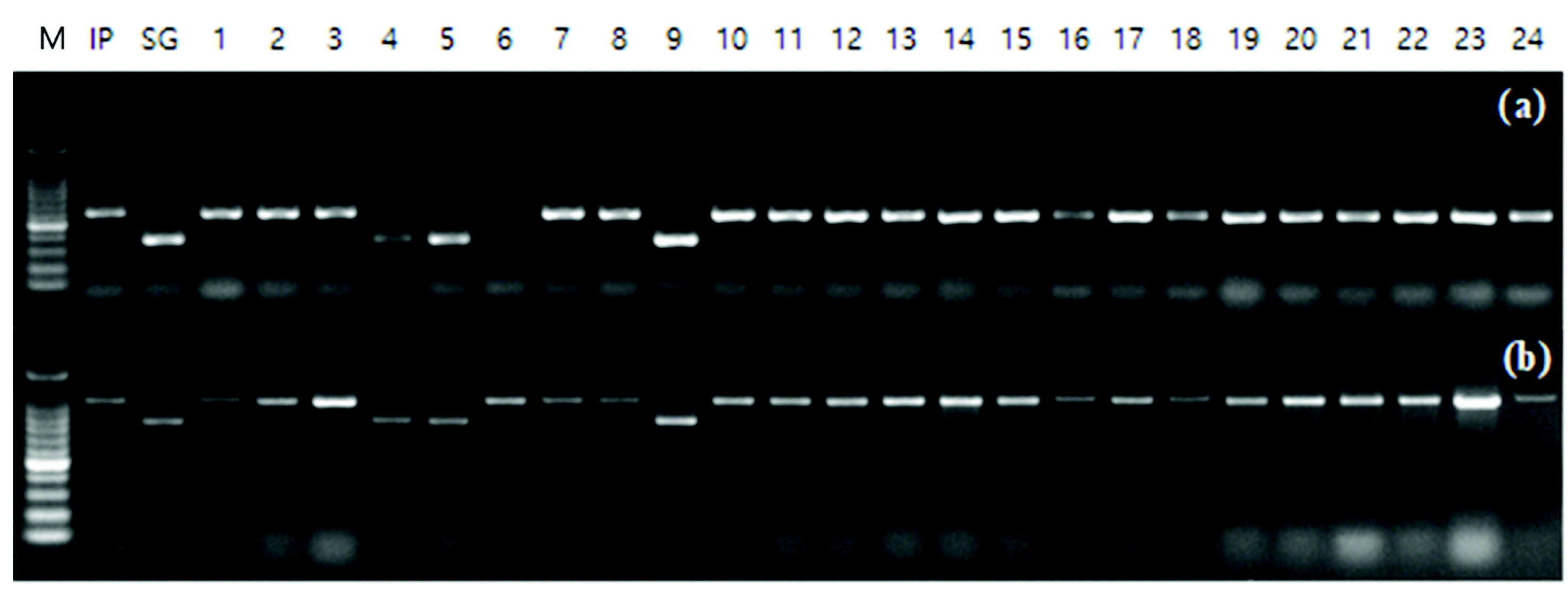
We performed genotype screening of reported primer (
Table 1) with 24 accessions which showed strong resistance (
Table 2)
and control group to identify their genotype and whether it is possible to use the marker for selecting resistant resources from Korean landrace group. The marker used in this experiment is Indel marker from Nampyeong related to
qFfR1 which is located on 87.9-91.7 cM in chromosome 1. Because this QTL share same position with other QTL reported from different accessions belong to other ecotype, it is expected that it will work in broad range of genetic resources (
Hur et al. 2015;
Fiyaz et al. 2016;
Ji et al. 2018).
RESULTS AND DISCUSSION
Evaluation of bakanae disease resistance
Korean rice landrace group which consists of temperate japonica type mainly, could be used as material for developing resistant varieties in Korea by crossing with elite varieties. In this study, we could identify 44 lines involved in highest resistance score. Especially, there were 17 lines which showed resistance rate over 90%. By comparing different traits of these resources, it would be possible to utilize them as material of resistant varieties (
Table 2). However, since Korean rice landraces had been tested only one time, it would be need more precise confirmation. Moreover, to develop stable varieties which can show resistance constantly in various conditions, additional study on landrace resources to identify resistant gene and its mechanism of resistant resource would be required too. To utilize bakanae resistant resource in Korea where normally cultivate temperate japonica type varieties, using accessions belong to temperate japonica type would be recommended. Moreover, to maintain agriculturally useful features like short height and higher grain weight, using bred resource in Korea rather than weedy rice or introduced rice would be recommended too. Thus, the result suggested highly strong 3 acessions (‘IT010631’, ‘IT009118’ and ‘IT009221’. to be used in breeding program. The temperate japonica accessions which showed resistance to bakanae disease included not only Korean accession but also accessions from other countries like China too. Besides, Jeju collections which showed resistance would not be adequate for developing varieties since they are weedy rice. Meanwhile, although ‘Milyang 88’, ‘Namseon 126’, ‘Suweon 159’ have not highly resistant trait, they have better adaptability to Korean agriculture because they are bred line from Korea. To develop useful bakanae resistant varieties efficiently, using these resources as material with existing elite varieties could be a good way.
Markers what we used in this study is related to qBK1, qBK1.1 and qFfR1 (
Table 1). Although these QTLs are discovered from different accessions, they share same position and it support a possibility that the putative gene works in different genetic resources (
Hur et al. 2015;
Fiyaz et al. 2016;
Ji et al. 2018). However, the marker related to them showed discordance with observed traits in Korean rice landrace group which is different with any of accessions that have been used for deriving QTL before (
Table 2,
Fig. 2).
We could identify 3 accessions which showed same genotype with ‘Shingwang’. Compare to other accessions which showed genotype of ‘Ilpum’, these accessions didn’t have significant different bakanae resistance. In the 16 accessions which showed resistance over 90%, only 2 accessions were observed as containing resistant genotype. Moreover, mean resistance of ‘Ilpum’ type accession is lower than ‘Shingwang type’s. This result support that there would be other putative gene related to bakanae resistance and landraces could be novel genetic material for bakanae resistant varieties. Additionally, it would be needed to analysis on their unveiled genes.
ACKNOWLEDGEMENTS
This research was funded by Rural Development Administration, grant number PJ01579403.
Fig. 1Evaluation of resistance to bakanae disease. (a) 1: resistance-9: sensitive. (b) Categoryzing resistant, moderately-resistant, susceptible.
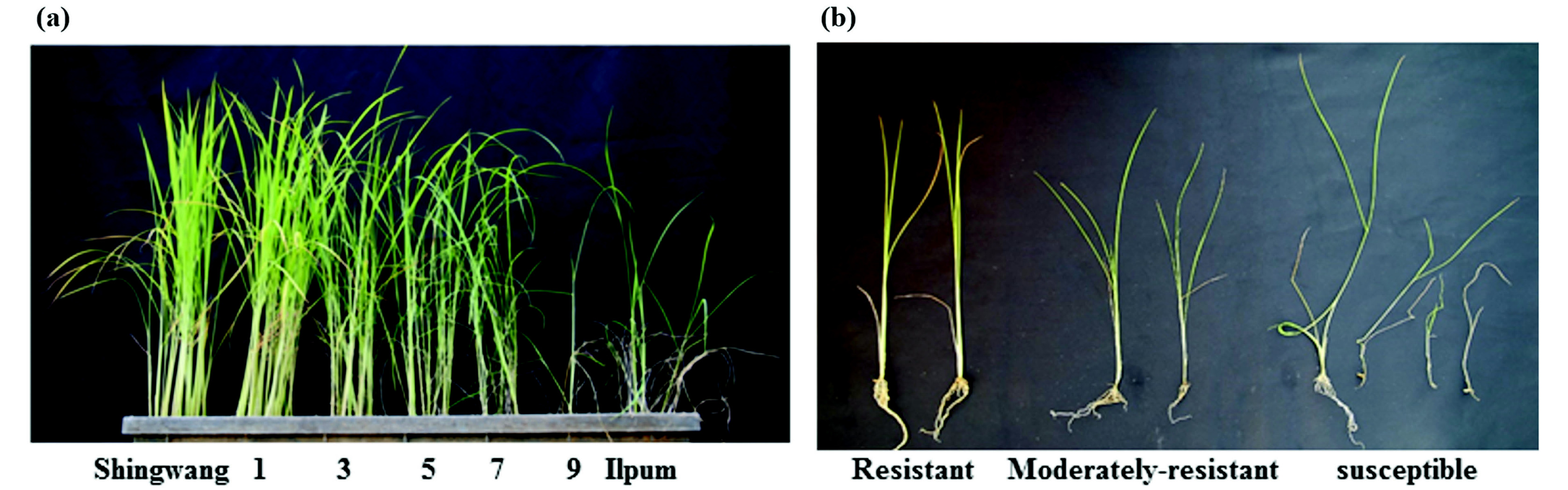
Fig. 2Results from genotype screen of 24 resistant accessions with (a) 1625IND and (b) 1675IND. M: 100bp ladder, IP; ILPUM, SG; SHINGWANG, 1: Taegujo, 2: Guwangdo, 3: Weonsanchalbyeo, 4: Jjokjebichal, 5: Hongdo, 6: Joslbichal, 7: Daejichal, 8: Guhwangdo, 9: Hyoseongjaeraejong, 10: Gangweondo, 11: Daesona, 12: Chanarak, 13: Akkudichal, 14: Baekcheon, 15: Ssalbyeo, 16: Sukna, 17: Cheonjeungdo, 18: Annamjo, 19: Gakssina, 20: Kangnungdo, 21: Jinhwa, 22: Jeokseongna, 23: Sukna, 24: Yongcheon.
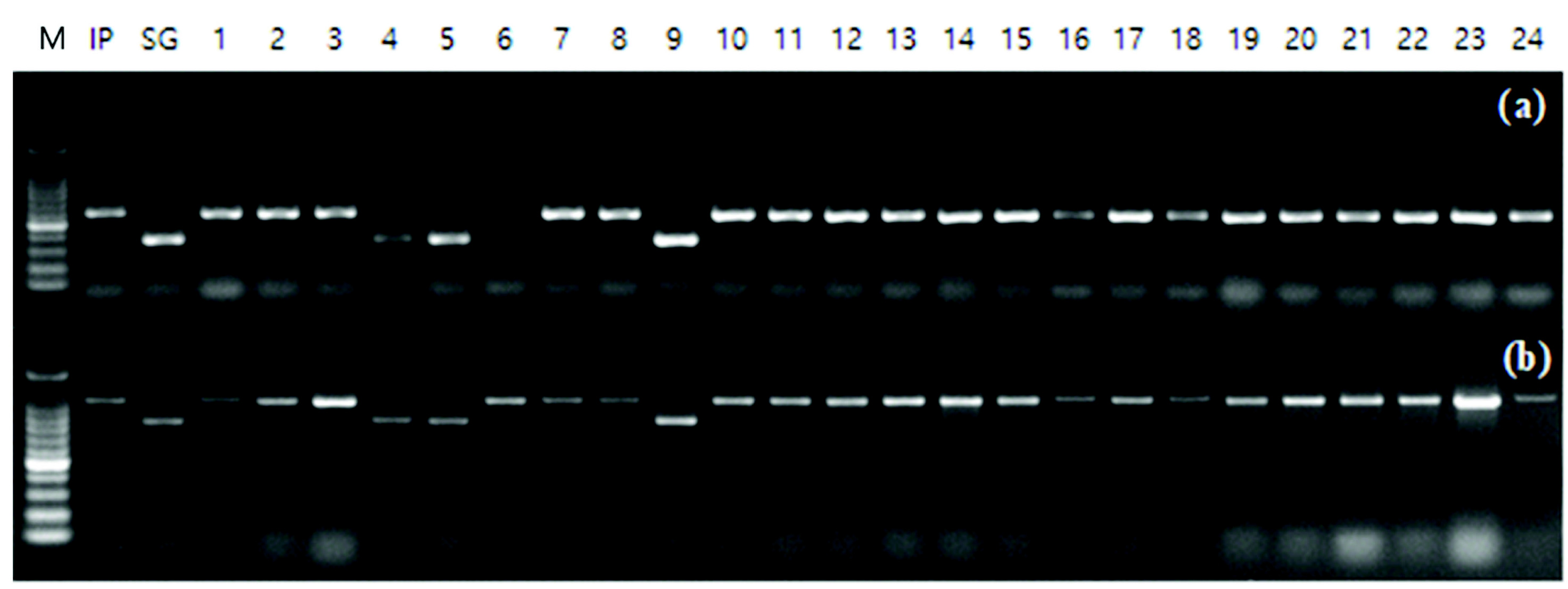
Table 1Sequences of screening resistant genotype to bakanae disease.
Table 1
|
Marker |
Sequence |
Reference |
|
1625IND |
F |
AAACAAGTTGGTTGGCGAGCTAC |
Cheon et al. (2019) |
|
R |
AGATTACGCCTTGGAACCTGTTA |
|
1675IND |
F |
TTTCTACTAAGTCACGTAGCATGCTCC |
|
R |
ATGTTCGTCGTATGCATAGCCAAAC |
Table 2Some agricultural traits of 24 rice landraces with strong resistant to bakanae disease.
Table 2
|
No. |
Name |
IT no. |
Headingdate |
Culm length |
Grain length |
Grain width |
Endosperm type |
Bakanae resistance(%) |
|
1 |
Taegujo |
k026144 |
08월 15일 |
109 |
6.4 |
3.3 |
Normal |
91.3 |
|
2 |
Guwangdo |
IT005044 |
08월 29일 |
124 |
6.2 |
3.4 |
Normal |
94.8 |
|
3 |
Weonsanchalbyeo |
IT151696 |
08월 16일 |
78 |
6.6 |
3.4 |
Waxy |
94 |
|
4 |
Jjokjebichal |
IT010631 |
09월 07일 |
101 |
7.7 |
3.5 |
Waxy |
90 |
|
5 |
Hongdo |
IT009118 |
08월 13일 |
100 |
7 |
3.4 |
Normal |
92.6 |
|
6 |
Joslbichal |
IT155896 |
08월 27일 |
90 |
6.5 |
3.2 |
Normal |
85.7 |
|
7 |
Daejichal |
IT155895 |
09월 08일 |
90 |
6.6 |
3.5 |
Normal |
91.1 |
|
8 |
Guhwangdo |
IT005068 |
08월 16일 |
92 |
7.4 |
3.3 |
Normal |
87.9 |
|
9 |
Hyoseongjaeraejong |
IT009221 |
08월 13일 |
85 |
7.6 |
3.1 |
Normal |
87 |
|
10 |
Gangweondo |
IT004770 |
08월 11일 |
78 |
6.1 |
3.4 |
Waxy |
94.6 |
|
11 |
Daesona |
k026156 |
08월 15일 |
91 |
6.5 |
4 |
Waxy |
87 |
|
12 |
Chanarak |
IT008732 |
08월 26일 |
100 |
6.5 |
3.6 |
Waxy |
86.5 |
|
13 |
Akkudichal |
k026159 |
08월 29일 |
106 |
7.1 |
3.3 |
Waxy |
100 |
|
14 |
Baekcheon |
IT006385 |
08월 02일 |
90 |
7 |
3.6 |
Normal |
92.6 |
|
15 |
Ssalbyeo |
IT006578 |
08월 23일 |
109 |
6.1 |
3.2 |
Normal |
93.3 |
|
16 |
Sukna |
IT007274 |
08월 25일 |
112 |
6.3 |
3.2 |
Normal |
91.4 |
|
17 |
Cheonjeungdo |
IT008804 |
08월 27일 |
125 |
6.7 |
3.6 |
Normal |
91.4 |
|
18 |
Annamjo |
IT007464 |
08월 24일 |
100 |
6.8 |
3.2 |
Waxy |
94.2 |
|
19 |
Gakssina |
k026169 |
08월 04일 |
83 |
6.6 |
3.3 |
Waxy |
93.8 |
|
20 |
Kangnungdo |
k026171 |
09월 02일 |
102 |
6.8 |
3.3 |
Waxy |
96.7 |
|
21 |
Jinhwa |
IT008725 |
08월 29일 |
106 |
6.1 |
3.4 |
Waxy |
88.3 |
|
22 |
Jeokseongna |
k026175 |
08월 26일 |
110 |
6.5 |
3.2 |
Waxy |
91.1 |
|
23 |
Sukna |
IT007270 |
08월 29일 |
109 |
6.1 |
3.3 |
Waxy |
92.6 |
|
24 |
Yongcheon |
IT007747 |
08월 15일 |
120 |
7.2 |
3.4 |
Waxy |
88.5 |
References
- Camacho Villa T, Maxted N, Scholten M, Ford-Lloyd B. 2005. Defining and identifying crop landraces. Plant Gen Res.. 3: 373-384.
- Cheon KS, Jeong YM, Lee YY, Oh J, Kang DY, Oh H, et al. 2019. Kompetitive Allele-Specific PCR Marker Deve-lop-ment and Quantitative Trait Locus Mapping for Bakanae Disease Resistance in Korean Japonica Rice Varieties. Plant Breed. Biotech.. 7: 208-219.
- Fiyaz AR, Yadav AK, Krishnan SG, Ellur RK, Bashyal BM, Grover N, et al. 2016. Mapping quantitative trait loci responsible for resistance to Bakanae disease in rice. Rice. 9: 1-10.
- Han S. 2007. Review of disease occurrence of major crops in Korea in 2007. Proc. Annu. Fall Meeting Symposium KSPP. pp. 19-20.
- Hayasaka T, Ishiguro K, Shibutani K, Namai T. 2001. Seed disinfection using hot water immersion to control several seed-borne diseases of rice plants. Japanese J. Phytopathol. 67: 26-32.
- Hur YJ, Lee SB, Kim TH, Kwon T, Lee JH, Shin DJ, et al. 2015. Mapping of qBK1, a major QTL for bakanae disease resistance in rice. Mol. Breed.. 35: 1-9.
- Hur YJ, Lee SB, Shin DJ, Kim TH, Cho JH, Han SI, et al. 2016. Screening of rice germplasm for Bakanae disease resistance in rice. Korean J. Breed. Sci.. 48: 22-28.
- Iqbal M, Javed N, Sahi ST, Cheema NM. 2011. Genetic management of bakanae disease of rice and evaluation of various fungicides against Fusarium moniliforme in vitro. J. Phytopathol.. 23: 103-107.
- Ishii H, Takeda H. 1989. Differential binding of a N-phenylformamidoxime compound in cell-free extracts of benzimidazole-resistant and-sensitive isolates of Venturia nashicola, Botrytis cinerea and Gibberella fujikuroi. Neth. J. Plant Pathol.. 95: 99-108.
- Ji H, Kim TH, Lee GS, Kang HJ, Lee SB, Suh SC, et al. 2018. Mapping of a major quantitative trait locus for bakanae disease resistance in rice by genome resequencing. Mol. Genet. Genom.. 293: 579-586.
- Khokhar LK, Jaffrey AH. 2002. Largescale screening of rice accessions to evaluate resistance to bakanae disease. J. Gen. Plant Pathol. 80: 408-414.
- Kim MH, Hur YJ, Lee SB, Kwon TM, Hwang UH, Park SK, et al. 2014. Largescale screening of rice accessions to evaluate resistance to bakanae disease. J. Gen. Plant Pathol.. 80: 408-414.
- Kwon SJ, Ahn SN, Suh JP, Hong HC, Kim YK, Hwang HG, et al. 2000. Genetic diversity of Korean native rice varieties. Korean J. Breed.. 32: 186-193.
- Lee YH, Kim SY, Choi HW, Lee MJ, Ra DS, Kim IS, et al. 2010. Fungicide resistance of Fusarium fujikuroi isolates isolated in Korea. Korean J. Pestic. Sci.. 14: 427-432.
- Lee YH, Lee MJ, Choi HW, Kim ST, Park JW, Myung IS, et al. 2011. Development of in vitro seedling screening method for selection of resistantrice against bakanae disease. Res. Plant Dis.. 17: 288-294.
- Li D, Luo K, Chen Z. 1993. Studies on resistance of rice varieties to bakanaedisease and pathogenicity of pathogen Fusarium moniliforme. Acta Phytopathologica Sinca. 23: 315-319.
- Ou SH. 1985. Rice diseases, 2nd edn. Commonwealth Mycological Institute, Kew. pp. 247-256.
- Park HG, Shin HR, Lee Y, Kim SW, Kwon OD, Park IJ, et al. 2003. Influence of water temperature, soaking period, and chemical dosage on Bakanae disease of rice (Gibberella fujikuroi) in seed disinfection. Korean J. Pestic. Sci.. 7: 216-222.
- Rajagopalan K. 1961. Screening of rice varieties for resistance to foot-rot disease. Curr. Sci.. 30: 145-147.
- Volante A, Tondelli A, Aragona M, Valente MT, Biselli C, Desiderio F, et al. 2017. Identification of bakanae disease resistance loci in japonica rice through genome wide association study. Rice. 10: 1-16.
- Yasin SI, Khan TZ, Akhtar KM, Muhammad A, Mustaq A. 2003. Economic evaluation of bakanae disease of rice. Mycopath. 1: 115-117.
Citations
Citations to this article as recorded by

- Genome-Wide Association Study to identify Bakanae disease resistance-related QTLs carrying novel candidate genes in rice (Oryza sativa L.)
Yuting Zeng, Fang-Yuan Cao, Ah-Rim Lee, Dongryung Lee, Backki Kim, Soon-Wook Kwon
npj Science of Plants.2025;[Epub] CrossRef - Current insights on rice (Oryza sativa L.) bakanae disease and exploration of its management strategies
Chinnannan Karthik, Qingyao Shu
Journal of Zhejiang University-SCIENCE B.2023; 24(9): 755. CrossRef - Evaluation of Major Rice Varieties for Bakanae Disease Resistance in Korea
Sais-Beul Lee, Ju-Won Kang, Ji-Yoon Lee, Gi-Un Seong, Youngho Kwon, So-Myeong Lee, Nkulu Rolly Kabang, Jun-Hyeon Cho, Seong-Hwan Oh, Dongjin Shin, Jong-Hee Lee, Ki-Won Oh, Dong-Soo Park
Korean Journal of Breeding Science.2023; 55(2): 103. CrossRef