Abstract
Phytophthora sojae is a soil-borne oomycete that causes both pre- and post-emergence damping-off disease in soybean that are present in poorly drained soils. Phytophthora root and stem rot of soybean has become an emerging threat to soybean production in South Korea as soybean cultivation in paddy fields has increased recently. The cultivar Daewon was identified as a genetic source for resistance to P. sojae isolate 2457; moreover, a 573 kb resistance locus was previously mapped on chromosome 3 via linkage analysis using Daepung × Daewon recombinant inbred line (RIL) population. This study aimed to develop a gene-based molecular marker associated with P. sojae resistance using single nucleotide polymorphisms (SNPs) at this locus. Three sets of single nucleotide amplified polymorphism (SNAP) markers were initially designed based on genic SNPs in the identified genomic region. Of these, the marker SNAP-Set2 successfully worked for allele-specific amplification for the respective Daepung and Daewon, as well as 20 RILs derived from crosses of the two cultivars. To validate this marker, 11 soybean germplasms were randomly selected and genotyped, which resulted in reliable allele-specific amplification that agreed with the 180 K Axiom® SoyaSNP array data. Phenotypic evaluation of the 20 RILs and the 11 germplasms subsequently demonstrated that Daepung-type and Daewon-type for the SNAP-Set2 are both associated with susceptibility and resistance to P. sojae isolate 2457. The availability of a molecular marker linked to this resistance locus would expedite the use of this valuable resistance allele in soybean breeding programs for increased resistance to P. sojae.
-
Key words: Single nucleotide amplified polymorphism (SNAP), Allele specific amplification, Soybean, Resistance to Phytophthora sojae
INTRODUCTION
Marker-assisted selection can improve the efficiency of plant breeding process, especially for single-gene-mediated traits, by facilitating selection of the introgression of valuable genes into elite lines. Currently, several types of molecular markers, based on allele-specific amplifi-cation in a single nucleotide polymorphism (SNP) site, are widely used in marker-assisted selection. Previously, polymerase chain reaction (PCR) and gel electrophoresis-based methods such as single nucleotide amplified polymorphism (SNAP) and PCR amplification of multiple specific allele (PAMSA) markers were developed based on SNPs; these have subsequently been used in genotyping or marker-assisted breeding (
Kim et al. 2005;
Li et al. 2013). Recently, sensitive, automated, and rapid genotyping tools such as high-resolution melting (HRM) curves, Kompetitive allele specific PCR (KASP), and TaqMan markers have been all utilized for the detection of polymorphisms and variants (Dong
et al. 2016; Aylaew
et al. 2019;
Lee et al. 2021).
Phytophthora root and stem rot (PRR), caused by
Phytophthora sojae, is a major soil-borne oomycete pathogen that can infect soybean (
Glycine max L.) plants. Since PRR was first identified in 1996 in Chungnam province in South Korea (
Jee et al. 1998), it has been a threat to soybean production in wet soybean fields.
Kang et al. (2019) first reported that the cultivar Daewon is resistant to
P. sojae isolate 2457. Subsequently,
Jang et al. (2020a) identified a resistance gene locus ranging 573 kb on chromosome 3 in the Daepung × Daewon population. This genomic region includes 14 annotated genes associated with disease resistance according to the reference soybean gene annotation Glyma.Wm82.a2.v1 (accessed at
http://soybase.org). The objective of this study was to develop a gene-based molecular marker using the identified SNPs in the target genomic region identified in
Jang et al. (2020a), which will facilitate marker-assisted selection (MAS) for resistance to
P. sojae in future soybean breeding programs.
MATERIALS AND METHODS
Plant materials
In the previous study, a major resistance locus for resistance to
P. sojae was identified via linkage analysis using the Daepung × Daewon RIL population (
Jang et al. 2020a). In this study, the two parental genotypes, Daepung and Daewon, as well as 10 resistant and 10 susceptible RILs were used for the initial tests of the designed primers and in the optimization (see the section
Optimization of PCR for allele specific amplification). Additionally, 11 randomly selected cultivated soybean germplasms, unrelated to the RILs, were utilized for validation of the developed marker via both genotypic and phenotypic assays.
Three genic SNPs between Daepung and Daewon were found in the 573 kb genomic region (approximately 3.9-4.5 Mbp) previously reported in
Jang et al. (2020a) (
Table 1). Pairs of allele-specific primers were designed based on the selected SNP. Pairs of primers for SNAP markers were designed using the web-based allele-specific primer (WASP) design tool (accessed at
https://bioinfo.biotec.or.th/WASP/) (
Wangkumhang et al. 2007) (
Table 2). To increase the discriminative force, primer-template mis-matches were made at the 3′-end region for allele-specific primers.
The DNA of each genotype was extracted from a single young leaf of each genotype using the cetyl trimethyl ammonium bromide (CTAB) method. Then, the concentrations of DNA samples were normalized to 20 ng/mL before use in subsequent experiments.
PCR was conducted in a SimpliAmpTM thermal cycler (Thermo Fisher Scientific, Waltham, MA, USA) with a final volume of 20 mL, including 20 ng genomic DNA, 0.25 mM forward primer, 0.25 mM reverse primer, 0.2mM dNTP, 1X SG-Taq buffer, and 1U SG-Taq polymerase (SmartGene, Daejeon, South Korea). For the optimization of the allele specific amplification, PCR was conducted as follows: initial denaturation at 95℃ for 2 minutes, 28 cycles of denaturation at 95℃ for 30 seconds, annealing at 58-62℃ for 30 seconds, and extension at 72℃ for 30 seconds, and a final extension at 72℃ for 5 minutes. Amplified PCR products were first resolved on a 2% agarose gel (VWR International LLC, Radnor, PA, USA) with DNA-staining BANDi load (SmartGene, Daejeon, South Korea). After electrophoresis, the gels were visualized under UV light. After optimization, an annealing temperature of 61℃ was applied to the subsequent PCRs for RILs and other germplasms.
Evaluation of resistance to Phytophthora sojae
Eleven soybean germplasms were used to validate the marker developed in this study. The selected soybean germplasms were examined for resistance to
P. sojae using the hypocotyl inoculation (
Dorrance et al. 2004). Up to 15 seedlings were grown in a 13 cm diameter pot filled with soil.
P. sojae was cultivated on a V8 medium approximately 10 days before inoculation.
P. sojae-grown V8 media were macerated twice using a 50 mL syringe and then transferred into a 10 mL syringe. A 1 cm cut was made on the hypocotyl of the seedlings, and a mycelial slurry of 0.2-0.4 mL was placed into the slit. The inoculated seedlings were incubated overnight (approximately 16 hours) in dark and humid conditions. The seedlings were then placed in a growth chamber [14/10 hours (day/night) cycle, temperature 25℃, and humidity > 70%] until re-actions were observed 7 days after inoculation. The reaction of each genotype was determined as the percentage of the number of seedlings killed. The reaction was determined resistant if < 20% died, susceptible if > 80% died, or intermediate if 20 to 80% died. This experiment was performed in triplicates.
RESULTS AND DISCUSSION
Jang et al. (2020b) listed SNP and simple sequence repeat (SSR) markers that have been previously reported to be associated with resistance to
P. sojae. Most of these are simply flanking markers of the identified genomic regions, while only a few SNPs of them are located on the soybean annotated genes according to Glyma.Wm82.a2.v1 (accessed at
http://soybase.org). Therefore, the development of gene-based markers can be important for the selection of breeding materials regarding
P. sojae resistance as well as for the molecular evaluation of germplasms in the pre-breeding process.
Of the 14 SNPs in the 573 kb region (3,893,390-4,466,635 bp) (
Jang et al. 2020a), four were located within three annotated genes (
Table 1). Two sets of SNAP markers were designed for each of three SNPs, except AX-90503215, to amplify either the Daepung-type (DP-type) allele or Daewon-type (DW-type) allele (
Table 2). The designed primers were initially tested at different annealing temperatures (58-62℃) to determine the optimum conditions for PCR. The two sets (Set1 and 2) of primers designed for AX-90360753 resulted in allele-specific bands for either the DP type or DW-type; however, the other four sets of primers failed to amplify any PCR products at all the tested temperatures (data not shown). AX-90503215 was ignored, because it was difficult to design a set of appropriate primers based on its flanking sequences.
Of the two sets of primers, SNAP-Set1 had a lower allele specificity than SNAP-Set2. Set1G and Set1A were expected to produce amplicons only for the DP-type allele and DW-type allele, respectively. However, the band amplified by Set1G was also shown in Daewon; indicating that Set1G lacks allele specificity for the DP-type. Consequently, the SNAP-Set2 marker was considered to be the most suitable marker (data not shown). Subsequently, an annealing temperature of 61℃ was determined for this marker set, which provided the most discriminative amplification.
SNAP-Set2 was tested for the RILs derived from Daepung × Daewon population. A total of 20 RILs were selected based on the reaction against
P. sojae isolate 2457 and the corresponding Axiom
Ⓡ 180 K SoyaSNP array data. These included RILs with either DP-type or DW-type allele for the target SNP, AX-90360753. As shown in
Fig. 1, PCR amplification using SNAP-Set2 was allele-specific and completely agreed with the respective parental genotypes. DP-type RILs were only amplified by SNAP-Set2G, whereas DW-type RILs were only amplified by SNAP-Set2A.
To validate the SNAP-Set2 marker, 11 genotypes, which were not a part of the Daepung × Daewon population, were used for genotypic and phenotypic assays. For the marker, allele-specific amplification was successful in all 11 genotypes, including 6 DP-type (“G” allele) and 5 DW-type (“A” allele) (
Fig. 2;
Table 3), which agreed with the Axiom
Ⓡ 180 K SoyaSNP array data. The 11 genotypes were also assayed to confirm the association between the marker genotype and the resistance to
P. sojae isolate 2457. All 11 genotypes displayed resistant or susceptible reactions, as expected by the marker genotype “A” or “G” (
Table 3). There results confirmed that the SNAP-Set2 marker is a potential molecular marker that can be used for the selection of a resistance allele for the target locus on chromosome 3.
Mismatches located in the 3′ end region (generally, within the last 5 nucleotides) of a primer provide markedly larger effects on the priming efficiency compared to those in the 5′ end (
Stadhouders et al. 2010). Consequently, primer-template mismatches are often helpful in allele-specific PCRs (
Stadhouders et al. 2010). Using this approach, in this study, one SNAP marker was successful in distinguishing between different nucleotides. It could be used as an important tool for modern molecular diagnostics.
In summary, an allele-specific SNAP marker was developed based on a SNP on an annotated gene located in the target resistance gene locus. The performance of this marker was confirmed in Daepung, Daewon, and the 20 RILs. The detection of variants was further validated with additional soybean germplasms unrelated to either Daewon or Daepung. For these germplasms, moreover, the expected phenotypes by the SNAP marker all concurred with the actual phenotypes following inoculation of P. sojae isolate 2457. The use of the developed marker could facilitate the selection or introgression of the Daewon-originating resistance locus on chromosome 3 in soybean breeding programs to provide resistance to P. sojae.
ACKNOWLEDGEMENTS
This research was funded by a grant from the Chungnam National University.
Notes
-
CONFLICT OF INTEREST
The authors declare that there is no conflict of interest.
Fig. 1Allele-specific amplification of the marker SNAP-Set2 in the Daepung (DP), Daewon (DW), and RILs.
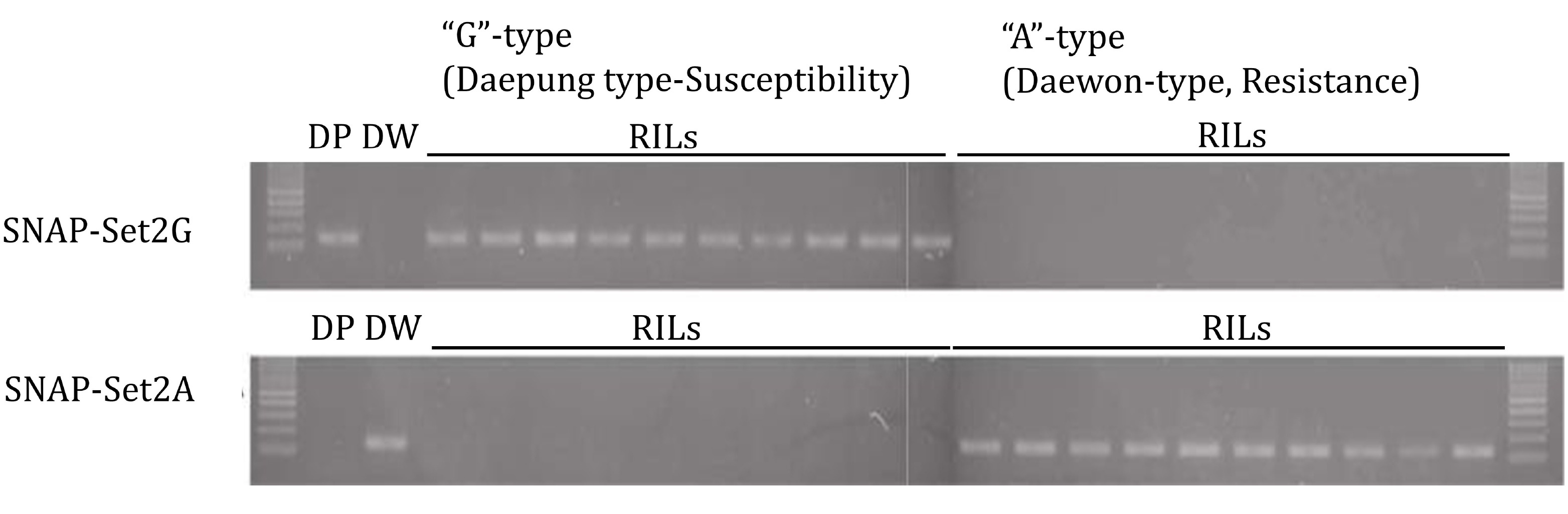
Fig. 2Validation of the SNAP-Set2 for selected soybean germplasms. 1, Shinlok; 2, Nokwon; 3, Yeonpung; 4, Sinpaldal2; 5, Nampung; 6, Myungjunamul; 7, CS01964; 8, Kwangkyo; 9, Sukye#43; 10, SLSB406-2; and 11, KLS77170.
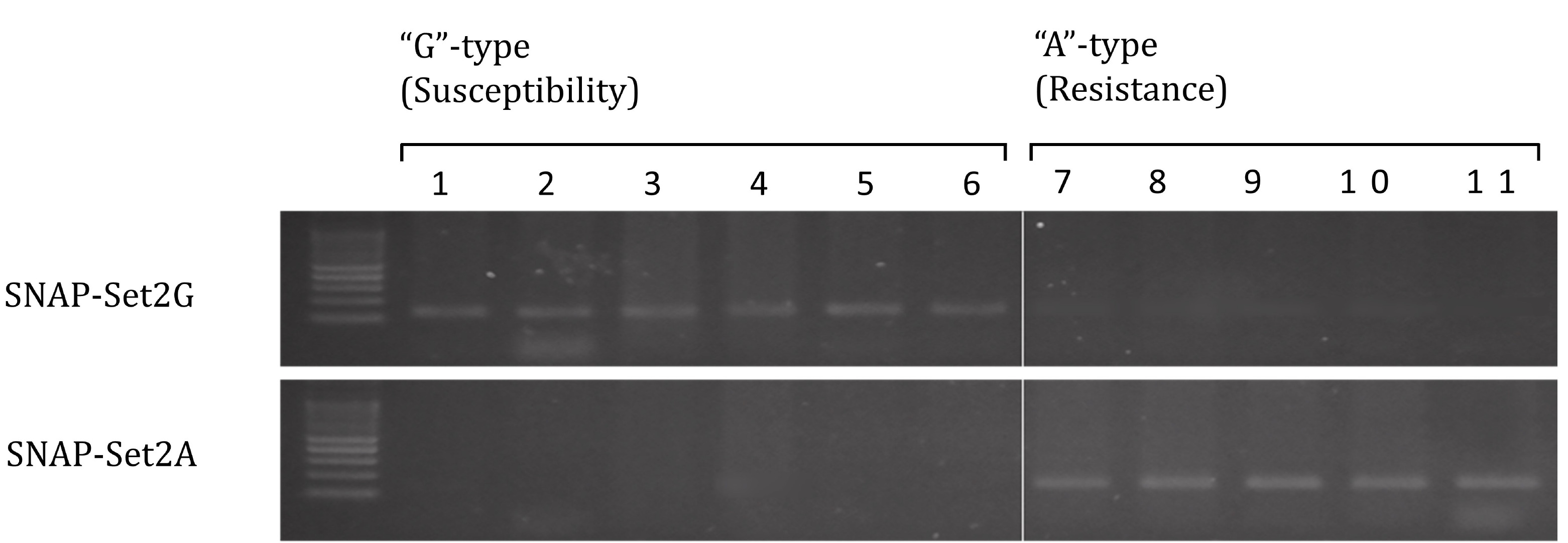
Table 1Three genic single nucleotide polymorphisms (SNP) of the target resistance locus on chromosome 3 reported in
Jang et al. (2020a).
Table 1
|
SNPz)
|
Position (bp)y)
|
Allele (DP/DW)x)
|
Gene modelw)
|
Gene annotationw)
|
Amino acid substitution |
|
AX-90360753 |
3,990,383 |
G/A |
Glyma.03g034200 |
LRR protein family |
Arginine/Lysine |
|
AX-90503215 |
4,200,520 |
A/G |
Glyma.03g034900 |
NB-ARC domain |
Threonine/Isoleucine |
|
AX-90337768 |
4,325,664 |
G/A |
Glyma.03g035900 |
MAC/Perforin domain |
Synonymous change |
|
AX-90385376 |
4,328,363 |
G/A |
Intron |
Table 2Primer sequences of single nucleotide amplified polymorphism (SNAP) markers.
Table 2
|
SNP |
Primer ID |
Target alleles |
Common primer (5′ → 3′) |
Allele-specific primers (5′ → 3′) |
Expected product size (bp) |
|
AX-90360753 |
Set 1G |
G |
TTCTTTTTGGTCCAATCCTA |
CCATCAAGAACAAGAGAAGATACAC |
202 |
|
Set 1A |
A |
CCATCAAGAACAAGAGAAGATACAT |
|
Set 2G |
G |
GATAATGTTCAAGGCTGGTC |
CATCAAGAACAAGAGAAGATACAC |
137 |
|
Set 2A |
A |
CATCAAGAACAAGAGAAGATACGT |
|
AX-90337768 |
Set 3G |
G |
GGTTTATCTGTGCGTGAAAT |
TCTGTCCTATAACTGATCTCCTTGCC |
199 |
|
Set 3A |
A |
TCTGTCCTATAACTGATCTCCTTGCT |
|
Set 4G |
G |
CATACAGGTTCCTTCCTTTG |
CTGTCCTATAACTGATCTCCTTGCC |
300 |
|
Set 4A |
A |
CTGTCCTATAACTGATCTCCTTGCT |
|
AX-90385376z)
|
Set 5G |
G |
GAAATGTCAAAAAGGCTGTC |
AAATGTAATTAAAAAGTCAGGAAAG |
129 |
|
Set 5A |
A |
AAATGTAATTAAAAAGTCAGGAAAA |
|
Set 6G |
G |
TGGGAGTTTTAATTCTGCAT |
AATGTAATTAAAAAGTCAGGAAAG |
265 |
|
Set 6A |
A |
AATGTAATTAAAAAGTCAGGAAAA |
Table 3Validation of the marker SNAP-Set2 by comparison between the marker genotypes and phenotypic reactions-following inoculation of Phytophthora sojae isolate 2457.
Table 3
|
Name of germplasm |
180K AxiomⓇ SoyaSNP array |
SNAP-Set2 marker |
Reaction to P. sojae isolate 2457 |
|
Daepung (check) |
G |
G |
Susceptible |
|
Shinlok |
G |
G |
Susceptible |
|
Nokwon |
G |
G |
Susceptible |
|
Yeonpung |
G |
G |
Susceptible |
|
Sinpaldal2 |
G |
G |
Susceptible |
|
Nampung |
G |
G |
Susceptible |
|
Myungjunamul |
G |
G |
Susceptible |
|
Daewon (check) |
A |
A |
Resistant |
|
CS01964 |
A |
A |
Resistant |
|
Kwangkyo |
A |
A |
Resistant |
|
Sukye#43 |
A |
A |
Resistant |
|
SLSB406-2 |
A |
A |
Resistant |
|
KLS77170 |
A |
A |
Resistant |
References
- Ayalew H, Tsang PW, Chu C, Wang J, Liu S, Chen C, et al. 2019. Comparison of TaqMan, KASP and rhAmp SNP genotyping platforms in hexaploid wheat. PLoS One. 14: e0217222
- Dorrance A, Jia H, Abney T. 2004. Evaluation of soybean differentials for their interaction with Phytophthora sojae. Plant Health Prog.. 5: 9
- Jang IH, Kang IJ, Kim JM, Kang ST, Jang YE, Lee S. 2020a. Genetic mapping of a resistance locus to Phytophthora sojae in the Korean soybean cultivar Daewon. Plant Pathol. J.. 36: 591-599.
- Jang IH, Lee S. 2020b. A review and perspective on soybean (Glycine max L.) breeding for the resistance to Phytophthora sojae in Korea. Plant Breed. Biotech.. 8: 114-130.
- Jee H, Kim W, Cho W. 1998. Occurrence of Phytophthora root rot on soybean (Glycine max) and identification of the causal fungus. RDA J. Crop Prot.. 40: 16-22.
- Kang IJ, Kang S, Jang IH, Jang YW, Shim HK, Heu S, et al. 2019. Identification of new isolates of Phytophthora sojae and the reactions of Korean soybean cultivars following hypocotyl inoculation. Plant Pathol. J.. 35: 698
- Kim MY, Van K, Lestari P, Moon JK, Lee SH. 2005. SNP identification and SNAP marker development for a GmNARK gene controlling supernodulation in soybean. Theor. Appl. Genet.. 110: 1003-1010.
- Lee JW, Chin JH, Yoo SC. 2021. Development of Kompetitive allele specific PCR markers for anaerobic germination 1 locus in Rice. Plant Breed. Biotech.. 9: 20-31.
- Lee YG, Jeong N, Kim JH, Lee K, Kim KH, Pirani A, et al. 2015. Development, validation and genetic analysis of a large soybean SNP genotyping array. Plant J.. 81: 625-636.
- Li L, Tacke E, Hofferbert HR, Lübeck J, Strahwald J, Draffehn AM, et al. 2013. Validation of candidate gene markers for marker-assisted selection of potato cultivars with improved tuber quality. Theor. Appl. Genet.. 126: 1039-1052.
- Panpan D, Koeun H, Muhammad IS, Kim JK, Meiai Z, Fu W, et al. 2016. Gene-based markers for the Tomato yellow leaf curl virus resistance gene Ty-3. Plant Breed. Biotech.. 4: 79-86.
- Stadhouders R, Pas SD, Anber J, Voermans J, Mes THM, Schutten M. 2010. The effect of primer-template mismatches on the detection and quantification of nucleic acids using the 5′ nuclease assay. J. Mol. Diagn.. 12: 109-117.
- Wangkumhang P, Chaichoompu K, Ngamphiw C, Ruangrit U, Chanprasert J, Assawamakin A, et al. 2007. WASP: a web-based allele-specific PCR assay designing tool for detecting SNPs and mutations. BMC Genomics.. 8: 275