Skip to main navigation Skip to main content
  • KSBS
  • E-Submission

Plant Breed. Biotech. : Plant Breeding and Biotechnology

OPEN ACCESS
ABOUT
BROWSE ARTICLES
EDITORIAL POLICIES
FOR CONTRIBUTORS

Articles

Research Article

Development of Molecular Markers for Distinguishing Onion (Allium cepa L.) and Welsh Onion (A. fistulosum L.) Based on Polymorphic Mitochondrial Genome Sequences

Plant Breeding and Biotechnology 2019;7(2):151-160.
Published online: June 1, 2019

Department of Horticulture, Biotechnology Research Institute, Chonnam National University, Gwangju 61186, KoreaJFIFddDuckydqhttp://ns.adobe.com/xap/1.0/ Adobed     ! 1AQa"q 2#w8B36v7XRr$9bCt%u&Ws'(xy4T5fH  !1AQaq"2B Rbr#u67Ѳ3sTt5v8Sc$4ĂCÔ%UӅFV ?_Aנj- H>>,m*>fzp"TrKkr^r.|_&]|*vPuܶvoQ1mwVJUhu-I"=LniAƕ8"۲ k*ҿ[yu:.vUQ+)%F DHyVBk>Hy8jݹ q~9D4KRmzQ)^ʔ.J%k_tVi5NTjg!'ky|5asOȻ)R۸ߩFMԿ3L4j6dڜ#NIwUF]JqB/(FafJRzq3\G՛ ?~\ 6)6W4m[O^L0E&rRMض*C .]Unl-1 1r#Rj/&QɈ׉˩s6Rj=5Tg.y.·Pӡ:JJS:C8-2u]d&vUz;7p9 5VnL֢"y)">iי(IDDd| Yj0; LRfS:ktYK%*N2^m|&dğth":ey)uPQZW)gcC3Pv&MMWd&Ŵ۲mvTRoժM03*F3Yd6\8,\hݻ kߔi<k NTwSԪmljj[>->ptU%'LR>&EBH$MQAUx[$Z6vi&_a.KIQ{hyƒ j"JOC9eFҝfj;˚Ω<[3_m% lQ@4g=5$(J]Yc-OMq<Ǎ wSzڗ)k$7VIP붾ͯnV+卵*t]iЎD31~SA1éC2u)ʼnQn-Uoi3:grI8ؓWm*G zܕ)ZקJ}Y YlGeJ6cB2I NS3Q>k=KTBT]W6+SOXQgGR? telˊ%-Re\hѯ2TF"C/OJΩ6r[N.0{SpljjX1“jOsӥ;ҭhe}xu`Ք&.)yO̒ Fߑ.$Qw;9Iw2o+RVJMSOj[SoҌZ%;`d$blQ{Ro{Imڌ>3egf\O֝Uzx"䢸g+mv%Gʆ:|V[N'&ס-ޝ'kfE|K,G&˳98Juin/\\Qݿ̋v~Ǩ!rtWU d|E߫R4d}.qPw*Ӭv5YEcn~f5c%MTMkb-F>5JT,})QHg%{("ӔȸWMsYyWNRrkkJr0XドnͫT}r-jj,Ŕʍ\Q2Ri>v$5!]"JB2WɅ)]VԜUc8i|.jeRO6^V.¸ Q&#|ܶ-*uOG%JAtRZRr]FFG\۩w+?'zչSѧt jz>KW&ot{7P&2D;&\\>Q2JzܗAKSfeNn[jRrԕf6,q,F1tRfԗ>vֶևj-&R'Zi2=xv~Elbsvm8=ӛ"ū񕜈BȩlWau[]ٷBߨF~J!|Ipr3R̴#Yp)={7:G{+:\W}n|Q#%)7^-h"Ƒq:M*%J&$T軨I333׎g_- ucBwwjp[6i25$̏bU’ٱRv?G\~#Iͪb7<<}Ezt" q_Inw,7-d,G÷%T* Wg1"䥱kq/A.,_KhqŒxwvo u2ۥۧ.bQ}XκA$֣ +K״ZUNmڸII{.v{5z5ѮRme[moyƾd~cRݾK'j.\i&/S6f|b=5: p!6i_ 4j6=.si˧eƾtS^c.Y^RJVS-Vi3,esi08?H$GvZgg?gi䤟2adw릿:"۪lkSN>q-4kI܋ێe̊qۅgDoѨ9; #T.Q;7#~_Ufstb_'w~Xw1Xk,vcOt._}v}8"(4Z\ۘgk?J?bm_c!g{HZV]Fkk%~gEt)b秴vΰB|꽸}mp~E6ݹv;7P٤v+ri*3Ԣ|'O14_~7nP{7ZU\Vű[ +7󖱅o#:ǥŬ\|3r%TJX]V7ez¨Y]lc|O3V! R zbJ'PnGqVJ"19WVeOF埜EaEJωqCN5Z g-9[S<$sUK5b|7sn\7x qmv##FF\ w[=-43$^ooVSiXօv7iB۴yg>]Vf"r$J3""32!Zh[K%7GvNLs+4nB/B{vlsobJaҺJR:0g%&zR\ S3T[&ִor*ⷳc3ʊO[iozW٨%$gn:ܶWwFBԹjHP&z u&F2\f;ipW73 [; '_̽b;vib!oec dC-tS__$Xs]l9&z$2/N>%'[}b{h/{`{Ji׉׏ YJB/X%}.|+{(S:qz]4_Kѵo`^tY_4S#* ^zvݾMr+TrkQ g.8Ͽ^i>ӈǙvix>$o( ^qt*&t1oJVu-ql5U6jCЉmĻ*"?JT=K'O/|=Vo}l0b}}f?X[?/\JSBe,kP8ETJ==?.p5ފgbU9}ǶdNKk—_$8̸͓ۍ8Di\BԿ-1v{FF]|.^ۅ{vl12׏z7-R7wE?\nh\jN/Kձr_oBw"N QMBZqe-m:ӨSn6j4%!hQ;sv'm4kcM=!8\m[M4{SMliۇ%eֽR&N:{2A8)THLK3Zj[jPBx#BگMf:G1\`edcʮ?|w(-̮vXt,bW2;.ιNHRR#YwTM"<;mk\.foIDjmlJ;vxy7o7i\,KQŊ9d^Mmgc L*.T6tLeIuOH3SJQ3=F/ʿ<9\JM6mN6=<{xkP!F1QR[I$6ُimXu2An2yԒMU q f[IB-'䤯jYm52&JG\zд\~vdg QtHGXw&1Lw+nDEdC1w|YJmvP)HZ>i0BPβә?R:QO["]I_Jʏۍ>QKyu^bycBq4lXF~l [\*N>-J6,Gq(Zr5h]CwYӤU~ʶߑ u*SIv%ZfJ7)! FS*s_\|IŸZ)J ]ܜi4"z[+Z,MOZ))}|Ʀ(RUNIII.S'ˍO~˨rn}M)xxӕ0 eyҵ7YMAB]ӣU:/ѭ*6bcwP͵ "+qēVjŹO|GtY4V j[mLV M -m>",B$ GD1~j6O4|LxnNmqATNR3ε|DŽa[fmn-ڭ+FiK7Pcm;r5 l8r{#-]'nrFh2ruycb;pW=njRqRJ(d mnpckNnʹ+6]tz~E=ʕ l ZZ5jSi3#47.Lcfe`9؏v囜.F\-UZ:*0_<Νu9Lӵm&)_3\^ҹ3"1n1v_|uRʞͫr'iȧN_kH׺8xXrj=\МH)V\ˬ.Xʸ oVRC}ySU9/OBY먌5 ٿwޞ)rw8Ӫi5*5ZΗcGƱ !ZۄlmpjJ -l <R̵/JAպZuq\IdUS 48wXJJtcg4cI~aqߓwŷrm-v)G7yS^7H^-\mŌAq|"m9IBnF㏉9[N+mmy/!KKۉ%n +BdddfFF6FQRN-U5;Sv'm4kcM=Mn)\qιqUd9F%",6MGdT%-+~ f%+y֛^3SrF>6lc(֪vۊN;g._0Sѧ]ETWرkQKzGe9ʨsKA"yC y2\[5 rԭ7Gk5Mzw_4sM3hxЊ'oÍ5jsub )ͪ~tR2H]R͍>̋m6=%(˿(Wrr-܅y5(ܔJ޺YunW̹븹NsqK ]/QR#"ZMDfD|43Qw|._ԡSqTZBg??O Ϥ)/E_U|i}2 9Z?¹0:x'3,whǣ?C y-A~=daJј&M?D1_PS+Oi&;a @;Dž7[ zZC"bv:jjMQk$M RԸ3uA\=wI.AwC"^.{?-\NSiˏ"b}T/}q/ o.1M}R%:-ZniʒL$SgrBW*,Mw'N\ɇ{s\j]VryG'8f`}'N<*/`U숻z CwHq18J+vԕKss4R53/&XTt1bZƟo\=%nO)h$rBi-nKĪ^ ջڜlwkYm[̑+/QrZo%TQ;TLs($2C:s.%+eoNttq۰kK7O0m_t_pZ1SsSM7"mevFZ[w -FJ*T*jФQRg BSu|]g:ɵzjqwmltL.e3sRMچkSmjkmWœިm++¦'tILk*բQ D,PB\lI[9{%Gb R6öۍmX-MaʉA931cs..G4CujQտ[9 }G-xwl)IQz j Ó"rqe&=]꾧֎c)<kӳ+0JrRR3'TnXi^xMF Bު*tIL.[h"2"nKzZe'ZV/RrNYz]8죝n]Ķܩ>^Ժ]u-7^\mZjܣ9+Rmn ߑv?oꋘ?&ƪy^N4o=3-ؔ̿*`}V݁ ƒPu8%$ ݗ]wt;\y\>='OjPIp/nJU8{϶FNMsf"ίNqƹ(+ ݮF2Km |jܴZs%zf*eȫ?]4)I۵nR&FX + [jDh(#哑9q9Eծj8noǕZf\J-l&Z˫}`ӎhyrΉn\űn]9pʌӣ"׮Wt?N4_I_~54#/my1Xr*척aS#DT >q ssΛW;3oUaJSRMDgQnt:Ql,/ ܷfRqiM Ȼ>Cob;A>ڦWقM9X~/!'MW.}Vrߔꔵ!5|iB(0-zF=}okڢE$^wW~nokY߮\6՜̌{i-AF*9)\t9IV6۸5ZUF6R$ŨQIq砳YUZ]eyv >hI櫥N )&l JulwE1GDOuFN2| }馥uC1rޫV+^gdb&W[4<^e4YW,d|htͮsUM)۸8:{3d{AѢ)~ \#J=NdƮꮓ90 |1K$v*?мS ]i$J,C,SG?/_՜pMSƯM|mG1V1$~K>CSvkuj=&) -,yLjuFHK{c駗.SOua;BrSqj-ۍZ#'Jys7[g2z/.u4+XV2VQ.ޕ)$"(%)#Z7suZ%j }BǬݕe)Jvz8zJf:hIN|svO1O#IEcۍjݽ:SdὮvu^@:o^5cs>i/VqmVm]ؔܢn6'vޑ̗J4Wn@OlKbX ;n:hgJ9ŻyǑz8f܌q&Y fN0N;[69 rbׅC2/#kE l&2~èMR.*%g=Ft.%؝e8<.e=Uv{~㻏"EˑnvDѭ͜Lu3u0:U֝$[M5<:oi+V4V9 6nXvx&_ q Qqw3W:uϔ2yb/(ɳ|5zQiJ#r|Hw#.W?4aDŲ\ugWG;Cw鐢K|xg)##=O.dF˟jMUvWĻsr.z]kPc9"]R)mkfOd*uYf١RsB Aîh=k]ʳUrrZsq`d#r$/Ը3o^&lRWȍyuW̦Y4QDUMJ65ƒ[+ygk XK_±k#y:8(TJOSQhJt2.DR}"5[) r)6V6u5k:eXZmv𭤔!푊Q[qQ}ҹLE- 8qIZG|UM4j}Mܕ[Vwm{} Naqµ"ԈM zOpKѰ?IAD3Ir0'/q1itoB5{%wkOBn-ۜduqIzYK60{+DʕܞqIt";r1mG/\/ym[6JƫR \L=S=OT@Ix[TMm{>ݾտ֒ݸӉLYIx>+"JVNzx||5rI?C{oz8۹e\R-^\A2F R+N9 vlT]"ۭ d)t֞i #E2jB@׵=#/N+!ĕhx}I!cM`ąZ*ŻɄҒ߮Y.Z}='/oۙ3IpW̮hT7cTSuz9>B}΄&h!>lӵn~j˅IvU.'v'CSZw8QK3G> ,J59ٷ+HSg䧎hJdzvwv-cvxS5[̊n~ؿ%ַX?O0\6ne 6kn9.ϯ} *h 8_QhLݣ7q +=XBҲ5?[[)+F`=4 }B,sNg==u*Nj9k_GJ)+R~GSPBȒZ:(K]heL=vKPӢwq(NrG^ثϣ?#tC?.ͼ[ۅo؞y#%ǛjVyLSw%T*s92JTM%"YkQО.q)gCͲn8cgi6j1MѾ[{9h^vƘǚםidfi.^RHmg&rׇz:}݃}xT$ضk'5s-狶,\vpbPD،=Okf.c#cdz2FK5T!&)|ntD<+OŹU i-G[EE*FDfeaf2QƤM\UG_{ǹm%\yrGy:.\4wjPGUJޕUV7Do\7Vy_13w;[?c]H\$IJ,*L]3b%L{y.JRKG2sq,B6T}(#nW|km+q5] r㪍bJ@y{byz,b踊3ϻJ,'^xd،)JVw#.Vټc''ÝպWtbRؒJz۠8!o9IۄS95E9ؔ-e9JR{dmnッ<[~n${~Њ$W?&ՐY_? #a.ߑv?oꋘ?&ơ|y^N4o=3t=~7!/M3>n8W홎2M`Qx+ z qy8%]7_~540ۦ彷]Wq CѡwkďyF5Dum_}~P(5.(X,K9vᯐ?leB9;Jhm#3{CxGE-S{;@Fz˙]=O'!ɿ]' r`:7'2bЖ>Iy,/eTy/V<.H?UYY{\^#ѣr9^7?xoRȆ7EoS_&??zϾM?(~Q-K&>"~aߨ t7Emsϛ+?;fCr)fY+>z$tIkjn_>vnrֳki-˹l= t;'EyC¥|/BLwBJdgjۛ$s S1|ɍV%JI6KvəhzIlBYɒ|0"Sy0F>eo5W)O+X˻u';v)2vVq۳kۮws?UʑBǴYO漪e2MIjPAک\b1)DDؚKm6ZWΨgȕ۶yjڳ 2ضN[C[|r@9Jfo<_eI7q.|cÊV߷:i.:$ȋ)1%%)ADZCEBxJ0MJۥy(bNsKM9k43IwNt.\%N簤I'.j|ƃ2$grBEٌ\}9:v*!n7M(ɽ]7c@XxƱԨ37īf62cTTfFK]9wntQHͮvٱI/f|j=7}\_V5U^+:uljSȃY(XI.ȱmo1甅jڎIZ2>#\*:gY|4k\8ZwSqtyA!+];бޞKծË¥e)#5ap.QK^8VdU{*ѽL\=qmjnB5>{ Ӟ`v±5 ^k&O~Oshɷ,;6nOW>u6{RqS`)S%jp\ipdEBLfTWy$GIYw~䲭J.1vSY5z.V>^+Ǎvc.I[R{QsNR3ӎfhd>y?UJ*}~[e\i5U^͛E]G_FS(Iɿ]i8:4zj~շsW,ˆsy:%O}iur]iF5~3M:Ӟ#N06)4ߧgdawIotiz:1r5YDZLHBSi;NQc44la=Y kQIT*ըl:tq2(է9VO4뒳܂~2rq'nrVZŦ[t7\oլfb/mlpc.I8콚q^1iE~䰳mi[dۧw֤ICfdFeCsg:i| 6擣׋* 96lust^{%99UNRvaMܽo ammi$em4D6DD\nA%$$#}۷/ݕr99JMն[oT޲E"KTaP+HGkŴj5TM5xƱOS-k`ۛkٝWz;{kS}F;~q|~^_|euwnE'pSupUP)V]vE+t =ZRaVdG6= *.ϼnj9:UɷbېmF_tޫgHjVS'śǕًdkkѻ_]Kv?nT>)^e=Ar1'3ԔILyD?:-^in):{7.؂\.:V }#뺾.3r̸*xbFM aȵz 6SQ:ײj[ 8nn iFMw rR"5M5I旘35f^j='j:nNW.ʭocZvZKV^ɚJ.cM1ZI7E'6rg탸5oZ=[m Z`\hbMUR١Ȗĉ):Jin!_7Dй+f̷eKҷvͨBPR(V`y6tw*MRΝcB.ڭTnc;P$8nFvm4(D(R#R-L -2:FP lxZKQc6I("Km%$E, 78uXIFA$RQI$JbInG]c[ֹ:ZM+n^')JmJMJRu{e)7jQDw~%yQl}BZujSSf۩QZ+Dzhd5o%BIc'GZ?}΍:>Ɵivז-%݌J5MqGWTVʦh݇ܟ~Օ_6 n'{3~mϬj'J11OȻn߃r Qr\3y٘+WӍ'WxEs^O3 o~[|7>]]H9݇ZomT@]?5B:Z߂'`V_+/MSKX߆ޠk3?o7y:4R/7þ] iG߬aBRU&?r&/} cQߥGj2?C5Yśe7hU=?+ x龳f-܈czW^7p%-(\D4h{UK&ӡn^m]Fݢ:`δvj俜F+) y[{{ 7 tu>gvrěOj'5 iRg[ͶFjGe n~qT$ci ۚ0oԹc*jL[sVWqj\ݻ&6"WoK:cnWmrv)o>66(F>=W^bf#c zzʞtپy%mՉPël e}J.\Zk4ttt>oEM=q)hJjI=ͥ(%]脼_88ф;͛gWG;Cw~˘$4=uWdĜTثNDkiQL9U*O"4XP`02,Ge-k5$h>ܼ]3vr6!9RQPIVSnM(ۓ{>;/Qͱv{3&-[rc)ܚI$n{Sv3[j00)-D3z}MRzVQпj,T[uVs0\}Sid;r(ݝJ>æʺL&c[jPK0~d(FKÝW\m]GTcF|Iׁ)I3~#oX%vҦEݑؼ5Żv2qAZTE^..M{ʐfȏ2##.R}*KʛZz^ӞN*lPťLf\G6[WVQquV]XAi)5J!,$iJ6o$tPZc;Kjx_n3`qIelV~vLy{fn匋Ѿn%;zV.n'-ұdd2߽1bZksPe3TI9)$ԩIN9Vơ\=2885N\ p)/a柛w9g_lױo8ݷ iixJV& ғRi{N^_oAŮE6Y7I$Nk$|Q)-*4Z)^¸%4Qm [I%.c-OV+C֧R#%ѨCe3i;w$G+_dy| Fzj$DI(=OA gj%v/]8qԯNIS*֩',Q%\44ZZ%D|Ǧʴ6&vֵI$%8(ԬƾS&#Z. }6z?b/|Jl{ץv&mpx4Z$”ڝ4-H%dGKfM:sKSRWeJAn]>s6应-W9'H]'uȫYvgK^\czp|My\鏩w/ËQ.)]\QiS`8uL뚛̸=J"ܻi\å'-)54Ue]:K\퓡vK xwBqrH\*֕TnzC.mT=t-H]SČ~Nu╏NÅ3f|͡G~B+Xm[Q7U{9"~jgK Zoʰ7"qJ,ekSeNGgϳ] ^.6:s}_,%eRg<5⿨z{ZPun#jRІ.6g T.!]xa c#jN$Zpl̋H WZu8WmMRýsĮ?Mco~sx TU҆Q :KDG4n42.<3/'^?6/ܠڒ^yrrÿr2\D}}B]^E~^T cɛ7϶Y[<֞[7d}2%QPqOLEQR\CIsj1?\}%tJ0e~ *sk"*)&ۓEi#{1J8Hrt|'ܝRr8)=ƔN'RVz:cf]F7bZyZUȘ4x8,#JG̒?.W9XnO]KO]%]ƻ O5Γ/3qÓj؍/r̺rƵ 5\&m6h.xoeX[=<3%< lZ"2h\Z[&jW3ejm?k&[]ųj+{N{66leu_+lj]q* 7g*knأYv= q ەdxЬZ|%GUrQ3jLŒqET]1% qkXYūYc[7Ś]QY\jko\</Lc7+'hMSUc6qXyؙ~6#ѯv.0$BQi5YyIhɍiy=KD!n3Vm[V%W-B%swa97ajۗ m+9~]fKq|Ddaˑ0A]_v޺mM5* F-BYHJ5}q>ʉ.6hyDmpD׬'-_v5;5[8K[viJ.3dR:oYHHh9I7:۽fi+wm^ [)odPѱ52CZUJicSw\&_s0uBȍh32džzQflcd^m|7GѹE!fO5]]H9݇ZomT@]?5B:Z߂'`V_+/MSKX߆ޠk3?o7y:4R/7þ] iG߬aBRU&?r&/} cQߥGj2?C5Yśe7hU=?+ x龳f-܈czW^7p%5|Y:SJE\U-(a_cƣUǽXXKiȞNlmۊڭڄR!**ܤMeȽ$|X5(Ź\rJ~ܮ]>'HB0cp XFr_c?f?7<ukSgov¥iG>>䙗i.+t+bOjIܶ . i^:nm}s}(3>NZ$2Qg([".>i.ƾ)B̋M8+"- >eE6DݥJnJˣt׻ 5.˅nJGwZD~!i۶a,Db3ZQ3O#KO5/֍ozuK'GbRi᝘NV_ҝcvם ZoX}F6z 7e5_e:ۓj=AB+iܔERadMBq*ԯ DwI/Gy*mĥiRKg6skY/#SN4e$-yXM YL?^ĸNNӪ{$r1JJRSLO]Aqm>V/s[~i/j+m>z}eI"Qvp]{ZԼ:{vPAG2=T͡@ڐ#u"E*>C;o$~C#_d/HBq^YRٽzIKbOm\~żjFFGdiQ(*/i*#.FF]©m=BmpQQQSP&Ҫ!T&^>:y)$ˑÐFčI Bӡ-t!bM WҦŶ'UZ=}zvn~oT/\ǒ'nr8 AJIӆz<^uߖ4eFC1i+v!3qNyߕni?4JZlmYFXFۼO0B\m[ tʄU3s"Sr(NJ;SKW72L4̏BVdf^Ҹj\]ȱ۪(ӷm?J-KEmWڽ^4<8qu%9pŹW~877ܾeVгS(յe^C]yX͹! םm4FGȋ\y'Z FX7e)|Gjt߹#gb\ŧq_([R8[qU$Z (ʻezV2V!iQ,i$JE˂٩ a(GK'O{vnBvryRd-RK4=qxZJMl_CuuIz @Rt㮽޳!|68\-l[џ84-2Pu" RJ_^OL>G1~XnBŬw6J0*Uvlږ1N G1q9IUm*'oWu][&UyYZbBZRZNfEJf"+2nF~Eû7n1xv.RUM$6 lAxSQJ&n5ܞwlEói"#>4׿Q.nEq7Oko[1wg8ZQwZYiqtm&~">Bo?w͡ni2峋NCEy Ҕ+%ZJ ʩq*fpˤl,~^Mχk1+:ݕ z&Y`KLӪУDr3[*Z :(SL&ݻ۬Vqsyԭs x|iI߽zZrg.:mp%6ԜvgmpIUt;QbS.Է) ǨKSV,*lڌ|5Jt3#NP.=+OZ~/G سIgbꥹJnl_DUM\iM!֔wVZuԺ,yV.Q>f v:݇WiaŸN5Ҕ[M7SsrvǣrMW= \8ZW-jsnڕ.ZnF2qt ً[ٻޘY۷Zm"Jxr&NAfA-݌to9s359݆mZ+N1-qS$D=17 x׵+%_ ve4ir6Z$FDڗnFtOr'7'{9C˨ꤡaYoace{Refnft RR"4%ʌm:Sj3)OdInTO>X'vxV#jܮw9Fog;5.~Y5\~18YQܹvj4+~t7S ﬕs %^۵ڴDZV69R^Y+rj$ԇoJKR5wB9C>Y:l+EǎS{ʲ{T6Wi* ^^9k/y/Cs\g*qڵgn4T8mERr|Ti+iPe;;.i\EBEJ 丬i9ɧM-ԼsGDrZ>r#R>~X9y4b棇9JwV۔%m(b[Tjvl}۩~nDԺ{Zo-YuK1vx.nWuO+jN [ٮ0%"΢CdTJK-RަH"$I(*ve &҉FzB,_Vpqp9m8werv')E;o&QE׵^d9˦j\_,ڵugZȻ̧8k+jK{wmr@3ӭ2 wFkzFVqs1؛.v'I%$[iT]D5Dl2 nk7qUxԫLS+sا3/ΖeZYK<["%-g/kRs:f3;*E ت wJ%)5&+&rw*霣i|sMҴ|;R+fm䡩.!**dӶ-6s6,]zAXMWjmnz%SJߴm2UXw7MQ%<!tKys#P,W>s;3IYwx<+i_\\\U6 u7P|xbn_k&ӓVOe䦒 VUr,-㘘"-LZeOSҠթrEvq8Kf%5%&K"#%vD/.ZYYŏ+p$nZkvއuW9㓱Z G wYIFyf)?ƎUm5ԉ/'k84{KO:rQI}XRuԪ|*lu)3qZ[mSm5R3".Xcَ5c®ࢫI*۳~wRϿQWޝ(EJrri&ۥ^ʶ齲Im|[yb;mnm֩uiܘq>E+Ikx߄3r33-5𹻖09ϖ9[Tz~mr5NsWl$oPusޛ^{Z;);sڹf\3oٹZmԉ/'k84{NO:rQIBø8Bݱ3n֤DiK4u& ofSȒܩx<˘|N0Fչ]qsp"}! QWw@t4ӭ+cO5%]'*{eM߲DRO1y*q8w++e!c߶ܪlZWّM欼 CQ̼빶lX{vib/V/ ai;x6~]+z]MWB>re-:lgk}պ!#9?%܋V-c[z!W?c7YNm/jRr[HOzԻefճ0q15Zp#rkQQ0tU-AmڵP/cȕ?0cZYj;:0ZM=D6g ?'UN+ձ[K ܖB2'xq9{|۫N0ku 7xaj;n\ 2[VznMlWiKbSk))f..)Km)&bGZ=>OR܍W:j'rM'wYz&/鶧{Sʵb"vջq[I-ՌZH._x*BagC'T(Q:$ͳQcMCKy?3g'ߝqnT);qs #ؤZ}OOI:cfnc8W~qy.;^pVl]Hԓ>^H^@7-AA܃nmL(uWܻS߿ Td95Bdh4t6*dDh!EhI[iŨ\L.&Nc ܮf^;$R)\rip9I|ٺ?#R.ZDZ;/]nݻqs\QE9M&Bd ]N mN*D>tgbK>+ˏ.!23]BȔR1ɝ^j'k2ƮqBQq[$di]icV/e`޵B.FIIJqbi>Ӥ|p; 6${)RU>_e}^dzdfzi %ekRVUS?6'hׂ)5.\+qUgzE2C˷ecŏ^֔ibk shesFWJ#~> Wk~ݨ}ڶ>ơǚ)׽ZƉo~B-ڼrvoE:Ʃ3ۣK7+Y`WirS):{>ڛ}:wԨ(J_";6R%[u&ƫdZ_\'np| RJwNeTW,=rrbnkڄ[M3ܴz)3- R.?:okۼ0TU'w{6&w7j1z3ON'fGoO?)S_bQ_¿R(^ԴԴG.EtMڇ&RUiW uQjU> Kiu1d<ѥIQ'RQ1:O/lŗᏩiʂv&Jc{D5 Tt)1.n[n۶X}RjqnOʽ(~[Ns{ސ⛌uO,kgo֢dRNQȄ .'6W!׌P朼tdZjFGE"]K@'i۪N;sI[{SOzk>`rRR+!σj8&TjlvA̷Q?HyjyLHNտJMjܶT۽lG?SnKN%<‘ nq[N0Sq[Ta(&t(|HGO~gvkݻTR4&Z$#ViOY1r$6YF?e4U/Mvxų:zbU^gQQ+NW_'4jfz^c'#`rvrڡ(IJ/J ݦ6 ]-CW |_{v*_q3^DZ}Ic6Uڌ8p7{crZq5ki`)mU6|-Z5^iEz3P=:Cu7DF'k%}<C-޹ֲ̱#\,(f88%X-N(ck0VLR~} G"-8ӏ/ϰKq?(#nrVTmZ;zióM4 m |UT'C^_1X.gXM{%ʤd 4\ovN":"y-,T)fLQgۢr=/CƹǨJVr[a+!rT|%Y\ٱzsS>jͱ.oOc6f$q% ǒGo;n[];ߎjrk{~\VۓNIGn:iqxo |~t5)Rxעri{Vi&NUOl_ѮMfsޕkЄay.0P{7N((BaIP$ K"U6Gl ݙqJRu+qN$ m#*p<|{:>-Ev=86N*MM긭U*uѾ?/^o7;'u,h4݌xښRM:5.(/ \իU.{F^rmF-Jɷ.>Q"[4xT^OZ~mK}T0ݛ^SAo9u?lX(' qj%=X}"^e4wˠ|rܫ 6I\Ķ;Ӻw!'ڍWg{ i U_9Avhۣƾ+:vs/MK[ɭīe{`Zgb}r[i'GE2J7Nez579wRq+Un ]J.cJ4M:h箽Wxxm^ pc\wcN%'My $$| :$Fqɏ¾^қP9J6Wxvu}ݵP>Z'FFdg"-; [¢cmWkÎT8nG%ݣ7*\խCLRYZͤiD&J#'ehbSyXK|y*ӞpS̍R`[pTr/Eg)K+92{_ n3zwz'oŸۤ+sOj J:`T>Cf*lwd\fYOP"R E֢̔L4ɥ :;.b(B02rJ蠟9>V'9M%)IqnhP<%,r'P/vNSwr#w"ݨaqc(|{kd=^0jTMR2ULNz|.<|^PfY22##!,K~E BEJۜ&jRNsHަޛg\r,v؜.jK3)[EJ2ii{KEiHP^&]Gn8x=K}Wx/KI9-ϵwQ%spܾ[^R}S3$qvq8M[ ozKxcqmJ/ӿ{_}7&ݨ\f6ZSyQz& 7ۉ[8~UNn|nkiTB+4RI8'Nc%tn{!]Ȋo.nEmʱn𵵥J A+wy#+ikǒڂ;՛s85'KmE:Ђu""Iģ5p=БbTY-ͽڔ詻ngL2Q}$de# fs^o{DUUsfwӶ;s1T,ǤtޒQ\෼J=.tKU,7čJ5 N$y3kdSMQU~mO[03 $zAڟsF5^뜞"Կ QHmrR"ӳηer+ҔZ]hE-6Jmt'ޒ=O[sQj)6K}?e4v_KfZheޓ=BV[bY}lݒTTЬ{ȫvO_qpRApVŗ 6ju=*BR)g "O1yhb=tqJ gtm\b3RY+JQ^Ō֍\յ\>+uSi{=x ^w;uӘ#ĸzLn*$anok߷CBӷ}5Yqvdž<( "_OWit5:EZj2 B ρ1̊fi[n!HQF82q1牙nqnEpT(2RMoM4ϳOu ':֧_Xjsg jP^(ڙ{2%E͖j^}ZU[Q$'U) <܂%!s"m R'G5M0<+zM6qYm$ڕ$3ǧH]?o2N<8F1̻r_my[Rf59NjpzBnl7*{.QP 3N&^BLJPjAHCK2Q}$#~YMq8 k(MFMU)8MEqTy+Tʞ-ar5yܕOXw!e;q-Jqܶ䓊Y:LC UE{/t>r"lI9)3KJjϤA 6SEE$d߇3KG*En|P\ԭTn6I-ƍKTj<1H_zwGr19wF N8ݝ+a9ɫM6mhePi%mmD! """"""*1bRKrD"vnrM۫mmĽm]ӡiG~e"˩ lhRTMk^MX["Jݱk7_ޕ*DqĒ&flՒ}`W}~SմZ{ĕ~wm*/{{ѹ_-0ط#P]xlڱ~Tn5wi*lڪ (JxioϏbqKYR|!|KN53 OS222$jzww%i}>N)E+rۥ7c$Ofl/LNث\6H9: FY󡈾I)fB֔JI_ ֣^: 9mY{66㒢7Uj]:.-os[R&gMF3˸#໹kmjq^8W"PΦURjʄWa˧T!͋ lW48JB2ko+ /Nw QwQzQ ے%$ޓ7^YL|r7!v%Trܥ &|M8~ybrn[RV gSn{{*#2#ԽᢏӴHak" ӌcwҜw&RJ07ױ>Ļ =^ BɆ)v32.M1=#6%̠tҤnzqMwԣ~s*%-j|_m*.Yx9Sz=)qE4 3pk+,`=kNRڥ=B=nŔNAx)Q$ԩȧ4z3t#Z2lҮYn$S%y- JzGpu|LBV7ZW#;Wwipܷ%(6jFG5#{$D"uۭ~]֫SrD܃fҎӾ+Tu>-ZTQ& N|$沸ii>eRWݳu'[O̻j8JۻEѩ[]vni= ڒ,[_%kC7I3Nv$4ɎЈeٸoUu:[}Do5|zNq=Tre%ɧ6&~DȍF]ƞG5q m]/w/ \ʲr8=oʔe9U(W"|S]uZd#?Se[W"ֿh][-7Nu:T=)R}.;ml*5Dlf $fF(̏T hiIUU4Szɕ t(%_|2 ~6eM;TƗK[f&]LK^CE2[ȏBOd;Mi|cx,^6;sیGpQ\NuJIFTJ~đArh* B"$H쉩eXPRj?sl"ԥ)su]xpԴY%VESH"ЋJǰ K&5^Ukzׄ8kEgS2h&Se\ Yl]WҶp-ZUvi7QS:4byqOo+[̺腋[6-_Fo.6[7$p&^ _GZԸߍkc.qqoI[9m߸YxOZЦ1uoiSH)P9Uʄjcq= S>֙NeR><;+ڌk%_qT].srNO?s[=vH[]RZHRMtᩗVؾ:/~u)ԍdg%=edVrISb{6vSu=(ܥ)mTv/J}̇8 S3ad:^hBSf؉OɔLhI_1d8,L><_A0y3rXq"'(۱;mFNII.v5_(^q~X>y{3צ I*Vܛv/jW' T'NR'j%ꔩ:mJ3SB}΋!-H-RJBТQoedi9tjENenPpke.%4]#{:>mkEɱdYWl\\\'nRM4&U>?Ќˉk÷!𴪛]]5}UqG~ݏI"O~s6(Ļ)qO~h}uԕd}Q~G,oE!&G&/]_H-O=o{k\̭bkv.Ô܈+;arZx)m?M\3lU$mk-CFXjTv6u' g:Vn_*qk:VC A%'4JV%EY)#BғO4<e׿jQQ]yUr4=wm[K1r׵%Iũ-O}|kC;/VcݩWZ)EHdžTru]8hgĵ-;=>U_ InvTm_jBM+QiF"9*{DI/iuo(=TzϖmPQl_v4z>T*ȴ>YF;ε\t]EH4ꌇ[VrLzef 2T^V>g2~kg5~Nק;{~Z~W}&ŒBӿS2$J?~(Yœ"˲ߩ\O]: J׉ښT{mmIѩn3˧)4LdFZ/zUG>U> n 5& ϴ-KJi2o]uKljvK3$bԔҚV旧iY5.ίfi96v7!v))FJM4{jG~Jt/lUE%pTAFe4qQk\ve۽/u/Im+W')v{\-E|Pms7߮DZRr۞/mu*1ՙaB܆ -xg3#6ۥtRogʌU)׎]ZҞNnŞr}F1Nnޞ;cZ{N}ۿMiuxʉ*3qi'9KHQ$WJxXyرŔe~[v5~/jN9Q4o6rJv FrdxM*iRjMzUinHdн7ᾞS=S'7 } ̽zt7K|_g J=Lq+/Bw_\ۧx\HJUPzQ<hqF[V0x==CsU7q|^ {)Iq38$_A(VgcKu06Ƅ"%i~_ˉk QCܣB8Ku/񋇵u([w}$F|8TՠI.E !;RJ^}MɒD_q2];Ɖ{5}*n7nEInO{Mwv}&q+v [V}Ĝ@%>#dXQ$f;iep.GquixVt x6bj͵mlKقQ[T]zs/&yەnM'W}!Fp_d^Tu N{ɻ'l{խ2.sTu{W^H&;1s)Pӛ6>$mě;Łnj= fLT)>׸+qReɴ[UR\L*P/!$Ӊ3Q 'K=m~6XqW3^W+ųO_[F$rR*u"T%@O +%# ]˽!aܽz{ͷvQh쩎]hGތ5ɇ*DzJDRNLi 4:{~2FmXY-zzĽ^f=]uū{/+&c:Ma{ĝDp2m܍kHș/(--m_vݮK(V{R}.k&yƴ7i^4@3f sK3^Ř˸B=]?gt5KbZB<e;kQLpxuWC}n 5ҴepB##~q= `x]KWF {GfŲ}?G.I9pjWkU]>={7q{kO/^I3==f1ɏ%nnʫ/Zu_yXN<57ۍ'vy/"8넭M2eԷ&Y,в33%IkjMr7xf nmQkX4踼>a-GcIeތw&U=-:qnW)z¥j :WqSZvԒ#j"KrIU)%qrmRoDGQ~SYRsu*V)  ,/x)MFD6O#]z 96[Ui(JRfw'y$GeUީkdMF-ݻ98F2d[o{Rn0n-xsV6Dh|Eb2E:KCOӪv4SJCr"J!!m,hRLD| ZYFm/X~ΧfrN&4Ƒ=Z9Mh.Mܵw/BdrܥniŪ8ɧ|y%œ[M=_tj?F!z5\evM:\ ~F-sg钬OWq“iiȍ<Gi%%n2rqͻllƑ)okw7}\Uk-:&fj솘XerV9yZuʼşdFC=rmo%~ZN78X(N)_7.Εn1MpJ}62jjJdI";R5&iLԸc:jmqiQj$ujp\{;v5B񥍪Xn Ą4qOERjzN(Ga٠䌡)p*v(J7#ZۻZ8O W uONb+^Qipv9GvֽƼϯrYƖKGJQDNPhRJjᡧC"21"9ѓS1;R_O7/WGz)8fE%F2ukmvSov/iZ&/]~KmI[:^~ͤ\kMi稜\ywJt3W7 8Ʒ~ݥeFgѼw"8VVSج\뻆}ݭ/J6Q)d|)zU3>k\L=;ow֯gN3pKѫ|wmkZ$z^2R:E)f>ς нd|#׆?\ǔpV{;\$ƵE%-ͪm0S6[n< kE[}mvE4DDZ^$OZ0*$~XUv҅B@^?]so#%ojw;Y#SxxueBگy v^i-)s)zV jC{7Gt.w3v,ygg8s]aE_,*E tY5k٨h=o"m泏:\6w噓aiL׎n^c\75AGkЯ0Lf46َ`egZ˓p/k;̛]kq!ݸzpԭG"}R9Ve>ˏHUjJ-&7nrnwG*Xv\˱/vN}O)ʼn&CV͍f̵]r\PMB-6Du-#RͰtRN^)mT _}nSȕC*_xBuTkJW[`ɩ`ejvsngP ڻ.-WUtܑqԹQj)t;vN&RNũT+8%IXӃ5fK՛-d9 ]CƑm|nZ-6=Hz,*aEm W3VzRšdY~Xf׀Xx"]s;)5u*ُHB BRGS6bݶؿ 9j[1*jױga7oX CUI%0v#~\-O-Ꙛuɷ쏪&5mY٦M`LJ2qK~HZbr =N'YobI. (^ ׾{_ ?OJ`S`3BN[}5w6:ǵ/iSlt=4F*d&T4y/#. ɵim5Uֲf 眕6Y7 fơ=3dϕq뚩$qTM-%r!$@A? ޾V0c~{[{;򥧅a~ڵ»&ڄv1ek=wb MLkNAԬw-x>~/r=e73VeVN)K%Sښe"+3uXuچrn ֺVzscJ峻m}vb㶓n\YbIUBT%*,0nov=;z꣓S/nSXSpl##k9mXGrZv^Gde!ŷRԠzQyjC]`gToPov{j~KRBMY}i[߶9KL2ԉO0K#m>wB[ٍ+n[[b٦DX ݲpo] [\m5qdT()mo4Oy9Ie b][wղmM~vmi۱~t \}$яimRk(L c Cvk7r9_r1 ;zv|F@KyZ[&jEji/"6$69ml#e]9s\{ScL}Ȣؿ0q/nZ*t,CLoD߉Njǚy=Pgmu6^]l-["çUʖMlʍp-"qmU>۷uFOJ%Ǔkx 'g=睋k[3u,{³WɘݪF]ՍeFX"Oy\,cچ=w/gn Ļ]#2? vqy-gXnR.^}ݺFs{ŝG]}e|#0mjx"ƬWكm?rgU^xVB":Dt>@LRbun~ݭ,w+v⪕;\U(RYa61>#Jm˞Μ9g9XKaG='u8gf}'qy#ɉw J]We.ʲ-<+&q%s?2dњztҼn`cΤmmqMdz O[-ߩӲ&;[tmܝVnr">{x<8U+p:Ig]zjGkt,uzf}dؠoJaکqEq -(:d<պ=eKy[˗^%ZXkX[C2߱\ITTLGzANM￵i]K>UsOGDDD.ZF6* ҃V Zhz{'xp^`wo8r0h ZmJ5"jb[l=yUu7-;7IT%:jFjߖm0tzU'K)څNۧYJ)4IQ}^KWm7kSP>q;ނ#)'n7&׊r?óM{IwR\j2Qn[v pe#/tAF\ϵ225q֒om6z})6҅*oqDsMf CNIN=T S2t,_ѧ}kveMF0J\Rnnݙܹy[rUc-j{yGtkQ%s]5qB.Nw.JN1LvR Ui5J ZESQԙr):MJ+g}χ!2;q([jAud][ljVK3$ײSJI=/|&tl'*n۽f.frܥ jQO8>&Z];.|7T/C}$ڋUmP2Reҭ8hFF\L 3~e v\۫]ݝNmrnB%*]Z«hKc=BTLG :V74$=Ǘy+EX'4tn(I:Ѝ;Df8c,k1%dJ6.j6ź{N~l6&*fœI7 WAlGOu-ҢH,,(ǔe뿋쩨kM܍ZſgRvQ' 9)?n|er˭|I|-fGK.rΛp8XV1%K6mvG+tc+qE&ǸC_Nm:l=_/m5^[dߌڇ.c<%:)tQ$Ow~-aY;UJ>=F)2[nk؆?훐M=l6[4(O.]2#-H^n#->&mp5~Fӛ+|| S,xag%qkEUzUgæBhߕP(7]kFnq?֖CpruZ6*rEڊtS|*tI*E}7R<,nUU֫^I7Q*mSly%rdȓd8hE<9oHhMfNSRj[i7D[Rj݊+kდq{"$$H?p\̅S?㭻;t~R߁)^/>Qj`yt[w ԛ;²~+ߔ_ YW~|o]?x^ᯛ `ʼn;g)T@vWn]>&4lp+$D̢1l|ȨF%-}.9[}w~ ԠLM9hСablfe&QoW!s?wjLK?s7yO>(=C~_nyǜu?v3vyo oI@qV-jeES^[9WoSܝh"l2C1a͔CiJ@3:Pճw=/7ovuk+\V;lDgն<[A+rX~d;m!_s8ݖ׷;;.0llUC+?i#_crʙ1~C.\–q ul8Hܶ2m`ܻM3Tov|Bs rɵ"oLS- DКw=Tv@f'6|YlD͓Y%׵-#Ѯo%:&!3o%\J<02;K87>^vgƓ# ;ݝmz^Y6=PS39U%~ &f# }o!muH;ʲŇ˷yvP+&.7e[3'vR4Yj̗IZ`e˽3o[WU{ m[sUbۋZǾۆl6~9'V*.\S2<Sd*zY[aŶ`]C$n.v^Ʌ dng>ەZ,Mmϑ :n6nϦezWqUJ4! ۇ4R! =>>Fn|Q[{pRO17ƕ~._I''00k=b՛o}Osðc2'o\3}ݭQ^2 . R1yKȣtAݿ-uܾw!`?1Whn|gzUo[ECWwjUIן)^h#1ɭ!/Z np;o;ΗŻkXs."6E`Z1 עӐ9Kl8qd q} 2Stt;#j>;խabONŗ=fwP1j)l6J̶|gV2`y/0E˛6+ԫ1? 6}KW c\KoKͨ2ۅFw–s*TԞLיuDx .kCzWXhy۶gLu|%TnupǺl-S* PRaLnT+c+*xl.v!.U=|; !_L̎뱚U=4hm:ٯ"y)$:>%(n}X'p[ȴ ^˒4kƓmzDx \ 'NqamP7nyN݅=j7%McSڵj%STy qXymvCg{w/w=wSW5r̹u erծˊsOm=DhEҚRb#n)QOxtվQwe]I}wCa'"[ۂ-z}2UuKP$㜉ԧ:mc<Ý>RoL?wu|%ҷ&K y_!y9 ??:tq3(UU-lkS'ɸ@jdzQˬR] EVPW1DJq2n:,c|ǻ̑;y{X,ۂ.u.b˕u.tKBjQ"[S園S`ٮdNبeJ&9Ơ ~0a(Vm٘L+Jr*vڑE( x0+tp˕ n';wm-ޜMOxX>{#2%jgb2M[`K*\5@8l'e=0u+w ֘鳾{y܀:R*Ya]"Ӧ%ktynlۣ65,3gU}{GYrb;ge'TKwǘ.,rpܚV]Tr,!dp /ԺU,xՉ>s׽~W5oTh yx?xrrx?)?ilbT׬,z$Ԏ.UH٠\U1pU:]JwSrGZq8àd驐,N67QYBӢD㏙W!Q25ϸo9ms-7-%3CihO.J鯽-;MZM8ku-7k9S$8]q2E(}bۏI[DKOK}3KUB^u %Y,u.-&f#]'܆o$x`Yu,dzwM;#oKxn;\[d7}Rb+*Y䛂ZuBӱl{j0O̓}LhK;[aֶaGL{Cb#S.T[>߃F]NK"u^LUʐ_ykW?!GRj29͖qa'0[npcDvV)qz9R)PۨM^aJx W] r>];eN3vxdmĘ(5W2K1䪖weF{mE/QP6\u54x5[hۮ-Nk”i[lUgL]J}5 S:EhiUrgHl!ŒJ$pe=q^b͵Q' ?6|R\,JA ڵ"TDꈭ:ymg`B5t%M] <N_zv2_Ortٵ/i/ReӮ*7[qүqEG* m"[I:6e^p"I$jԴęh!m)]GZkcjS!{e^z}+Cѥ9;R|/ֱeiUԏCNu2Zhcٗg$ݭwvr P8*7/Lk~I'Km1+MW%Bk|oOm>-#qj*|Dbѱkn|n{v#jĮqNpMIUm(7Liz;{ҜݞڝVƚVϬ+sO!OstGvxӉ']uӎ4g_ 1^-8ۦ k!)Ύ5O;YSB#2Zzχ;<.ֵOtge~.(RC#wFZeGZٸ6FFJ4e2ˇpJT$[wgV)q6muDGJ56q\I!̗ y/I~RtJ9kJ]Iy*'FN0s.[l!fw'y(7$œ WƫgyΙdMEU JQJv̋vmrۖ.jWR_M֨djYgSj0^\y'EoECjm$ IƩK>Z28J2TiJ2N#}.s cArl嫶nB.FIJ.)۔\ZiM>/hLĸ=C1s[?YMqp|94- 鮝𦔽/k^#NT(Y LS$6˩}{;5 )B۷W$qpN)qqoot}ZDVә;7TiK|6f3h$dԄ}fqݡ>Nb򗉉+ͶO]>ߡ_VtYf79ڰիF sq~prս|QM)g%l0ocJȨHz V;Bb/kLAcfPJ,ԭ{ƍgpjNR6VSI*$!yV足jᇑ.](EܣqM\qJ2eZT).<9UB/(B0j)mtKEj#׿fDI-=rZړj|'Nڤ]k*i$5qt"ݙPM6E4ke^Z8ۏhz$Q(R Ay2zfRñnpnkbkI:=j &ΝșW?׵d{+ύM'??XqeeĽ.[o=UxFS=ӷdZwenՄ]_X=ĭVa* pKs0ބۍfJ3 gz̚i|wnxtjc¼5${(1fXQ65ȼb̶Zkn>%FQMJXӡ{TZEVNᖣimT/37cNJUPnP҂ZOE~"-Rc4^b- FEͧtf5[)S!OZIښݲ͑;tvܡ+N)AR=hCNn;wL16-:特7M$=Tҕ-.R[HٷnXk sn[ҞD-0WS9p9:-Ϸ-jѬNu{ҹfv)[Ľvwfg(ٷfe+0mYj8Q1\ݧg]Eǎvڿc!4#j5̋C2"}BRriFp7=ô\TZ:\BLfj#I22װ<;صZl j 6:l"6]۸ K'6RTѯ^ئOԓV\?$x7s#r:Oh{ց=MmuHԷd{pN /܅:UE#Yy+(SgQ(Щ)RHzw>^Ѿݻ>mK&^ '$Jۻ&w%F|xfz%˳ L~3N?Cy9 v w/{ƿ kz3x> sXv}vP"@WyC z`'톽Dw%-tt yVY\wmuPYQA0iG-2JP,6/gˢ]u.-n!Zw.N7Q]Df}Q0({a\@=i_X7gFǘ8^⻲}G MZ1)WEfO12G+=-B@z\`||w6ċj߬m}UwRox֢I &c~XGP6Qndpvܻul'V7^FJt^{b^B(L~sѣ6@߿^xqU!ڙ5|Vpvef-uӥ^3  FSDɯKD%0r}FF穛r7 +o"V8tv̖NQU!5uFd"bCr^bJ=֤fM#ʳԷP0O-9xRBm\=`r-:;~3Tl(nXtXi%2Vٛ#vwqƴ`L@"H‹qW.j,JM5B[)WܺUeZFqc'V˷1W7V̾-MHФwn8N;HPSdݷC7&2j.W\τGŎ'Vb]c.x+Rx1%C2T{myg[qU|+m:M:շ8҉yWd)ՋWS%%:iqlʹmGwݹ WnNŤѩ5(9hTٵDdGUi-)vSs2 2{OnT$Xck n:¶(lASLeȔBjμPpTb2~N2~%^k[ܗ[Jzs0ӓHBKq[}JَA-$dFQgjxxFv4r/x*Rm% `4J(&iv7SkԲmSH1YWmx 8n.k']:Z˭_W >ڃXЩ. jTq%Aā[E}amc]D:rmHRiu:uӚӢ\p(5-q%e)(۬ҖȽIf<߽pr&ݫVfY91q2ĭEQgYbTGQ&,yL+N$[q*RVۉQ=FuTܻ>f>f㋳8N6$܌n)9&»iˤsX,݅܍ȩv+sRTpO}d?Wn/Inpȸ%O]StQO|v5\}7Zwb.AIVK^:wb{[uݯcytO߶S<{8KSRׁH̏N7ۚ[xkwYy_'ZӵF+>쌛ZUĦreE9F[24De{}@:ExWs-\ǻ7K-\JNvEk%:s˙#κ].oͳ;լ7wB6nwu:$L; DkI#Wz.:Xp(˅v$Sq,wn\qIN-e<5Oe+vuYTpcojUI_ާP8 O 7&VL8z$_B-H-[uh]T{|8=qVRN-:Ij:7PUtXϷmy鉿:RIM~33ӸS2#׳GdŲ5+/Bx{(WzȨ5Y㞎#|˖+ ط.|e<o/rߔX>7s}VE.OVti׽ .5nNJO"95{#q}Ay9do]R"M6z\tnNS-D!@3N_jicWsy*5uٮRcWv/.,j}=S)j5C^> Ie =gu9ӛqjtz]۪TMoߧI!Ǧ¶m:,"[L!{qAv-o 3{"KʼnrIkfٶj2ƙ؄S`7` k6jzޞ?e5G&6uʷ2%ԒRKE*G\Npom F/V |C0.q_eenƣ<5Oh'67ɪn[SĽ{ڔjǘzs;~׌(ۂ`ܢ1ƣ` _l9Va6%UQWh~P~\F^ZHR@:ۧCJ{ôGeBh;~ۧnU J\O+n2 RҠ)ng}Kh{5+S×ܛ.1ZjG)iRȤIN 4%{oΜ/eO[Nffd ĹK?nnԼMqX'܌nZvq<ķbFnͪaQ`5 s,M_լ?-@_{w{ӺձJ}GF[%v\5[ŒGkOw/ΜM9rjË%2+rd~+󲕛C9U۳r[aJǭm|˒LAʨSCq[XMۺoubfp:t+ΤĻo ][ zt-*67kvS7D·MMCQXm;)܎n_h%]4ܙnRk!]ڵsDUF"`R, &#R_*[z*ZqFXɻ]7|۵w+'pFDەs=r./ᐚm3Hשy yD"jHCr':sA65نѮ^o1V/ f;nFr3VM)e*- s D'H݅fӧ\*޷[k<7u<-]֍Q8R h|p=WlW3s%Q %3l}@U-K6f-NϿu|ڴmWN׮[׸F*mW\%r! C78:޳vBG7ŵ.JթԚ2x)ST!řn~9 W:Wpܢ件{xf8ٳwKE ҰWxVB\qBZ 2wMb[lGSnyԚ~z9ZmያvoN2Afnݽjf>)j3 !;gOYʹK" Wftڎ+׭b*2ϻK>ۢӱeyԪXISUm[z+ugX%0lϏnvg!;t{BqPj>PyvR7Cj]O%+ݲ :qiMj6W}3vC/R=4Som]ŗ=ю, TF6U_-\6MyskwMr&Q\wjKܩyMϣUj0*}RZܷSdY3>Zjqj6TgzpA/M`/Cmл,޻feE[/+uk^Vs1W$G(JsW2ٰu*߻q*Y޵.Wi:ur5T),=0uRmho.twܖiYwrWHntvEj8qhf`Ͻpf(R&>Ki%I7$QӖm-2 ~yߗQ-앑/ x[k8nw.c㩵k}]FkbJl:{.(˩n0Hqvαp7 귎.Gupx[N`Yq'+ruU7[ү+>!xrȫoSo]OC# d^Q]\>!ƛGw^Mx"-+%vdX-:M2UR%d>%l ioSu6lsj7D P>XxHz Ukà(n^Q V>5cVtWj SEiJdznyej[lE' 3kuٌNn4JW)gB {4 j6&]' m-(ZMEz8cz>WZ6#7+[,MR-Z!4ܓtCyE|umj1ƽvƷV\;%>Q :#Le(iVz5 4ũۤUWxX ^(ҔsլB2w-V ^R+; ˂M\z+Uwr+RWY⺧~ Q*JcYSNSλUd8in=v K낫k\IRרSUaCFmϿ5̗P|u ZTԕ}>oYѲ1sfP+sQkX8Gb~6r,s>^\,mGL+7[n-E\.Fqḕcl*Jmjb5 ,m]c}NXfeVlǸJ5eˡ$4%g~N p4Y*WwW٧<8v#;qԩTut,m"#Y D\5V`\\Lȋ];LȇiS6ϝZ l>LruR\v=ǘϔDg=ԈdFZ+M{=|,[;0>RiSi4,S5}yxw&(E7&fݙ4UՕ! ~'Id)]ǽu2K-fޭ \08Vڅ쓬=Vy^^ IhyKR-B#Ըr=]mܻӾ'*Umkoy rTqT_i,/8Q^<ݤ|4ԻO(܄"'5N~#m.(Ҿ2i6Uev&I*<}҄$eNtÛzyWJubW^iBW.܅Wڮg]irO6Ve90sgv.+sV޿aޔ[p?3q*FutUo*eL\KM'EG*ZcAFfG5J 5jj=MJ3OK:k˝'NMB7m3uFҕ\-Ywg%PRqMIyZGY9|μvn߻5cWݷa^+X֥vnݘ\v7m>Fgzv"-;Ew֝}1|RjN𿊀7g#֟*GQQ|#/bo]p$>_Un9гUbn9׃ErQBU-^vDmVh'<R[fdHT]*~}3j;nvjc7s-rӳ Y8[n[1pJx kX[Jk9Mn!_Nю6x:iZ˦U |߉^Ԛ݃hYxk &U^bwKk.[jE+P(˞=9j@snCv7%c_7=xǁ<l {t'酚+1F‹l׭:ݻILruǶkL-L(K0L1&>wXB(pm;1fpnlp֓%Skidkt(U +xulo'/ڕeN r=^pZZ:Pnj8Hf"48ijY[ N[yZٻ+=  ø:3 ?^ܷ^Sr#YK[UF?CuhC b]GM')mڏsNrܗI]ljq6VB. W,UK"YX5{c >Iqā> T:n!,5l2VzCl|+I[*SrjnS6٨y+x,@>П.g+!rn9>N|W>OZT_ut Y""v7|sfި;Pclm EùN,{'fNT%U&LfH8~1v>Il}统u6P˗c(WV~H^bMU.o*oOF0N:_:6Smr_.b+|ݶYY غF,mwjv>f*>QM뭱Sd:`N{l/⎱;n-z~"Gze퇎J5S KG9!Gn;N1 ݎ h6m|S?ɂ5'WOÞ 7|7^ao @mxGmi^jϽ>01Mf0լD3-2T. VXR"ɥV Kl J O7|u?bvа;6.eߓ|[1bmRr,eRz`z 6܎-ͨku͹Fː dPhYgZUj}nvX;z=gVեTv_J }\1n7w2J?ޘγc\E 1Aޑzq;\r]]\Y&[nsNei\uURje*Qk2CSl*xJz-xٶlm+|UjUؓ`Ladqiĩ!Gd\W~fz;Tn*PdRM&T4`չSWq5k훶(N"Ӎ% V]֦wb.nUO!u*J&Oӕ2e|Z=eV쫚΅g#+/RW:طnbi*Wyo)p{:ETKؚR(RY+r웓r(IF) VmȵNB:h Q1ғ|u8E]{,'$-TR[j49l*3"I鯴zhd>Q+\BkNF=.$ZR4Nwհ(IpNi.(Gi33#33e$FXK*NdWrud[r{xnk$v2ıh+J1TQ[#JQl[tRO]LHKٮ NӍnF񨔤֞Em'MILB"ԋ%dBŋ+p̿_17jzT~4pc Vo\ƹb9Rq-'1j;8ܗ)hE%DZKS<璸Bu*%*Yw5ڻ9ۣ^z4U; Ñk\U(o~G?VUĎ:?P?_F_Kߤ~ᓾI |pr.Ok\SklRhҪz{­P .}SktZ7UQ4ڌIM8̈eaӊJZ%FFZu,KZvln廐SNFIVtuNi?CM5]+Ph,{jN JSR$IS^tSUVrORYu.9WyP6 [Kiu m!X|]Y79ӄ)\ģ)pbڳr%*&ꑶ_-H*dzk)1 V3')UAϹٶWRxe'պn۫h7AR9 EAJeGLms!%D| A 5]/Q3eb̄vnVn%za\m kZnv([emqrIҕij|""><hjJשvvǕ|Pޟs}V~2&Z?+2N&Z4w@)4iSڪ_>/JN9Hiۏuf8'It[ȲR.hZ$ȋ_Y ~U<UUO*6b)Ovzڜj\R̋.$FsQuҊj^נ䈈y<zZIuP[}Qm=C?zN(Exqu/kn S-FzKZzOסӽjJ\)F3b!r5ٝ|;6 o=-3*λ]αb\abqRi-w޵⦪~b8Kpo)Z=>)ғ"5/GTZLE-輵f7ݘ۹~+&+w/7GFI:l33fg.N~۲\2|*cnermnnM+Fq"ѪIz%j =YW8@~gc/~?N'?)«qȸs➟n=k" X“m֮VreMh2[uݖ] *FܖN)MȐ`f0 g,C9̑o;ddudJ=In13:ݒvvdMUEJLp^,6t-@͐9'{7m{-3,>hnF;ѰM)->>+Ěz!R* :`e--m7nB\u{b U>[8֪]6^ߤLʦ\DFNo$$dͶlgno8OrsQ\l̯hRo8tuNo+ CTxu!2[>ctFpeޓƻֶR"3QrQuOѳgwQr;S~)6HhZw/GgVTmUf_yt7%$];zLWF̰xy2Ʉu!MCmš_0[W6jf#a-KLi+3Q7c^qg%s<1aYIQeZf+}>;S6L0]Yu_h9߻<ƅpmiM$AVvŚ,*#t2.8Y)-Zhshü97/#Oro"u^/uFgWɺ,p:6a,^x%$Yve^3PƗMnTP&yS}OJ '덫MH^:rXԴJۋ/rI;S*,+yz1hv)Qw^ڍJ2oL׊q(\fDj:^T%vOadɂnS}ZO)N*λdaȜkG_PIEO}нa(^iQX᯦-7^)%g'SJx(.S9zVɴZ{E ))ۅi/s7 VIV-|sj0*UBTHIqRf>FP$KqN0 R̻8j\GcC}IUz\i 6F)Q{Gҧ3qSzKj-Az VЛS-zy:8*mNk|D鿓ND2u+0Yŝ7kqm·?8Ib]u>˗^_>(]vӋzv+ݩ){vZrJ2RQ몋C$z [,pp,8mڊbR]Il .f~d/ݓs㓓mͶ{mgjQwn=Oic9ܚm4Q/6ݨ[TƧ?nԶoytf{@AzT{e{[O'ZRZt~AGD?s3􌿂ՉIw'|~U\ w~di:Kޱ)U/sU%njѩ&GSP^ǝd)..!^U` 1wX[aԇSxoFV6_扐)T 2Mfd=ۖͭiZ7KK Bi9%7@<3<ճԻU,},a}FRqɛr i@ONJvK KLN M, ʖv0n-]DwlI-X6ܶ$Jʴh5O+mOI+Ra瞠\ MG7BفjYo1#͖0V`Ѱ2M?c8>-Crt*JkIGS:e#hPKx[鱼>{5m;wcն&>j-M֥^َ) 6yȜl_w{-ō̱r> U=]iw3)r*]:K]6BdCTZ|>gf}LW}[$'Y5 &c -j.z6R 67MԷFMnÌwI7w5E}o޽+K ֵy4܌ȥW"COyR[q5Ӱ͙f[v"_#q{MV6܍3"u9BK(41ӯqˇc${ߝCi6I(OmθzҜ5k^:>Jzw.>qV8{vU[ڶEm|DžBz].KHjI]x;Mɗ{m,qZXr忇2u^RO2Z}ZێS[2Jen!*NDcrBUً4<ǼMҲs1Zw57c3&ĖڻzmP*FuJG1-dN:|OU}ҵgi2t~F^^Z.VxjvŧnNNh<:]^~NN+ge^g.SԔGFe߯'[vn'(ScJ]kܗ7eJOlRrfziݮq̋S"\*U<*W]k$FջV}? 7g#֟*GQQ|#/bo]p$>_Un9;l S VvQU%OLU{οmU6bZ1MTx%!֙Q7, J=!3 ;Q,ڌ;6ͱ݅q^&ߔ·n #WbwӖX.HtG)N&d̵zpI,n cu ޖUj+VXUp[w]N o.J6Z8Ts&utxln;~HPHS/xw`G\ʡ¿rj Z^vt"[L:SD\h0sUwR,}[x^X,R2Vn< ]2YDr[SRKs8tXb̷G?Ps Tv 3be,zVz D[/I.KOEQrm'$7|[J>r S`5յwT#\w1FTz\Ԛ &"ׅhSHrD\'r]~/>p;:Piuu:"9ő=tTaS7V2rӷk7mb[^WmPp*[y.Þ6f]cizJCgRR@UVl큝.WJP1N{/\whZ ػϧӱE7|E֫Sί.x-Y&pi%v''-x6r'Ws*6=DwwUu]=C?MK [yrtܒG$!WGqJ*%SAz ED[^)/tė/g=#Omd.|^n/sl׉g DZqemqowݮRzUܜ=ڽ-o/Iۖ;qVʘgPp|mm;6zGl9.8pwWgsJ2qPbe}}UpNjٯ}7TMQKrؽtEx%v w߾8%|j;~|}pK]ơ/ w߾8%|j;~|}pK]ơ/ w&~e_H 8PL7:%ʭ5Kw&U2vwR_+rm'}C7#rWoO&HoG?M$UR7{FU]u ;# !Wk`|W>׹潇9Vn)6)*ҹ{%qV4q>W1vi#T"Qk&GwxcJBJ- Ϸ^ˁxkU}ԣ/3.;]J=<*)cS)ROK9H=,r zX @)cS)Da^ԽQ gxJI=w֣gf*TRj

*Sunggil Kim, dronion@jnu.ac.kr, Tel: +82-62-530-2061, Fax: +82-62-530-2069
• Received: May 2, 2019   • Revised: May 18, 2019   • Accepted: May 18, 2019

Copyright © 2019 The Korean Society of Breeding Science

This is an Open-Access article distributed under the terms of the Creative Commons Attribution Non-Commercial License (http://creativecommons.org/licenses/by-nc/4.0) which permits unrestricted non-commercial use, distribution, and reproduction in any medium, provided the original work is properly cited.

  • 8 Views
  • 0 Download
  • 3 Crossref
prev
  • During seed production of onion (Allium cepa L.) and Welsh onion (A. fistulosum L.) cultivars, seeds are inadvertently cross-contaminated with each other. However, it is difficult to identify cross-contaminated seeds by visual examination since seed and seedling morphologies of onion and Welsh onion are almost identical. To develop molecular markers for distinguishing onion and Welsh onion at early seedling stages, polymorphic mitochondrial genome sequences between two species were isolated. Using complete mitochondrial genome sequences of onions as references, genome walking was performed to isolate polymorphic Welsh onion sequences. Unlike conserved 3′ sequences flanking the atp9 gene, the 5′ flanking sequences were completely different between onion and Welsh onion mitochondrial genomes. A simple PCR marker was developed on the basis of polymorphic 5′ flanking regions of atp9, and a high resolution melting (HRM) marker was developed based on one of single nucleotide polymorphisms (SNPs) in the 3′ flanking regions. A total of 41 onion and 19 Welsh onion cultivars were analyzed using these two molecular markers. Results showed that the onion-specific marker genotype was detected only in onion cultivars, and vice versa. To estimate distribution of onion-specific and Welsh onion-specific organizations of atp9 among Allium species, 14 Allium species related to onion and Welsh onion were analyzed. Results showed that specific organizations were conserved among closely related species of onion and Welsh onion, respectively, implying that there might be no intraspecific variation in the atp9 organizations.
The genus Allium consists of more than 700 species. Among them, approximately 20 species have been cultivated for foods and medicinal plants (Friesen and Klaas 1998; van Raamsdonk et al. 2003). Onion (Allium cepa L.) is the second most important vegetable in the world following tomato (Griffiths et al. 2002). Welsh onion (A. fistulosum L.) is an important vegetable in East Asian countries such as Korea, Japan, and China (Brewster 2008).
In the case of onion and Welsh onion, proportions of F1 hybrid cultivars has been increasing to exploit hybrid vigor and to protect plant breeders’ rights (Yamashita et al. 2010; Cebeci and Hanci 2016). To produce F1 hybrid seeds of onions and Welsh onion varieties, cytoplasmic male-sterility (CMS) has been used for genetic emasculation of maternal parents (Colombo and Galmarini 2017). CMS is defined as inability to produce viable pollen grains due to aberrant genes in mitochondrial genomes and is widely distributed in many plant species (Laser and Lersten 1972). Induction of CMS by aberrant mitochondrial genes is related with unusual features of plant mitochondrial genomes (Schnable and Wise 1998; Budar et al. 2003; Hanson and Bentolila 2004; Kim and Zhang 2018).
Unlike single and circular chloroplast genomes, in vivo structures of plant mitochondrial genomes remain controversial (Backert et al. 1997; Oldenburg and Bendich 2001; Allen et al. 2007; Sloan 2013; Skippington et al. 2015). In particular, multipartite subgenomes are commonly present, and rearrangements among subgenomes have actively occurred through repeat sequence-mediated recombination (Small et al. 1989; Albert et al. 1998; Kmiec et al. 2006; Woloszynska and Trojanowski 2009). As a result, organizations of plant mitochondrial genomes are highly variable among related species and even at the intraspecific level (Sakai and Imamura 1993; Bellaoui et al. 1998; Janska et al. 1998; Arrieta-Montiel et al. 2001; Kim et al. 2007). Mitochondrial genes responsible for CMS are considered to be created by such dynamic rearrangements of plant mitochondrial genomes (Hanson and Bentolila 2004; Kim and Zhang 2018).
CMS in onions is relatively well characterized compared to Welsh onions. Two kinds of CMS (CMS-S and CMS-T) have been reported in the previous studies (Jones and Emsweller 1936; Jones and Clarke 1943; Berninger 1965; Schweisguth 1973). Almost complete mitochondrial genome sequences of normal, CMS-S, and CMS-T cytoplasms have recently been reported (Kim et al. 2016, 2019). A chimeric gene, orf725 was suggested to be a causal gene for CMS in both CMS-S and CMS-T cytoplasms. Compared with normal male-fertile cytoplasm, CMS-S mitochondrial genome was highly variable, and many polymorphisms have been found (Kim et al. 2016). Meanwhile, there were only three single nucleotide polymorphisms (SNPs) between normal and CMS-T mitochondrial genome sequences, except for orf725 which was detected only in the CMS-T cytoplasm (Kim et al. 2019).
One type of CMS was discovered from Welsh onion accessions (Moue and Uehara 1985), but this CMS has not been widely used in F1 hybrid breeding due to susceptibility to several diseases (Yamashita et al. 2010). Another type of CMS has been produced by introduction of cytoplasm of A. galanthum (Yamashita et al. 1999). However, molecular genetic information about mitochondrial genome sequences and CMS-inducing genes are very limited in Welsh onions.
Using well characterized onion mitochondrial genome sequences, polymorphic organizations between onion and Welsh onion mitochondrial genomes were identified in this study to develop molecular markers for distinguishing onion and Welsh onion at early seedling stages. Since seed and seedling morphologies of onion and Welsh onion are hard to distinguish by visual examination, molecular markers for distinguishing two species are required to identify cross-contaminated seeds of onion or Welsh onion cultivars during the quality control process of harvested seeds. However, no report on development of such molecular markers for distinction of onion and Welsh onion has been published yet. Cross-contamination of seeds of onion and Welsh onion sometimes occurs during harvesting seeds in the fields and cleaning harvested seeds at seed conditioning facilities.
Plant materials and total genomic DNA extraction
A male-fertile (2702B) and a male-sterile (2702A) Welsh onion breeding lines were used to identify polymorphic mitochondrial genome organizations between onions and Welsh onions. A cetyl trimethylammonium bromide (CTAB) method (Doyle and Doyle 1987) was used to extract total genomic DNAs from leaf tissues of two breeding lines after male-fertility phenotypes had been confirmed. A total of 41 onion and 19 Welsh onion cultivars were used to validate reliability of molecular markers developed in this study. Lists of onion and Welsh onion cultivars analyzed in this study are shown in Supplementary Tables S1 and S2, respectively. Total genomic DNAs were extracted from seedlings of three-to-four leaf stages using a CTAB method. A total of 14 Allium species closely related to onion and Welsh onion were used to estimate distribution of specific atp9 organizations. A list of these Allium species is shown in Supplementary Table S3. One accession for each Allium species was used. Total genomic DNAs extracted by a previous study (Kim 2013) were used.
Identification of conserved mitochondrial genomic regions among three onion cytoplasm types
To identify conserved syntenic blocks among three onion mitochondrial genomes, complete mitochondrial genome sequences produced in the previous studies (Kim et al. 2016, 2019) were used. A single circular sequence of CMS-S (GenBank accession: KU318712) and four scaffold sequences of normal mitochondrial genome (GenBank accessions MH548362-MH548365) were compared. In the case of CMS-T whose mitochondrial genome sequences were almost identical to those of normal cytoplasm, additional organization flanking orf725 depicted by Kim et al. (2019) was used for comparison.
Genome walking and sequencing of PCR products
Genome walking was performed to obtain flanking sequences of atp9 of both male-fertile and male-sterile Welsh onion breeding lines (2702B and 2702A) using a Universal GenomeWalker kit (Clontech, Palo Alto, CA, USA) according to the manufacturer’s instruction. PCR products of genome walking were visualized on 1.5% agarose gels after ethidium bromide staining. Next, PCR products were purified using a QIAquick PCR Purification kit (QIAGEN, Valencia, CA, USA). Sequencing of PCR products was performed by a specialized company (Macrogen, Seoul, Republic of Korea).
Analysis of molecular markers using simple PCR amplification and high resolution melting (HRM) analysis
For analysis of a simple PCR marker, PCR amplification was performed in a 10 μL reaction mixture containing 0.05 μg template, 1.0 μL 10× PCR buffer, 0.2 μL of two forward primers, M1-F1 and M1-F2 (10 μM), 0.2 μL reverse primer, M1-R1 (10 μM), 0.2 μL dNTPs (10 mM each), and 0.25 U Taq DNA polymerase (Prime Tag DNA polymerase; GeNet Bio, Nonsan, Republic of Korea). Primer sequences are shown in Table 1. PCR amplification procedure consisted of an initial denaturation step at 95°C for 5 minutes; 40 cycles at 95°C for 30 seconds, 65°C for 30 seconds, and 72°C for 1 minute, and a final 10 minute extension step at 72°C. PCR products were visualized on 1.5% agarose gels after ethidium bromide staining.
For analysis of an HRM marker, HRM analysis was performed in 20-μL reaction mixture containing 0.05 μg template, 2.0 μL 10× PCR buffer, 1.0 μL forward primer (10 μM), 1.0 μL reverse primer (10 μM), 1.0 μL dNTPs (10 mM each), 0.25 U Taq polymerase (Prime Tag DNA polymerase; GeNet Bio), and 1.0 μL 100-fold diluted SYTO®9 green fluorescent nucleic acid stain (Thermo Fisher Scientific, Waltham, MA, USA). Primer sequences are shown in Table 1.
PCR amplification was carried out with a condition consisting of an initial denaturation step at 95°C for 10 minutes and 45 cycles at 95°C for 10 seconds, 60°C for 5 seconds, and 72°C for 5 seconds. Next, PCR products were heated to 95°C with a ramp rate of 4.4°C/s, cooled to 40°C with a ramp rate of 2.2°C/s, and heated again to 65°C with a ramp rate of 2.2°C/s. Normalized HRM curves and peaks were obtained with a LightCycler® 96 system (Roche Molecular Systems, Pleasanton, CA, USA) by melting from 65 to 97°C at a rate of 0.07°C/s.
Construction of phylogenetic trees
Nucleotide sequences of atp9 and its 3′ flanking regions of three onions (normal, CMS-T, and CMS-S) and two Welsh onion breeding lines (2702B and 2702A) were used to estimate phylogenetic relationship of these sequences. Onion sequences were obtained from complete mitochondrial genome sequences (Kim et al. 2016, 2019). To construct a phylogenetic tree of 16 Allium species, chloroplast sequences between rps16 and trnQ were used. These chloroplast sequences of 16 Allium species were obtained from a previous study (Kim 2013). In both cases of mitochondrial and chloroplast genome sequences, nucleotide sequences were aligned using BioEdit software (Hall 1999). Gaps in the alignment were removed using Gblocks software (Castresana 2000). Phylogenetic trees were constructed using MEGA version 7 (Kumar et al. 2016) with a neighbor-joining method. Node support of the phylogenetic tree was assessed by 1,000 bootstrap replicates.
Identification of onion-specific and welsh onion-specific regions in mitochondrial genome sequences
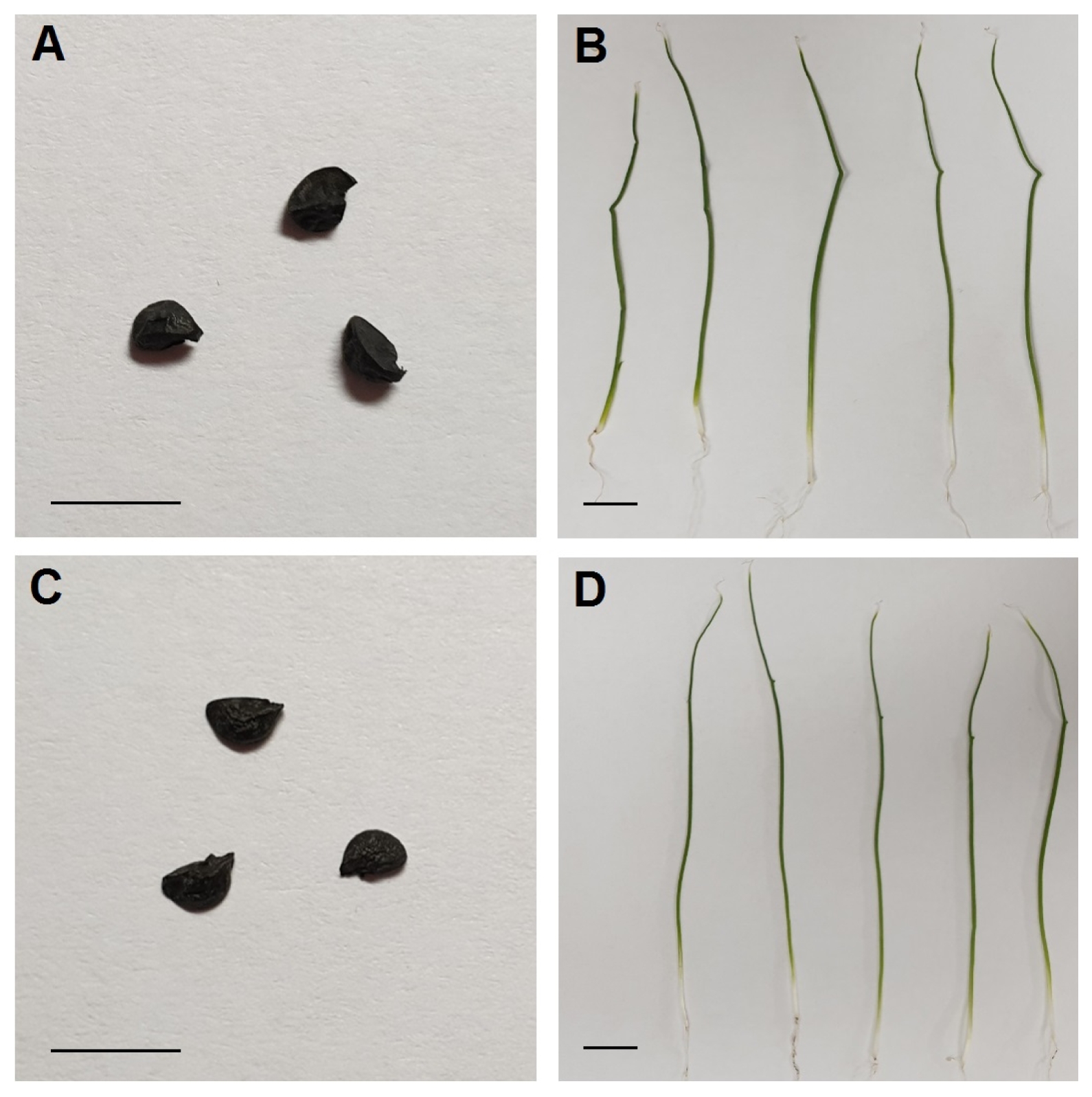
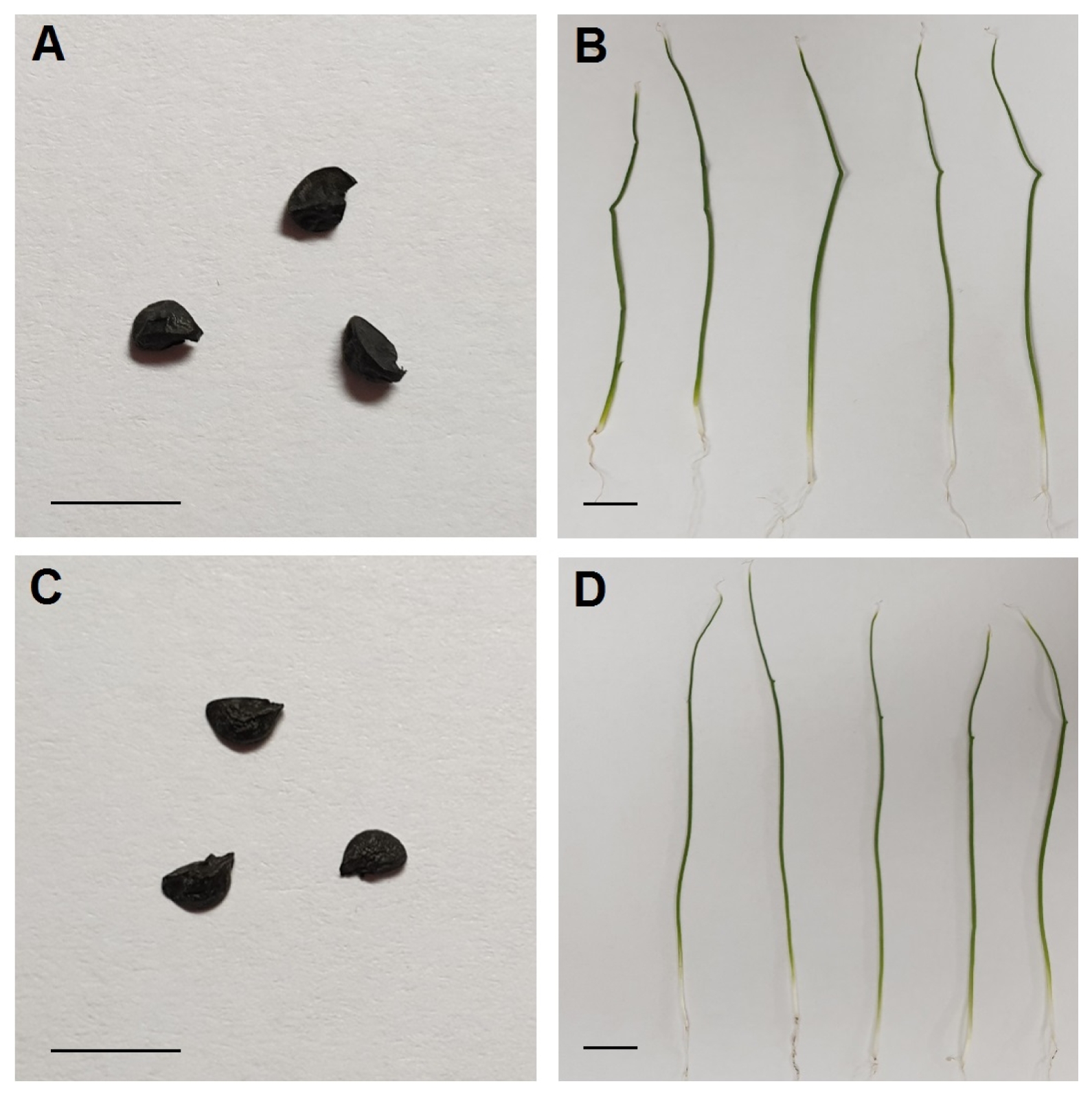
During the process of seed production of cultivars, seeds of onion and Welsh onion are sometimes mixed with each other. However, contaminated seeds cannot be distinguished by morphological difference. Seed morphologies of onion and Welsh onions were almost indistinguishable by visual examination (Fig. 1A, 1C). Furthermore, it was difficult to distinguish onions and Welsh onions based on morphologies of cotyledons (Fig. 1B, 1D). Therefore, molecular markers for distinguishing onion and Welsh onion at early seedling stages would be useful to test whether onion or Welsh onion seeds are contaminated with each other and to estimate proportions of contamination in seeds which are sampled for quality control.
For universal application of molecular markers to all onion and Welsh onion cultivars, differential regions in mitochondrial genomes were selected as target sequences for development of molecular markers. Complete onion mitochondrial genome sequences of normal (339,180 bp), CMS-T (359,188 bp), and CMS-S (316,363 bp) cytoplasms (Kim et al. 2016, 2019) were compared to screen the genes whose 5′ and 3′ flanking sequences were conserved among three onion mitochondrial genomes. Among them, the atp9 gene was selected as a target gene for marker development, since flanking regions of atp9 was prone to be involved in frequent mtDNA rearrangements. For an example, partial sequences of atp9 was involved in creation of a chimeric gene, orf725 in onions (Kim et al. 2009).
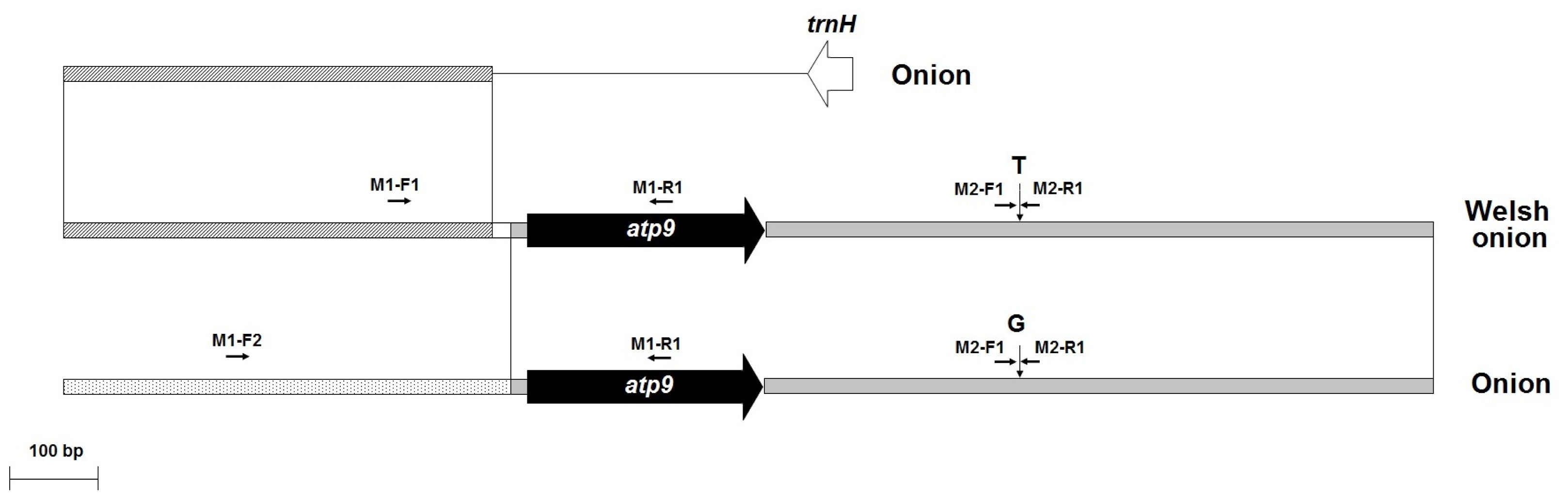
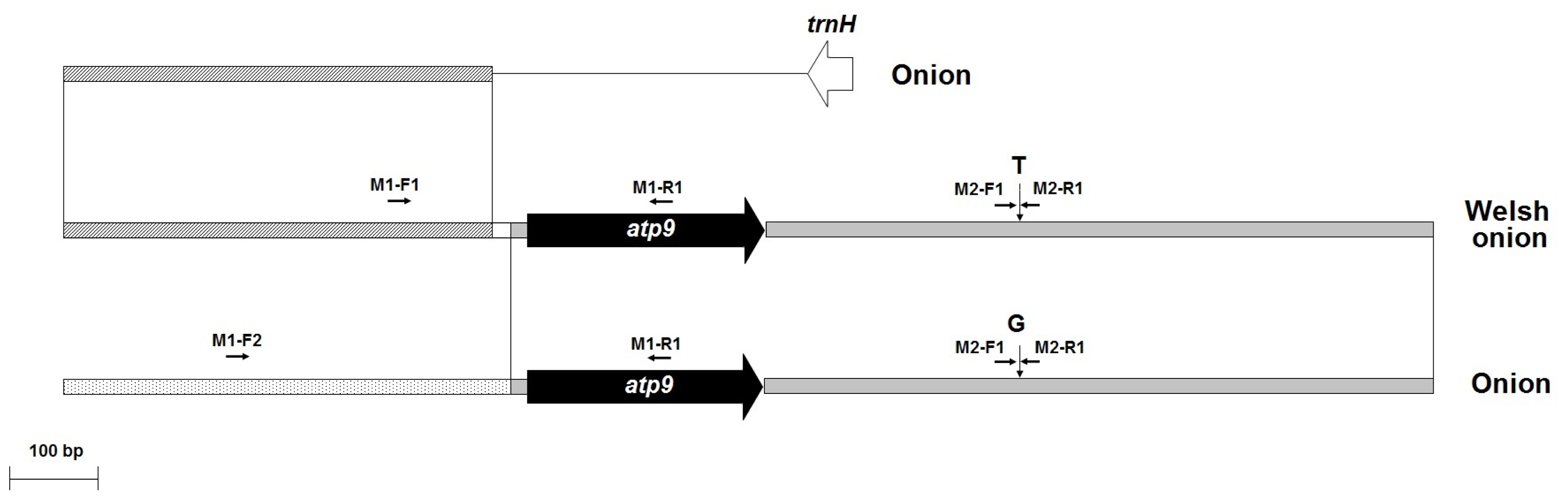
Genome walking was performed to isolate flanking sequences of atp9 in mitochondrial genomes of Welsh onions. From a male-fertile Welsh onion, 527-bp 5′ and 755-bp 3′ flanking sequences were obtained (Fig. 2). Although 3′ flanking sequences of onions and Welsh onions showed more than 98% nucleotide sequence identity, the 5′ flanking sequences were completely different between onions and Welsh onions (Fig. 2). The partial (485 bp) sequences covering the 5′ flanking region of Welsh onion atp9 were identified from onion mitochondrial genome of the CMS-S cytoplasm. Although this 485-bp region showed 100% nucleotide sequence identity with corresponding onion sequences, this region was separated from atp9 with a distance of 152,572 bp in onion mitochondrial genome of the CMS-S cytoplasm (GenBank accession: KU318712).
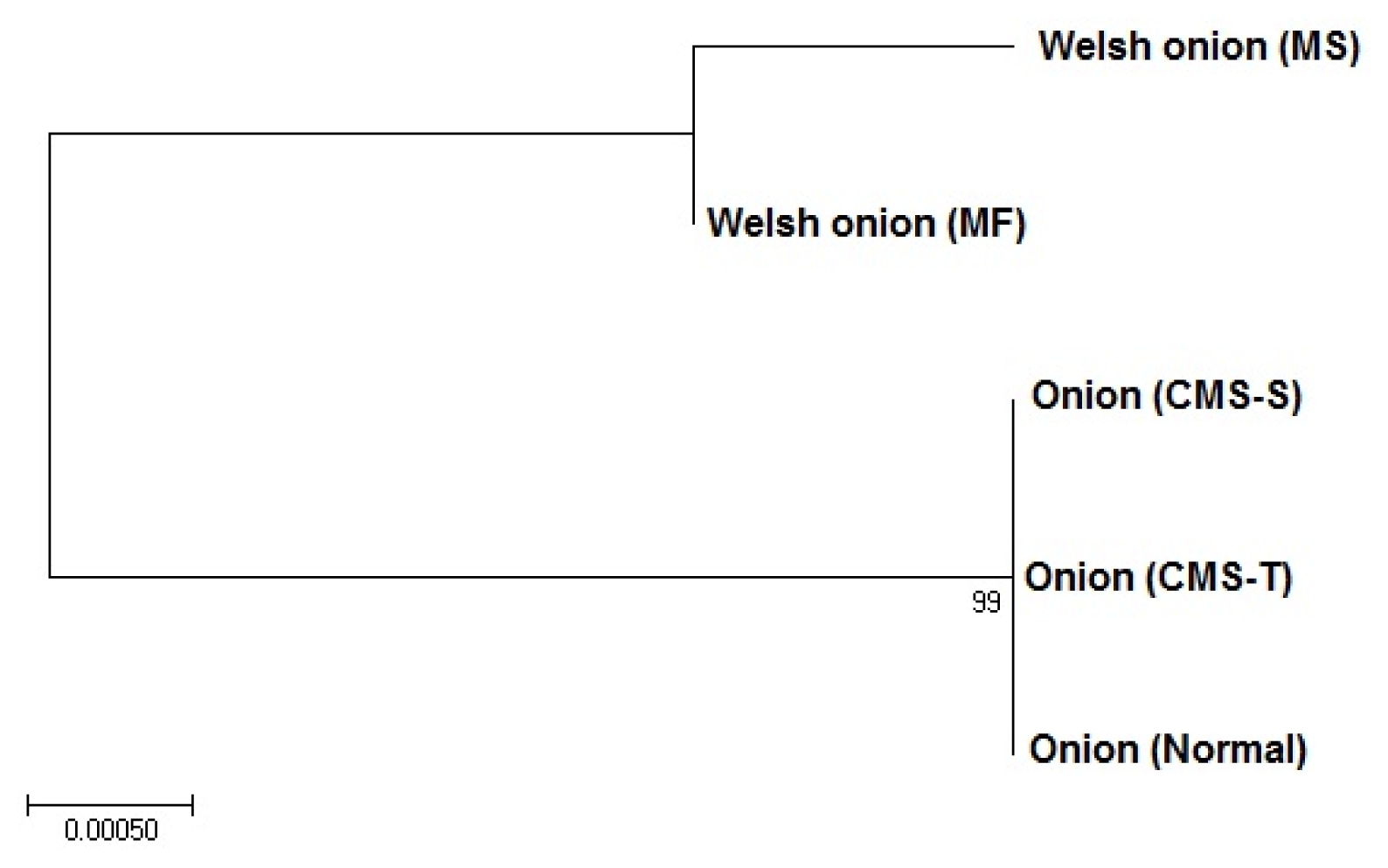
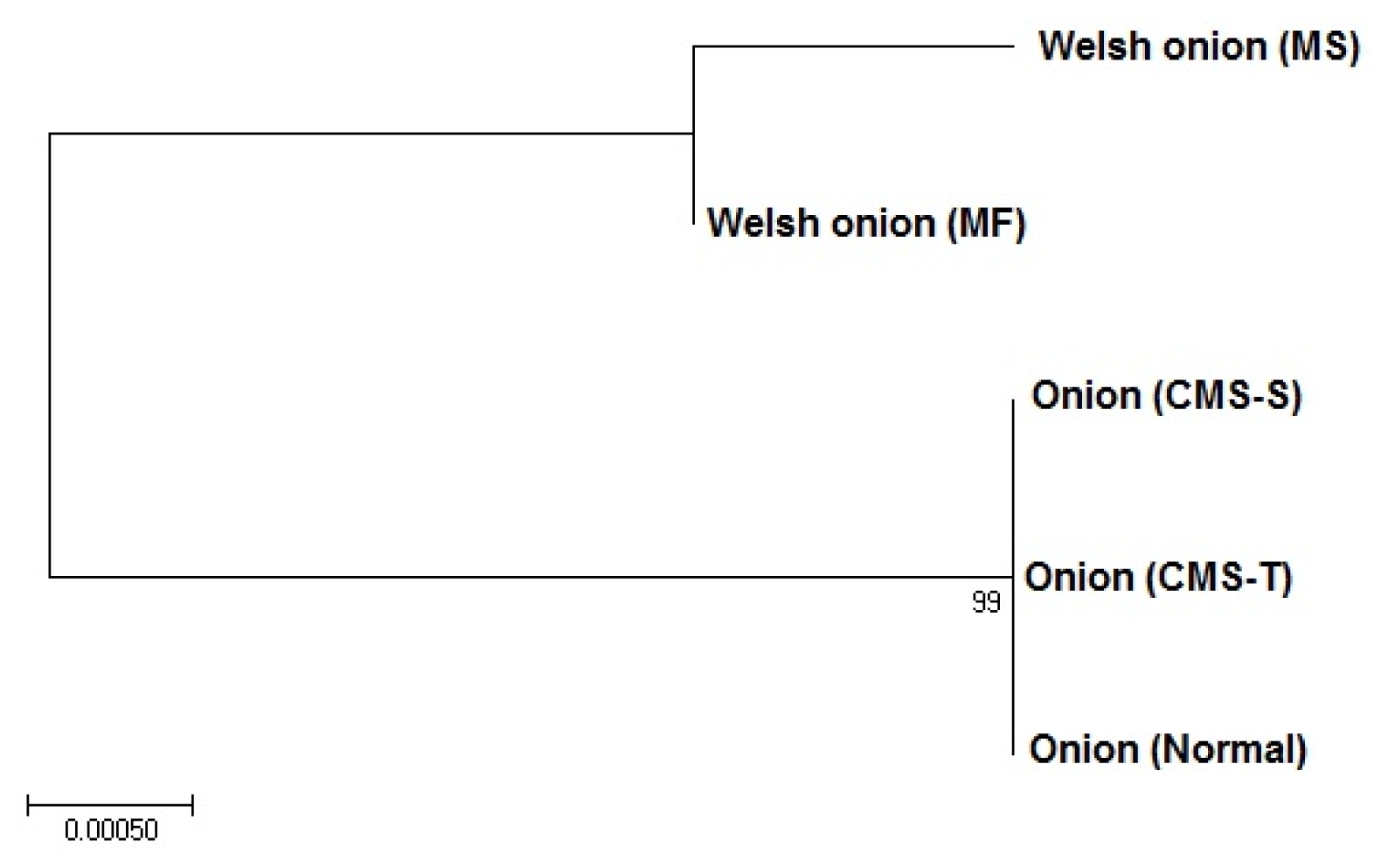
Based on the flanking sequences of atp9 in a male-fertile Welsh onion, homologous sequences were isolated from a male-sterile Welsh onion. The organization was identical to that of the male-fertile Welsh onion, but there were two SNPs and one 2-bp InDel between male-fertile and male-sterile Welsh onions. In the case of onions, sequences flanking atp9 were identical between normal and CMS-T cytoplasms, but there were two SNPs in the 5′ flanking region between normal and CMS-S cytoplasms. When onion and Welsh onion sequences were compared, there were six SNPs and two InDels, implying that interspecific genetic distances between onion and Welsh onions were longer than intraspecific distances (Fig. 3).
Development of molecular markers for distinguishing onion and Welsh onion
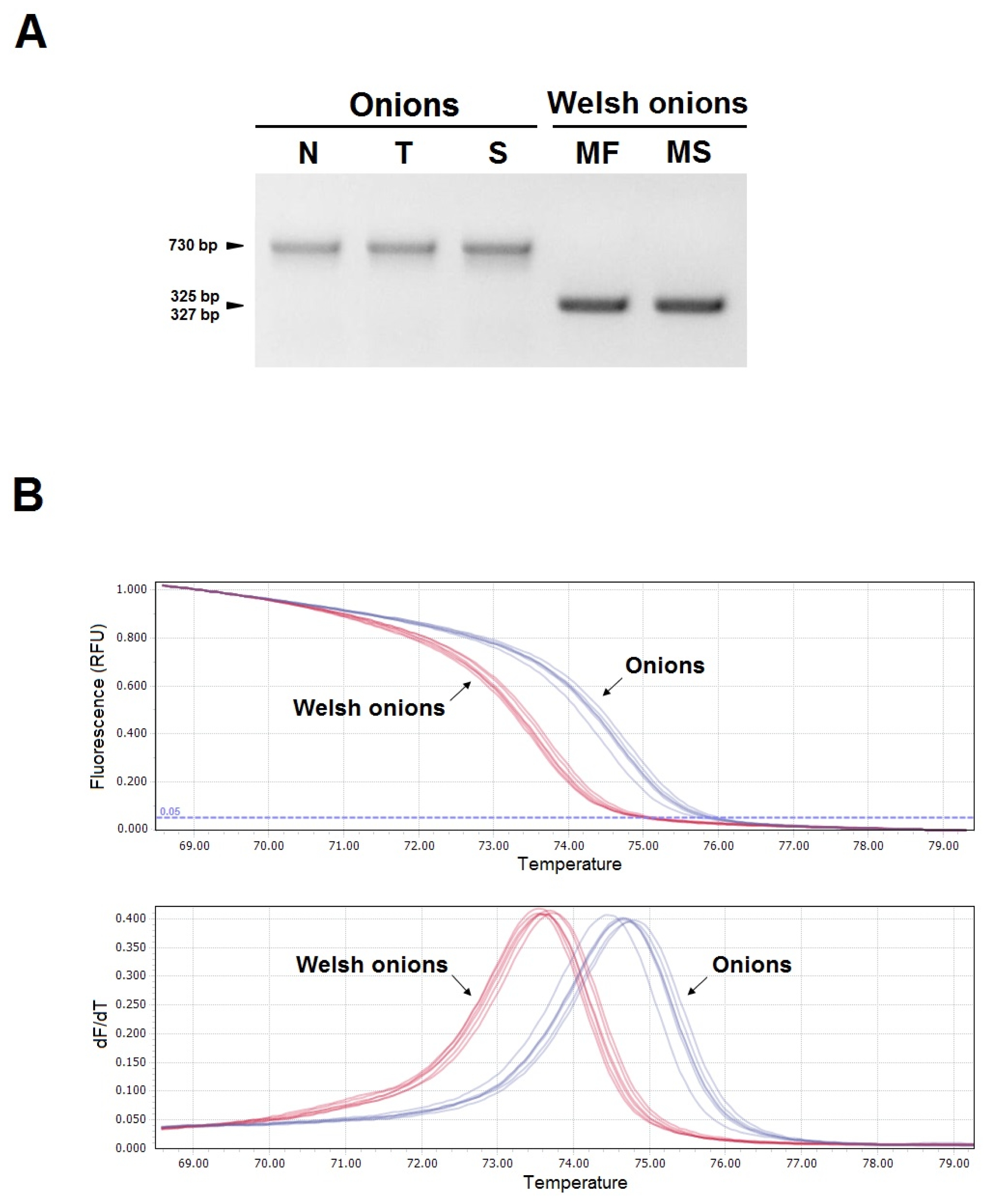
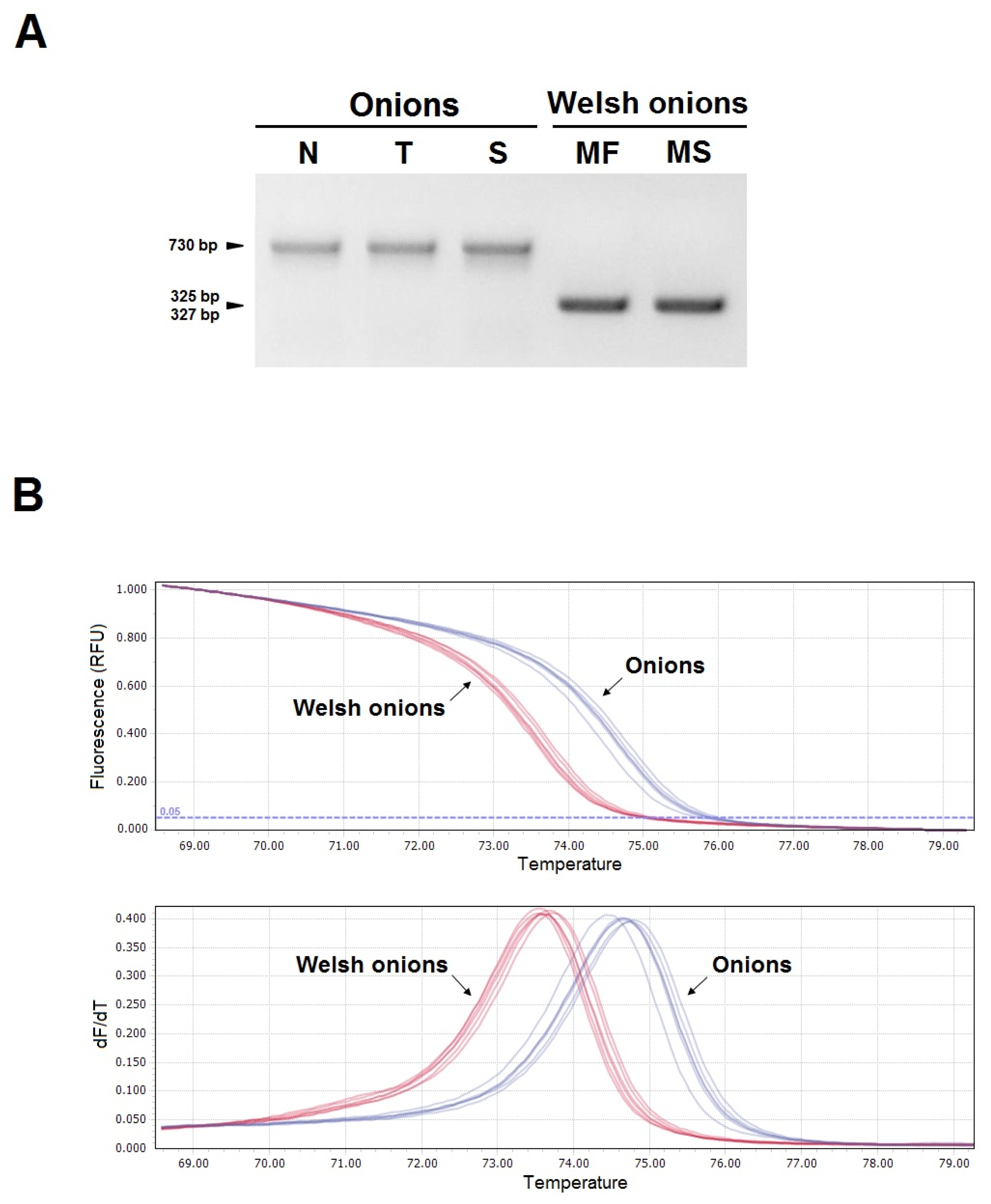
To develop a simple PCR marker, a common reverse primer (M1-R1) was designed on the atp9 coding sequences, and one Welsh onion-specific forward primer (M1-F1) and another onion-specific forward primer (M1-F2) were designed on the unique regions, respectively (Fig. 2). Single PCR products with expected sizes were amplified in both onions and Welsh onions when PCR amplifications were performed using a combination of three primers (Fig. 4A). In addition, an optimal HRM marker was designed using one of the SNPs between onion and Welsh onion in the 3′ flanking region of atp9 (Fig. 2). Normalized melting curves and peaks of onion and Welsh onions were clearly separated (Fig. 4B). To validate applicability of simple PCR and HRM markers, 41 onion and 19 Welsh onion cultivars were tested using these two molecular markers. As expected, onion-specific PCR products and HRM peaks were observed in all tested onion cultivars (Supplementary Table S1). Likewise, marker types specific to Welsh onion were detected only in Welsh onion cultivars (Supplementary Table S2).
Distribution of onion and Welsh onion-specific sequences flanking the atp9 gene in closely related Allium species
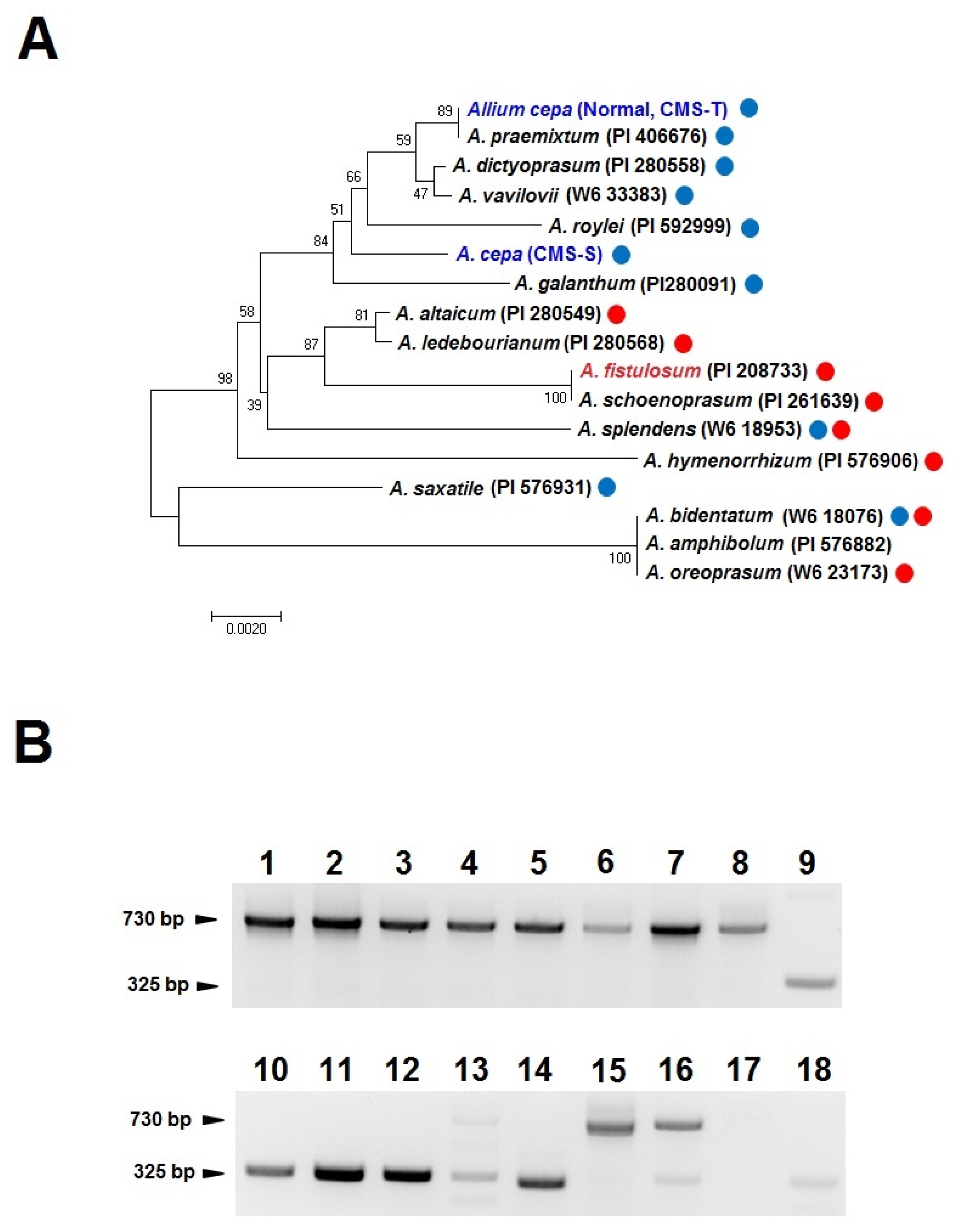
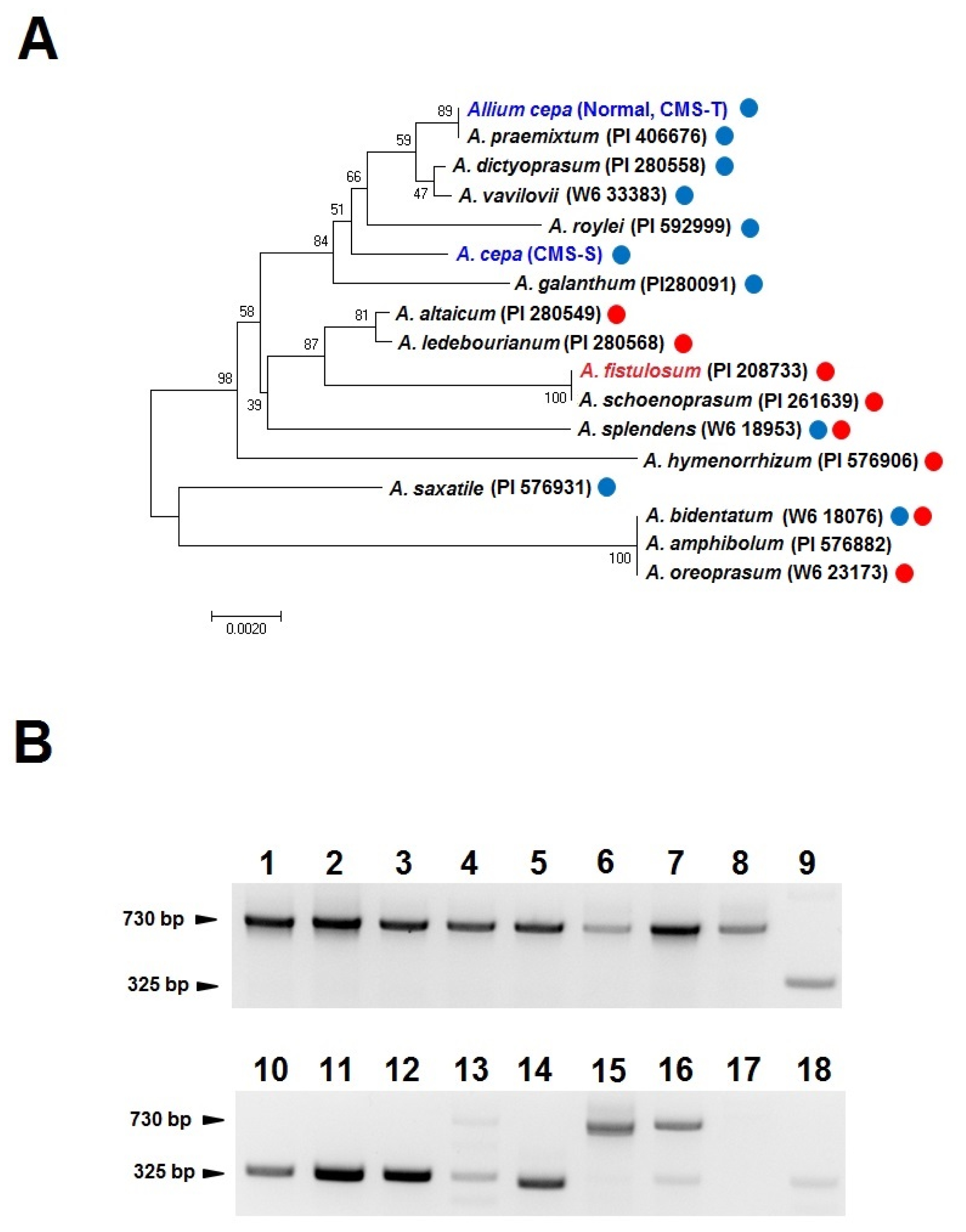
To ascertain the time when rearrangements in the 5′ flanking regions of atp9 have been arisen in onion or Welsh onion mitochondrial genomes, 14 Allium species related with onion and Welsh onion were analyzed with the simple PCR marker. The onion-specific PCR products were amplified in five (A. praemixtum, A. vavilovii, A. dictyoprasum, A. roylei, and A. galanthum) closely related Allium species, while Welsh onion-specific PCR products were amplified in three (A. altaicum, A. ledebourianum, and A. schoenoprasum) closely related Allium species (Fig. 5). In the case of relatively distantly related species, PCR products were generally not as intense as closely related species due to possible mismatches on primer-binding sites (Fig. 5B), and even no PCR product could be amplified in A. amphibolum. Despite low efficiency of PCR amplification, the onion-specific PCR product was observed in A. saxatile, but the Welsh onion-specific PCR products were amplified in A. hymenorrhizum and A. oreoprasum. Interestingly, both onion-specific and Welsh onion-specific PCR products were identified in A. bidentatum and A. splendens (Fig. 5B). These results implied that both onion-specific and Welsh onion-specific organizations of atp9 might have existed in common ancestors of these related Allium species.
Development of reliable molecular markers for distinguishing onion and Welsh onion based on polymorphic mitochondrial genome sequences
Polymorphisms in mitochondrial genome sequences were used to develop molecular markers for distinguishing onion and Welsh onion in this study. Since nuclear genome sequences are assumed to be highly variable depending on accessions and cultivars, it might be difficult to develop molecular markers which can be applied to all varieties. Therefore, mitochondrial or chloroplast genomes are likely to be suitable for development of universal markers. Complete chloroplast and mitochondrial genome sequences of normal, CMS-T, and CMS-S cytoplasms of onions were reported in our previous studies (Kim et al. 2015, 2016, 2019).
Compared with highly variable mitochondrial genomes, the content and organization of genes were conserved among three onion chloroplast genomes (Kim et al. 2015). In contrast, organizations of normal and CMS-S mitochondrial genomes were highly rearranged with 31 syntenic blocks (Kim et al. 2019). Therefore, mitochondrial genomes were selected to develop a simple PCR marker of which genotypes could be analyzed using agarose gels without expensive equipment. In addition, the SNP positioned on the 3′ region of atp9 was used to develop an HRM marker optimal for high-throughput analysis.
To estimate the time when rearrangements in the 5′ region of atp9 have occurred, 14 Allium species relatively closely related to onion and Welsh onion were analyzed using the simple PCR marker developed in this study (Fig. 5). Onion-specific and Welsh onion-specific PCR products were amplified in five and four Allium species which were closely related to onion and Welsh onion, respectively. However, both onion-specific and Welsh onion-specific PCR products were detected among four relatively distantly related Allium species.
It is hypothesized that both onion-specific and Welsh onion-specific organizations of atp9 might have existed in common ancestors of these 14 Allium species. ‘Heteroplasmy’, defined as presence of more than one type of mitochondrial genomes in an organism is considered to be a common state of plant mitochondrial genomes (Kmiec et al. 2006; Gualberto and Newton 2017). However, during divergence of Allium species, the onion-specific organization is assumed to be predominant in onions and five related species. A similar phenomenon might occur in Welsh onion and three related species. Since the onionspecific organization was observed in normal and CMS-S cytoplasms of onions and even in five related Allium species, the Welsh onion-specific PCR products may not be amplified in any onion varieties, indicating high reliability of molecular markers developed in this study. In fact, no Welsh onion-specific PCR products were amplified in all tested onion cultivars in this study.
Application of molecular markers for distinguishing onion and Welsh onion in seed production of onion and Welsh onion cultivars
Since seed and seedling morphologies of onion and Welsh onion are almost indistinguishable by visual examination (Fig. 1), cross-contaminated seeds cannot be identified during seed production of onion and Welsh onion cultivars. Cross-contamination of seeds might happen at two stages of seed production. First, seeds can be contaminated during harvest in seed production fields if onion and Welsh onion fields are closely located. Second, seeds can be inadvertently introduced during cleaning and conditioning of harvested seeds at seed conditioning facilities. Unless seeds are completely removed from a series of equipment at seed conditioning factories, cross-contamination is inevitable. Therefore, molecular markers developed in this study can be efficiently used to detect cross-contaminated seeds during quality control process.
Although all tested onion and Welsh onion cultivars contained their own cytoplasms in this study, some onion or Welsh onion accessions have been produced by inter-specific crosses between different Allium species. For examples, onion accessions resistant to downy mildew have been produced by interspecific crosses between onion and A. roylei (Kofoet et al. 1990; van der Meer and de Vries 1990). In addition, CMS Welsh onions have been produced by interspecific crosses between A. galanthum and Welsh onions (Yamashita et al. 1999). Since hybrid plants are known to be produced between onions and other Allium species such as A. galanthum, A. fistulosum, A. vavilovii, and A. roylei (van Raamsdonk et al. 2003), supplementary molecular markers for detecting such interspecific hybrids are required to be developed in the future.
This research was supported by Korea Institute of Planning and Evaluation for Technology in Food, Agriculture and Forestry (IPET) through Agriculture, Food and Rural Affairs Research Center Support Program (Vegetable Breeding Research Center) funded by the Ministry of Agriculture, Food and Rural Affairs (710011-03), Golden Seed Project (Center for Horticultural Seed Development, No 213007-05-3-SBB10), and a grant from the Next-Generation BioGreen 21 Program (Plant Molecular Breeding Center No. PJ013400). The authors thank Ji-wha Hur, Jeong-Ahn Yoo, and Su-jung Kim for their dedicated technical assistance.
Fig. 1
Seed and cotyledon morphologies of onion and Welsh onion. (A) Onion seeds. (B) 14-day-old onion cotyledons. (C) Welsh onion seeds. (D) 14-dayold Welsh onion cotyledons.
pbb-7-151f1.jpg
Fig. 2
Organizations of mitochondrial genome sequences flanking the atp9 genes in onion and Welsh onion. Arrow-shaped boxes indicate genes and 5′-to-3′ direction. Homologous regions connected with vertical lines are shown with same patterns or colors. The nucleotides on vertical arrows indicate genotypes of the SNP used in developing an HRM marker. Horizontal arrows indicate primer-binding sites.
pbb-7-151f2.jpg
Fig. 3
Phylogenetic tree constructed using nucleotide sequences of atp9 and its 3′ flanking sequences of onions and Welsh onions. MS: male-sterile, MF: male-fertile.
pbb-7-151f3.jpg
Fig. 4
Molecular markers for distinguishing onion and Welsh onion. (A) PCR products of the simple PCR marker. N: normal, T: CMS-T, S: CMS-S, MF: male-fertile, MS: male-sterile. (B) Normalized HRM curve and peak patterns of the HRM marker. Six samples from each onion and Welsh onion were used for validation of the HRM marker.
pbb-7-151f4.jpg
Fig. 5
Distribution of onion-specific and Welsh onion-specific atp9 organizations among closely related Allium species. (A) Phylogenetic tree of 16 Allium species constructed using chloroplast genome sequences between rps16 and trnQ. Blue and red circles indicate onion-specific and Welsh onion-specific atp9 organizations, respectively. (B) PCR products of 16 Allium species amplified using the simple PCR marker. 1: onion (Normal), 2: onion (CMS-T), 3: A. praemixtum, 4: A. dictyoprasum, 5: A. vavilovii, 6: A. roylei, 7: onion (CMS-S), 8: A. galanthum, 9: A. altaicum, 10: A. ledebourianum, 11: A. fistulosum, 12: A. schoenoprasum, 13: A. splendens, 14: A. hymenorrhizum, 15: A. saxatile, 16: A. bidentatum, 17: A. amphibolum, 18: A. oreoprasum.
pbb-7-151f5.jpg
Table 1
Primer sequences of molecular markers developed in this study.
Table 1
Primer name Primer sequence (5′ to 3′) Molecular marker Size of PCR products
M1-F1 GGTCCCTAGGCGCGTAAATACCCCAGT Simple PCR marker 730 bp (Onions)
M1-F2 TAAAGCTGGCAAGAGGAGACCGATCCA 325 bp (Male-sterile Welsh onion)
M1-R1 GAGCAAAGCCCAAAATGGCATAACCA 327 bp (Male-fertile Welsh onion)
M2-F1 TTCCTTAGAGCTATGAATTGTGTGA HRM marker 52 bp
M2-R1 TTAACCACTTAACCGAGAACAGT
  • Albert B, Godelle B, Gouyon PH. 1998. Evolution of the plant mitochondrial genome: dynamics of duplication and deletion of sequences. J Mol Evol. 46: 155-158.
  • Allen JO, Fauron CM, Mink P, Roark L, Oddiraju S, Lin GN, et al. 2007. Comparisons among two fertile and three male-sterile mitochondrial genomes of maize. Genetics. 177: 1173-1192.
  • Arrieta-Montiel M, Lyznik A, Woloszynska M, Janska H, Tohme J, Mackenzie SA. 2001. Tracing evolutionary and developmental implications of mitochondrial stoichiometric shifting in the common bean. Genetics. 158: 851-864.
  • Backert S, Neilsen BL, Börner T. 1997. The mystery of the rings: structure and replication of mitochondrial genomes from higher plants. Trends Plant Sci. 2: 477-483.
  • Bellaoui M, Martin-Canadell A, Pelletier G, Budar F. 1998. Low-copy-number molecules are produced by recombination, actively maintained and can be amplified in the mitochondrial genome of Brassicaceae: relationship to reversion of the male sterile phenotype in some cybrids. Mol Gen Genet. 257: 177-185.
  • Berninger E. 1965. Contribution à l’étude de la sterilité mêle de l’oignon (Allium cepa L.). Ann Amélior Plantes. 15: 183-199.
  • Brewster JL. 2008. Onions and other vegetable Alliums. CAB international. Wallingford, UK:
  • Budar F, Touzet P, De Paepe R. 2003. The nucleo-mitochondrial conflict in cytoplasmic male sterilities revised. Genetica. 117: 3-16.
  • Castresana J. 2000. Selection of conserved blocks from multiple alignments for their use in phylogenetic analysis. Mol Biol Evol. 17: 540-552.
  • Cebeci E, Hanci F. 2016. Male sterility applications in Allium. Acta Hortic. 1145: 51-55.
  • Colombo N, Galmarini CR. 2017. The use of genetic, manual and chemical methods to control pollination in vegetable hybrid seed production: a review. Plant Breeding. 136: 287-299.
  • Doyle JJ, Doyle JL. 1987. A rapid DNA isolation procedure for small quantities of fresh leaf tissue. Phytochem Bull. 19: 11-15.
  • Friesen N, Klaas M. 1998. Origin of some minor vegetatively propagated Allium crops studied with RAPD and GISH. Genet Resour Crop Ev. 45: 511-523.
  • Griffiths G, Trueman L, Crowther T, Thomas B, Smith B. 2002. Onions-A global benefit to health. Phytother Res. 16: 603-615.
  • Gualberto JM, Newton KJ. 2017. Plant mitochondrial genomes: dynamics and mechanisms of mutation. Annu Rev Plant Biol. 68: 225-252.
  • Hall TA. 1999. BioEdit: a user-friendly biological sequence alignment editor and analysis program for Window 95/98/NT. Nucl Acids Symp Ser. 41: 95-98.
  • Hanson MR, Bentolila S. 2004. Interactions of mitochondrial and nuclear genes that affect male gametophyte development. Plant Cell. 16: S154-S169.
  • Janska H, Sarria R, Woloszynska M, Arrieta-Montiel M, Mackenzie SA. 1998. Stoichiometric shifts in the common bean mitochondrial genome leading to male sterility and spontaneous reversion to fertility. Plant Cell. 10: 1163-1180.
  • Jones HA, Clarke A. 1943. Inheritance of male sterility in the onion and the production of hybrid seed. Proc Amer Soc Hort Sci. 43: 189-194.
  • Jones HA, Emsweller SL. 1936. A male-sterile onion. Proc Am Soc Hort Sci. 34: 582-585.
  • Kim B, Kim K, Yang T, Kim S. 2016. Completion of the mitochondrial genome sequence of onion (Allium cepa L.) containing the CMS-S male-sterile cytoplasm and identification of an independent event of the ccmFN gene split. Curr Genet. 62: 873-885.
  • Kim B, Yang T, Kim S. 2019. Identification of a gene responsible for cytoplasmic male-sterility in onions (Allium cepa L.) using comparative analysis of mitochondrial genome sequences of two recently diverged cytoplasms. Theor Appl Genet. 132: 313-322.
  • Kim S, Lee E, Cho DY, Han T, Bang H, Patil BS, et al. 2009. Identification of a novel chimeric gene, orf725, and its use in development of a molecular marker for distinguishing three cytoplasm types in onion (Allium cepa L.). Theor Appl Genet. 118: 433-441.
  • Kim S, Lim H, Park S, Cho K, Sung S, Oh D, et al. 2007. Identification of a novel mitochondrial genome type and development of molecular makers for cytoplasm classification in radish (Raphanus sativus L.). Theor Appl Genet. 115: 1137-1145.
  • Kim S, Park J, Yang T. 2015. Comparative analysis of the complete chloroplast genome sequences of a normal male-fertile cytoplasm and two different cytoplasms conferring cytoplasmic male sterility in onion (Allium cepa L.). J Hortic Sci Biotechnol. 90: 459-468.
  • Kim S. 2013. Identification of hypervariable chloroplast intergenic sequences in onion (Allium cepa L.) and their use to analyse the origins of male-sterile onion cytotypes. J Hortic Sci Biotechnol. 88: 187-194.
  • Kim Y, Zhang D. 2018. Molecular control of male fertility for crop hybrid breeding. Trends Plant Sci. 23: 53-65.
  • Kmiec B, Woloszynska M, Janska H. 2006. Heteroplasmy as a common state of mitochondrial genetic information in plants and animals. Curr Genet. 50: 149-159.
  • Kofoet A, Kik C, Wietsma WA, de Vries JN. 1990. Inheritance of resistance to downy mildew (Peronospora destructor [Berk.] Casp.) from Allium roylei Stearn in the backcross Allium cepa L. X (A. roylei X A. cepa). Plant Breeding. 105: 144-149.
  • Kumar S, Stecher G, Tamura K. 2016. MEGA7: Molecular evolutionary genetics analysis version 7.0 for bigger datasets. Mol Biol Evol. 33: 1870-1874.
  • Laser KD, Lersten NR. 1972. Anatomy and cytology of microsporogenesis in cytoplasmic male sterile angiosperms. Bot Rev. 38: 425-454.
  • Moue T, Uehara T. 1985. Inheritance of cytoplasmic male sterility in Allium fistulosum L (Welsh onion). J Jpn Soc Hortic Sci. 53: 432-437.
  • Oldenburg DJ, Bendich AJ. 2001. Mitochondrial DNA from the Liverwort Marchantia polymorpha: Circularly permuted linear molecules, head-to-tail concatemers, and a 5’ protein. J Mol Biol. 310: 549-562.
  • Sakai T, Imamura J. 1993. Evidence for a mitochondrial sub-genome containing radish AtpA in a Brassica napus cybrid. Plant Sci. 90: 95-103.
  • Schnable PS, Wise RP. 1998. The molecular basis of cytoplasmic male sterility and fertility restoration. Trends Plant Sci. 3: 175-180.
  • Schweisguth B. 1973. Étude d’un nouveau type de stérilité male chez l’oignon, Allium cepa L. Ann Amélior Plantes. 23: 221-233.
  • Skippington E, Barkman TJ, Rice DW, Palmer JD. 2015. Miniaturized mitogenome of the parasitic plant Viscum scurruloideum is extremely divergent and dynamic and has lost all nad genes. Proc Natl Acad Sci U S A. 112: E3515-E3524.
  • Sloan DB. 2013. One ring to rule them all? Genome sequencing provides new insights into the ‘master circle’ model of plant mitochondrial DNA structure. New Phytol. 200: 978-985.
  • Small I, Suffolk R, Leaver CJ. 1989. Evolution of plant mitochondrial genomes via substoichiometric intermediates. Cell. 58: 69-76.
  • van der Meer QP, de Vries JN. 1990. An interspecific cross between Allium roylei Stearn and Allium cepa L., and its backcross to A. cepa. Euphytica. 47: 29-31.
  • van Raamsdonk LWD, Ensink W, van Heusden AW, Vrielinkvan Ginkel M, Kik C. 2003. Biodiversity assessment based on cpDNA and crossability analysis in selected species of Allium subgenus Rhizirideum. Theor Appl Genet. 107: 1048-1058.
  • Woloszynska M, Trojanowski D. 2009. Counting mtDNA molecules in Phaseolus vulgaaris: sublimons are constantly produced by recombination via short repeats and undergo rigorous selection during substoichiometric shifting. Plant Mol Biol. 70: 511-521.
  • Yamashita K, Arita H, Tashiro Y. 1999. Cytoplasm of a wild species, Allium galanthum Kar. et Kir., is useful for developing the male sterile line of A. fistulosum L. J Jpn Soc Hort Sci. 68: 788-797.
  • Yamashita K, Tsukazaki H, Kojima A, Ohara T, Wako T. 2010. Inheritance mode of male sterility in bunching onion (Allium fistulosum L.) accessions. Euphytica. 173: 357-367.


Download Citation

Download a citation file in RIS format that can be imported by all major citation management software, including EndNote, ProCite, RefWorks, and Reference Manager.

Format:

Include:

Development of Molecular Markers for Distinguishing Onion (Allium cepa L.) and Welsh Onion (A. fistulosum L.) Based on Polymorphic Mitochondrial Genome Sequences
Plant Breed. Biotech.. 2019;7(2):151-160.   Published online June 1, 2019
Download Citation

Download a citation file in RIS format that can be imported by all major citation management software, including EndNote, ProCite, RefWorks, and Reference Manager.

Format:
Include:
Development of Molecular Markers for Distinguishing Onion (Allium cepa L.) and Welsh Onion (A. fistulosum L.) Based on Polymorphic Mitochondrial Genome Sequences
Plant Breed. Biotech.. 2019;7(2):151-160.   Published online June 1, 2019
Close

Figure

  • 0
  • 1
  • 2
  • 3
  • 4
Development of Molecular Markers for Distinguishing Onion (Allium cepa L.) and Welsh Onion (A. fistulosum L.) Based on Polymorphic Mitochondrial Genome Sequences
Image Image Image Image Image
Fig. 1 Seed and cotyledon morphologies of onion and Welsh onion. (A) Onion seeds. (B) 14-day-old onion cotyledons. (C) Welsh onion seeds. (D) 14-dayold Welsh onion cotyledons.
Fig. 2 Organizations of mitochondrial genome sequences flanking the atp9 genes in onion and Welsh onion. Arrow-shaped boxes indicate genes and 5′-to-3′ direction. Homologous regions connected with vertical lines are shown with same patterns or colors. The nucleotides on vertical arrows indicate genotypes of the SNP used in developing an HRM marker. Horizontal arrows indicate primer-binding sites.
Fig. 3 Phylogenetic tree constructed using nucleotide sequences of atp9 and its 3′ flanking sequences of onions and Welsh onions. MS: male-sterile, MF: male-fertile.
Fig. 4 Molecular markers for distinguishing onion and Welsh onion. (A) PCR products of the simple PCR marker. N: normal, T: CMS-T, S: CMS-S, MF: male-fertile, MS: male-sterile. (B) Normalized HRM curve and peak patterns of the HRM marker. Six samples from each onion and Welsh onion were used for validation of the HRM marker.
Fig. 5 Distribution of onion-specific and Welsh onion-specific atp9 organizations among closely related Allium species. (A) Phylogenetic tree of 16 Allium species constructed using chloroplast genome sequences between rps16 and trnQ. Blue and red circles indicate onion-specific and Welsh onion-specific atp9 organizations, respectively. (B) PCR products of 16 Allium species amplified using the simple PCR marker. 1: onion (Normal), 2: onion (CMS-T), 3: A. praemixtum, 4: A. dictyoprasum, 5: A. vavilovii, 6: A. roylei, 7: onion (CMS-S), 8: A. galanthum, 9: A. altaicum, 10: A. ledebourianum, 11: A. fistulosum, 12: A. schoenoprasum, 13: A. splendens, 14: A. hymenorrhizum, 15: A. saxatile, 16: A. bidentatum, 17: A. amphibolum, 18: A. oreoprasum.
Development of Molecular Markers for Distinguishing Onion (Allium cepa L.) and Welsh Onion (A. fistulosum L.) Based on Polymorphic Mitochondrial Genome Sequences

Primer sequences of molecular markers developed in this study.

Primer name Primer sequence (5′ to 3′) Molecular marker Size of PCR products
M1-F1 GGTCCCTAGGCGCGTAAATACCCCAGT Simple PCR marker 730 bp (Onions)
M1-F2 TAAAGCTGGCAAGAGGAGACCGATCCA 325 bp (Male-sterile Welsh onion)
M1-R1 GAGCAAAGCCCAAAATGGCATAACCA 327 bp (Male-fertile Welsh onion)
M2-F1 TTCCTTAGAGCTATGAATTGTGTGA HRM marker 52 bp
M2-R1 TTAACCACTTAACCGAGAACAGT
Table 1 Primer sequences of molecular markers developed in this study.